Sign In

Delhi News Daily

  • Home
  • Fashion
  • Business
  • World News
  • Technology
  • Sports
  • Politics
  • Lifestyle
  • Entertainment
Reading: 1,600-year-old Roman wine factory discovered beneath ancient castle | World News – The Times of India – Delhi News Daily
Share

Delhi News Daily

Font ResizerAa
Search
Have an existing account? Sign In
Follow US
© 2022 Foxiz News Network. Ruby Design Company. All Rights Reserved.
Delhi News Daily > Blog > World News > 1,600-year-old Roman wine factory discovered beneath ancient castle | World News – The Times of India – Delhi News Daily
World News

1,600-year-old Roman wine factory discovered beneath ancient castle | World News – The Times of India – Delhi News Daily

delhinewsdaily
Last updated: October 29, 2025 9:31 pm
delhinewsdaily
Share
SHARE


Contents
Unearthing the ancient vineyardA castle’s hidden companionFrom grape to glass: how the Romans made wineA glimpse into late Roman life
1,600-year-old Roman wine factory discovered beneath ancient castle

Archaeologists in Turkey have unearthed a remarkably preserved 1,600-year-old Roman wine production site beneath the ruins of an ancient mountain castle. The discovery, made near the village of Oymakli in southeastern Turkey’s Kahta district, sheds light on the scale and sophistication of winemaking in the late Roman period. The site includes grape-crushing installations, cisterns, and grinding stones, all remarkably intact after more than a millennium. Experts believe the complex once operated as a large-scale industrial winery, serving both local residents and the nearby Kahta Castle, an important stronghold during the Kingdom of Commagene.

Unearthing the ancient vineyard

The excavation, led by the Turkish Ministry of Culture and Tourism, began after archaeologists discovered fragments of stone and pottery believed to be of historical value. The site spans nearly 37 acres and lies in a mountainous region overlooking the Euphrates River valley.Researchers found several installations used to crush grapes and channel juice into cisterns for fermentation and storage. Grinding stones and remnants of clay vessels suggest the factory also produced flour and possibly olive oil, hinting at a wider agricultural economy.According to Mehmet Alkan, provincial museum director, the site’s foundations survived “remarkably well” despite being built from irregular stones. “Its preservation offers an exceptional look into ancient craftsmanship and industrial-scale production,” he said.
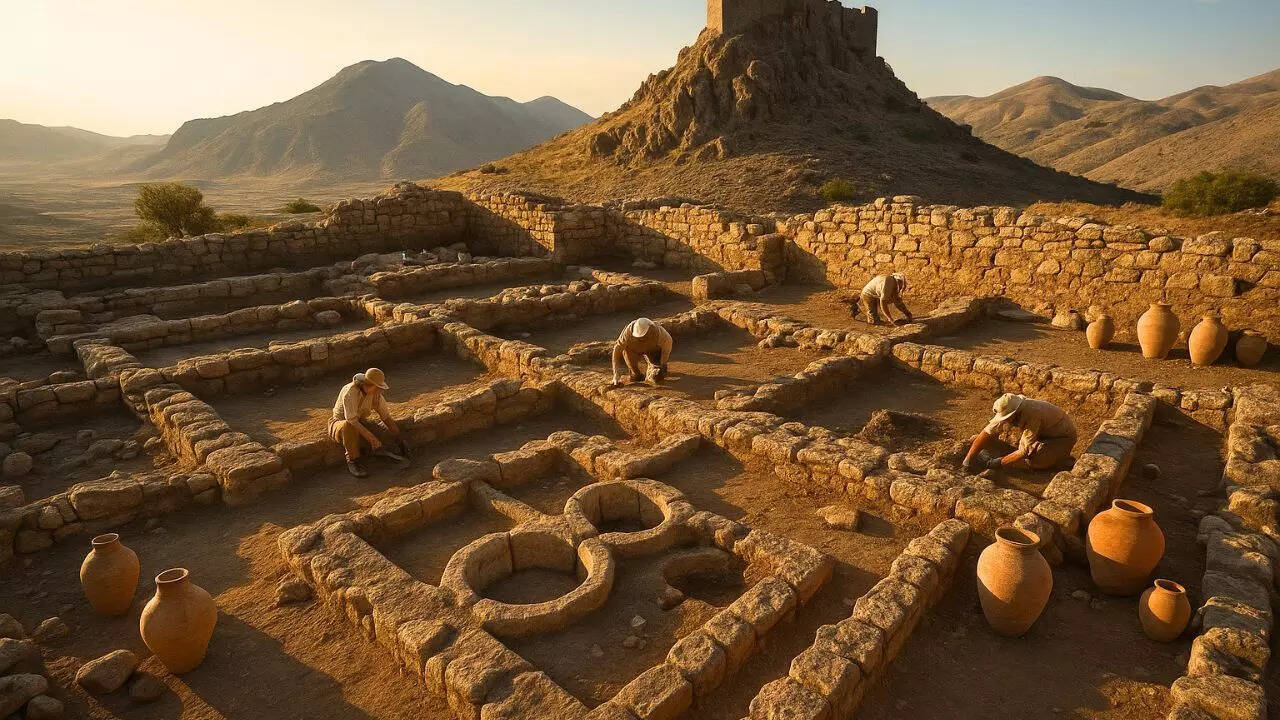
Aerial view of an archaeological site near a mountain castle in Turkey, showing stone ruins, ancient grape-crushing basins, and clay jars under sunlight, archaeologists working carefully, cinematic lighting, realistic detail, 16:9 composition.

Representative AI image

A castle’s hidden companion

The ancient wineworks lie close to Kahta Castle, a fortress originally built in the 2nd century BC for the Kingdom of Commagene, a Greco-Iranian dynasty that thrived before Roman annexation. Archaeologists believe the site may have once served both as a production hub and as a residential settlement for those who worked at or supplied the castle.Given the castle’s position on a major trade route between Mesopotamia and Anatolia, experts say the winery could have played a key role in provisioning the garrison and exporting wine across the region. The discovery provides rare evidence of how local economies functioned under Roman rule in Anatolia’s remote mountain regions.

From grape to glass: how the Romans made wine

The structures uncovered mirror other Roman-era wineries found across the Mediterranean. Grapes were likely pressed manually or with wooden beams, allowing juice to flow through carved channels into stone basins. From there, it would have been stored in large clay jars, or amphorae, to ferment.Archaeologists also uncovered cisterns carved directly into rock, which would have stored water essential for both winemaking and daily life in this dry region. The presence of such facilities suggests that the complex operated at an industrial scale, far beyond the needs of a single household.

A glimpse into late Roman life

Dating to the 4th century AD, the site falls within a period when Christianity was spreading through the Roman Empire and Constantinople was emerging as its new capital. The discovery shows that even in remote provinces, life thrived through trade, agriculture, and craftsmanship.The blend of Roman engineering and local traditions in the architecture highlights the cultural fusion that defined this era. “This settlement reflects both Roman influence and Anatolian adaptation,” researchers noted in their preliminary report.




Source link

Share This Article
Twitter Email Copy Link Print
What do you think?
Love0
Sad0
Happy0
Sleepy0
Angry0
Dead0
Wink0
Previous Article WWI soldiers’ letters found in a bottle on Australian beach: What’s written inside | World News – The Times of India – Delhi News Daily
Next Article Desert masquerades: Dubai’s high-fashion take on Halloween nights | World News – The Times of India – Delhi News Daily
Leave a comment

Leave a Reply Cancel reply

Your email address will not be published. Required fields are marked *

Recent Posts

  • India’s high intensity training session at Wankhede Stadium – Delhi News Daily
  • Congress Releases First List Of Candidates For Assam Polls, Fields Gaurav Gogoi In Jorhat – Delhi News Daily
  • Global Markets | Japanese stocks plummet as Mideast conflict widens – Delhi News Daily
  • Andrew Was A Target for Foreign Influence? WILD Report Claims Handlers Exploited Rift With Charles – Delhi News Daily
  • Shivakumar To Host Dinner For Karnataka Congress MLAs, MLCs Amid Leadership Change Buzz – Delhi News Daily

Recent Comments

No comments to show.

You Might Also Like

World News

Netizens react to Trump’s Iran bombings; calls for Barron Trump to enlist in US army after Iran strikes | World News – Times of India – Delhi News Daily

Netizens react to Trump's Iran bombings; calls for Barron Trump to enlist in US army after Iran strikes As US…

5 Min Read
World News

Powerful earthquake at Russian coast: Far East hit with tremors of magnitude 7.4; ‘hazardous’ waves possible – The Times of India – Delhi News Daily

An earthquake of magnitude 7.4 struck off Russian Far East's Kamchatka on Saturday, USGS reported. The Pacific Tsunami Warning Center…

3 Min Read
World News

Tasteless trolls trend ‘Trump is dead’ amid health concerns – The Times of India – Delhi News Daily

Donald Trump (PTI file photo) TOI Correspondent from Washington: Distasteful rumors about the demise of US President Donald Trump trended…

6 Min Read
World News

Amazon, JPMorgan Chase, Microsoft: List of companies increasing most H-1B visas this year – The Times of India – Delhi News Daily

An analysis of federal data reveals that several US companies increased their use of H-1B visas in 2025. With the…

6 Min Read

Delhi News Daily

© Delhi News Daily Network.

Incognito Web Technologies

Welcome Back!

Sign in to your account

Username or Email Address
Password

Lost your password?