
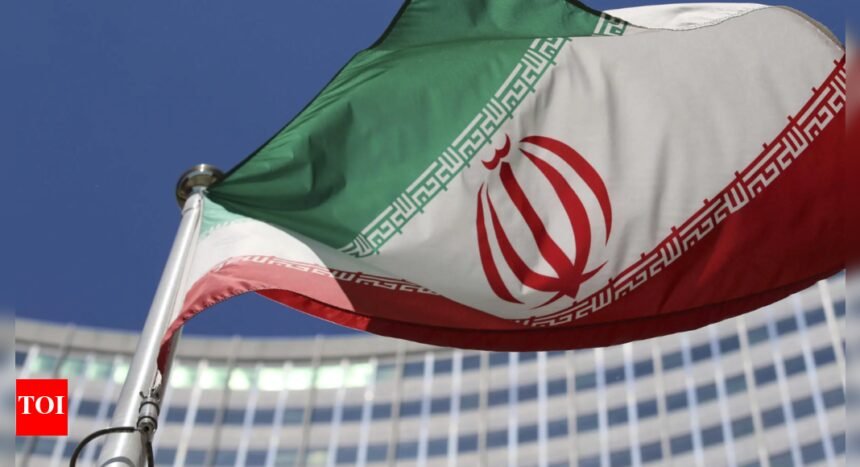
Iran is once again facing crippling international sanctions on its weapons trade, oil exports, international banking, and much more under the snapback mechanism of the 2015 nuclear deal.The accord, concluded between Iran on one side and the US, France, Germany, the UK, Russia and China, as well as the European Union on the other, provided Tehran economic relief in exchange for curbing Iran’s nuclear program.While the US unilaterally pulled out of the deal and reimposed restrictions under Donald Trump in 2018, others participants worked to salvage it and keep the sanctions relief in force.In August this year, however, the UK, France and Germany triggered the embedded snapback mechanism. The trio accuses Iran of not complying with the terms of the deal by continually producing too much enriched uranium, not providing international inspectors with sufficient access, and not pursuing “direct and unconditional negotiations” with the US.
Iran facing ‘a full, suffocating embargo’
Despite efforts by China and Russia to delay the process, the 30-day snapback grace period expired this week, meaning that all sanctions that had previously been lifted on Iran have now been automatically reinstated.“It is not just another round of sanctions; it is the return of a full, suffocating embargo that Iran has not faced in years,” international security analyst Shahin Modarres told DW.“This means banking channels are blocked, oil exports are strangled, and even basic trade becomes tangled in a web of restrictions. For ordinary Iranians, this translates directly into daily hardship,” he added.According to Modarres, the punitive measures will triggered the collapse of Iran’s currency, which would make imports painfully expensive. Jobs will be lost, and those still working will see their wages eaten away by inflation.“Economists have a term for this, the ‘misery index,’ a combination of unemployment and inflation, and in Iran it is already high. Snapback ensures it will climb much higher.”German-Iranian physicist and nuclear policy expert Behrooz Bayat told DW that the people will bear the brunt of the crisis on two fronts.“First, they will be directly affected, especially the middle class, which is the backbone of any democracy. Second, regimes like the Islamic Republic may refuse to back down, and the situation could escalate into full-scale war. While the regime might ultimately collapse, it could come at the cost of the country’s destruction, a scenario in which the Iranian people gain nothing from the outcome,” Bayat added.
Can diplomacy still bring change under sanctions?
European officials and US secretary of state Marco Rubio have reiterated their willingness to continue pursuing diplomacy and negotiations with Iran as sanctions return.However, with Ayatollah Ali Khamenei recently dismissing the idea of talks with the US as a “sheer dead end” and senior Iranian officials echoing this sentiment, diplomatic avenues seem very narrow.“The clerics in Tehran know that the world will not settle for anything less than the complete dismantling of both the nuclear and ballistic missile programs,” said security analyst Modarres.“If they were to surrender these programs voluntarily, they would lose the loyalty of the one group that still sustains them: the small but powerful ideological minority that enforces repression inside the country,” he added.The regime’s leadership will risk everything in order to keep its base happy, even wage war, according to Modarres.“They imagine that if Western powers attack, it will be outsiders, not themselves, who destroy the nuclear facilities and missile bases. That way, the regime can claim that it never gave in, that it was forced into this position by foreign aggression.”Regime leaders would be willing to accept a broken and failed Iran, as long as they are still the ones who rule it, Modarres claims.
Is US seeking regime change?
There are also growing fears in Iran that the US is pushing for regime change in Tehran with the Islamists off balance due to the return of sanctions and the recent 12-day war with Israel.These fears were fueled by the comments made by the US ambassador to Turkey Tom Barrack last week, when he referred to Iran and Hezbollah as Washington’s enemies and said the US needed to “cut off the heads of these snakes.”But Iranian analyst Shahin Modarres does not believe this is enough to expect a new course for the US foreign policy.“History shows that regime change is never a matter of rhetoric alone. It requires political will, resources, and a vision of what comes after,” he said.“For regime change to become a real objective, it must grow into a collective decision, embraced not only by individuals but by the White House, Congress, and America’s security establishment, and sustained by allies abroad.”In order to have Washington pushing for regime change, American leaders and institutions would have to commit to it as a shared goal be “ready to live with the consequences of what follows,” Modarres said.“Without these, what we see is pressure, not transformation: sanctions to weaken the regime, covert actions to slow its programs, diplomatic isolation to reduce its reach. These measures may push the Islamic Republic into a corner, but they do not yet amount to an official US doctrine of regime change.”
What could come next for Iran?
As Tehran finds itself isolated once again, the Iranian regime seems determined to pursue the course set by its hardliners.With the activation of the snapback mechanism, Iran once again falls under Chapter VII of the UN Charter, a designation that frames the country of over 90 million as a threat to international peace and security.Inside Iran, many are debating the implications under Article 41 of the chapter, which allows for “measures not involving the use of armed force” to be employed “to give effect” to UN’s decisions, including cutting off economic and transportation ties, as well as communications and diplomatic relations.Moreover, Article 42 of the chapter indicates that the security council can go further if such measures “have proved to be inadequate” and may take further actions including “operations by air, sea, or land forces of Members of the United Nations.”“The resolutions and Iran’s placement under Chapter VII do not yet justify war,” German-Iranian expert Bayat said.“Specifically, Article 41 does not authorise military action. It’s Article 42 that allows the use of force. However, the world doesn’t always operate strictly according to legal frameworks,” he added.

