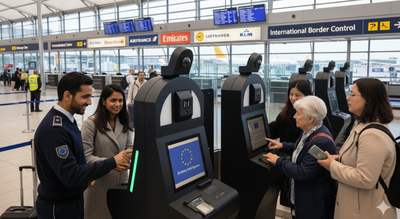
Starting 12 October 2025, travellers from the UAE heading to Europe will experience a major change at Schengen Area borders. The European Union’s Entry/Exit System (EES) will go live, replacing the traditional manual passport stamping process with a digital border control system that uses biometric data. Designed to enhance security and streamline entry for non-EU visitors, the system applies to millions of third-country nationals, including those travelling from the UAE. Here’s a complete breakdown of what the EES is, who it affects, how it works, and what UAE residents need to prepare for before their next trip to Europe.
New rules at Europe’s border: What EES means for UAE travellers
The EES introduces automated border checks for non-EU nationals entering or exiting the Schengen Area for short stays. This includes UAE citizens and residents who are visa-exempt or travelling on a Schengen short-stay visa (up to 90 days in any 180-day period). From 12 October 2025, border control officers will digitally register the following data on arrival:
- Full name
- Type of travel document
- Nationality
- Date and place of entry (or exit)
- Biometric data: fingerprints and a facial image
This data is stored in a centralised EU database managed by eu-LISA, the European Agency for large-scale IT systems in the fields of freedom, security, and justice. On future trips, travellers won’t need to repeat the full biometric process. Instead, the system will verify identity using previously stored data and digitally log border crossings. Importantly, manual passport stamping will gradually be phased out, though some locations may continue to stamp passports during the system’s early rollout phase.
Who is affected – and who isn’t?
The EES only applies to travellers from non-EU countries, meaning it directly affects UAE citizens and residents visiting the Schengen Area for short stays.
- UAE passport holders entering the EU for tourism, business, or family visits (90/180-day rule)
- Travellers who are visa-exempt but not residents of the EU or Schengen Area
- Short-stay visa holders from third countries
- EU citizens
- Schengen Area residents
- Holders of long-stay visas or residence permits
- Non-EU family members of EU citizens
- Nationals of countries with special arrangements, including: Andorra, Monaco, San Marino, Vatican City
- Researchers, students, au-pairs, and intra-corporate transferees
- Holders of local border traffic permits
- Train crew on international journeys
- Privileged or diplomatically exempt travellers
Airlines operating in the UAE, including Emirates and Air Arabia, have already issued alerts to their passengers about the upcoming changes. Both carriers are advising travellers to allow extra time at border checks, especially during their first visit after the system goes live, as the new process could take longer than usual.
Why Is the EES being introduced?
The European Union is launching the EES to modernise its border management, increase security, and improve efficiency for both authorities and travellers. The current system — manually stamping passports — is time-consuming, often inaccurate, and unable to reliably detect overstayers. The EES aims to:
- Eliminate manual passport stamping
- Automate entry/exit tracking
- Detect overstays and invalid entries
- Prevent identity and document fraud
- Enhance border security and migration control
The system also supports wider use of automated border control gates and self-service kiosks, making travel more seamless once initial biometric data is captured. This initiative is part of the EU’s broader Security Union agenda, supporting the goals of the European Agenda on Security and the European Agenda on Migration, particularly around countering terrorism and cross-border crime. The proposal for the EES was initially presented on 6 April 2016 under the Smart Borders Package. After negotiations, it was adopted on 20 November 2017, and came into force on 29 December 2017.
What data will be collected and how is it used?
The EES collects and stores several pieces of personal and biometric information:
- Name, nationality, passport type
- Date and location of entry or exit
- Biometric data: facial image and fingerprints
- Records of any refusals of entry
All data is stored securely and handled under strict EU data protection laws. Access is limited to:
- Border and immigration authorities
- Visa-issuing officials
- Law enforcement agencies, including Europol
- Transport carriers (for checking visa compliance)
In certain circumstances, data may also be shared with international organisations or third countries under regulated conditions. Each travel record remains valid for three years from the last recorded crossing. If you cross the border again, the clock resets. Renewing your passport will not affect your stored data — the system will automatically match your new passport with your existing biometric records through facial recognition.
Additional information for UAE travellers
No advance registration required
There is no need to register in advance. Your biometric data will be collected on your first entry after the system goes live.
Passports may still be stamped at some locations
Although the EES is intended to replace manual stamps, some countries or border points may still apply physical stamps temporarily during the transition period.
Medical insurance
There is no insurance requirement under the EES. However, some countries (e.g., France) may ask at kiosks whether travellers have medical coverage. Travel insurance is highly recommended but remains optional.
Frequent Traveller programmes
Some EU countries may offer National Facilitation Programmes to speed up border checks for frequent visitors. Eligibility criteria and availability vary by member state.
Which countries are covered by the EES?
The EES applies across all external borders of the Schengen Area. Travellers from the UAE should expect the new system when visiting any of the following countries: Austria, Belgium, Bulgaria, Croatia, Czechia, Denmark, Estonia, Finland, France, Germany, Greece, Hungary, Iceland, Italy, Latvia, Liechtenstein, Lithuania, Luxembourg, Malta, Netherlands, Norway, Poland, Portugal, Romania, Slovakia, Slovenia, Spain, Sweden, Switzerland.
Looking ahead: What comes after EES?
While the Entry/Exit System (EES) is set to launch in October 2025, another significant change is scheduled to follow about a year later: the introduction of ETIAS (European Travel Information and Authorisation System) — often referred to as the “Euro visa.” ETIAS will be a mandatory pre-travel authorisation for visa-exempt nationals, including those from the UAE and the UK, who plan to travel to any of the 30 European countries in the Schengen Area. It is not a visa, but it is a compulsory security clearance designed to screen travellers before they arrive. The authorisation is:
- Digitally linked to your passport
- Valid for up to three years, or until the passport expires — whichever comes first
- Required before boarding flights, trains, or ships bound for the Schengen Area
If a traveller gets a new passport, they must apply for a new ETIAS authorisation, even if their previous one was still valid. Once implemented, ETIAS will work in tandem with the EES, further tightening EU border security by vetting travellers in advance and tracking their movements upon arrival and departure. For now, the focus remains on the smooth rollout of the EES, a foundational shift in how Europe manages border entry, aiming to balance security, efficiency, and traveller experience.