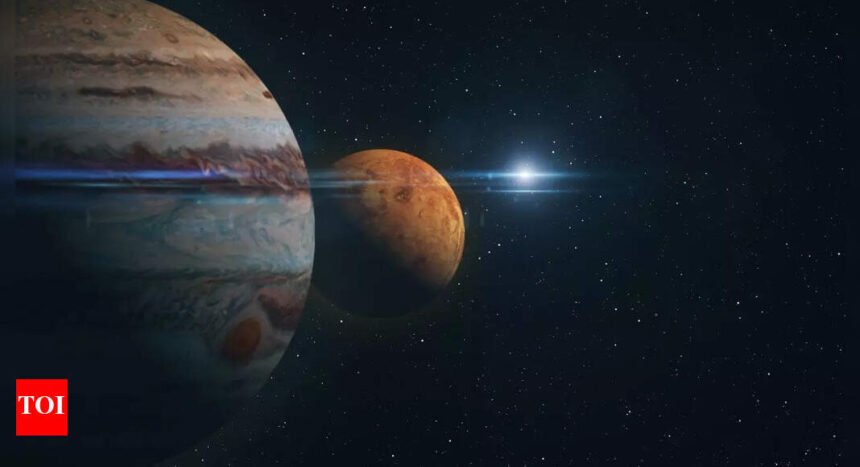
The story of how our solar system formed is not a simple one. For years, scientists believed that all planetesimals, the small rocky bodies that became planets, formed at roughly the same time. But new research suggests something very different. It shows that the solar system’s earliest days were shaped by Jupiter’s fast growth and strong gravitational pull. These changes not only influenced how planets formed but also where they ended up. Understanding how Jupiter shaped the early solar system gives us a clearer picture of how Earth and its neighbouring planets came to be. It also helps explain why our solar system looks so different from others we observe today.
The evolving picture of planet formation
A study published in Science Advances challenges the long-standing belief that planetesimals formed all at once. It found that some of these early building blocks formed within the first million years after the solar system began, while others appeared two to three million years later. This difference in timing raised new questions about how the solar system stayed balanced and why certain elements remained separated across regions.The researchers proposed that Jupiter’s early growth changed everything. As Jupiter formed, it acted like a giant divider in space. It created a barrier that separated the inner and outer parts of the solar system. On one side were the noncarbonaceous materials, the kind that helped form rocky planets like Earth and Mars. On the other were the carbonaceous materials, which later formed the icy bodies and comets. This clear division explains why scientists still see chemical differences between meteorites that come from different parts of the solar system.
Jupiter’s early growth and its powerful impact
The model used in the study showed that Jupiter’s early formation influenced the gas and dust in the Sun’s surrounding disk. When Jupiter grew, it began to carve gaps in the gas. These gaps created “pressure bumps”, areas where dust could gather and form new planetesimals. These conditions made it possible for a second generation of planetesimals to form much later than the first.Jupiter’s gravity also affected the gas flow in the young solar system. As it grew, it caused the inner regions of the disk to lose gas more quickly. This reduced the chances of smaller planets drifting too close to the Sun. In other words, Jupiter helped stabilise the inner solar system, keeping planets like Earth near their current orbits. Without this early influence, the planets could have migrated inward, possibly ending up too close to the Sun to support life.The researchers combined simulations of disk dynamics, gas flow, and dust behaviour to show how these forces worked together. Their model helped explain why the solar system has a stable inner region with rocky planets and an outer region filled with gas giants and icy bodies.
The mystery of the second generation of planetesimals
One of the most interesting findings of the research is the idea of a “second generation” of planetesimals. These later planetesimals formed from leftover dust and debris, long after the first wave of formation had ended. Normally, dust close to the Sun would drift inward and disappear. But Jupiter’s influence changed that. Its gravitational pull created zones where dust could collect and remain stable. This made it possible for new planetesimals to form even after the first generation had already become larger planetary embryos.This second generation explains why some meteorites and asteroids appear to have formed later than others. It also supports the theory that Jupiter grew quickly, within the first 1.5 to 2 million years after the solar system began. The planet’s early formation likely shaped both the timing and composition of materials in the inner solar system.Interestingly, this also helps solve the long-standing puzzle about isotopic differences found in meteorites. By trapping dust and preventing material from mixing freely, Jupiter helped preserve the chemical signatures of different regions. This preserved the isotopic contrast that scientists still see in meteorite samples today.
Linking Jupiter’s role to modern observations of planets
The same model that explains our solar system’s early evolution also fits what astronomers see in other planetary systems. Many exoplanets orbit very close to their stars, suggesting that migration is common. Yet in our solar system, the terrestrial planets stayed around one astronomical unit from the Sun. The study suggests that Jupiter’s early influence created “planet traps” that limited inward migration. These traps likely kept Earth and Mars from moving too close to the Sun.By using advanced computer simulations, the researchers showed that Jupiter’s presence helped speed up gas dispersal in the inner disk. This process made the inner solar system more stable and prevented smaller planets from falling into unstable orbits. It also explains why our solar system lacks the kind of tightly packed, short-period planets that many other systems have.This model ties together chemical evidence from meteorites, orbital data from planetary science, and physical models of disk evolution. It provides a more complete explanation of how the solar system’s structure formed and why it remains so distinct.The study offers a simple but powerful idea: Jupiter’s fast growth shaped the solar system’s layout and long-term stability. It acted both as a divider and a protector, influencing where planets could form and how they evolved. While there are still open questions, such as how Saturn’s formation interacted with Jupiter’s effects, this framework gives a coherent story linking chemistry, physics, and planetary motion.In the end, this research shows that Jupiter was more than just the largest planet. It was an architect of the solar system’s earliest design. By creating pressure zones and limiting gas flow, Jupiter set the stage for the stable arrangement of planets we see today. The work reminds us that even small changes in timing or location during the first few million years could have changed everything—perhaps even determining whether a planet like Earth could ever exist.Also Read | What IS 3I/ATLAS: The Comet that’s breaking all the solar system rules