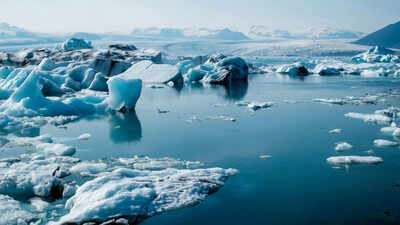
The Arctic Ocean has long been seen as a frozen, lifeless frontier. But as climate change melts the region’s sea ice, surprising new discoveries are emerging from beneath the surface. Scientists have found that melting ice could actually stimulate marine ecosystems by increasing the growth of algae, the tiny plants that form the base of the ocean food web. This finding challenges long-held ideas about life in the Arctic and may reshape how we understand the region’s role in regulating global carbon levels. Yet, it also raises new questions about whether this process will help or harm the planet’s delicate climate balance.
Hidden life beneath the Arctic ice : A new discovery in nitrogen fixation
An international team led by researchers at the University of Copenhagen, with participation from the Alfred Wegener Institute, recently made a discovery that redefines what we know about the Arctic Ocean. For decades, scientists believed that nitrogen fixation, the process where bacteria convert nitrogen gas into a form that supports life, could not happen beneath thick Arctic ice. Conditions were thought to be too extreme for the bacteria responsible for this transformation.The study revealed otherwise. Beneath the central Arctic ice, scientists found that nitrogen fixation not only occurs but may be more widespread than expected. Instead of the usual cyanobacteria seen in other oceans, a different group known as non-cyanobacteria performs this role in the Arctic. These bacteria feed on dissolved organic matter and release nitrogen compounds that nourish algae. This means that the Arctic, once considered too barren for such activity, could be home to a quiet but vital process supporting marine life.
The link between nitrogen fixation and algae growth in a warming Arctic
The research found that nitrogen fixation was strongest along the edges of melting sea ice. This is where sunlight, open water, and nutrients mix, ideal conditions for both bacteria and algae. As sea ice continues to retreat due to rising global temperatures, scientists believe the nitrogen cycle in the Arctic will change dramatically.“In other words, the amount of available nitrogen in the Arctic Ocean has likely been underestimated, both today and for future projections. This could mean that the potential for algae production has also been underestimated as climate change continues to reduce the sea ice cover,” says Lisa W. von Friesen, the study’s lead author.Algae are essential to the Arctic food chain. They serve as food for microscopic crustaceans, which are then eaten by small fish and larger predators like seals and whales. More algae could strengthen this chain, potentially increasing the productivity of Arctic marine ecosystems. However, this shift also highlights how climate change creates complex and unpredictable feedbacks within natural systems.
Algae and the carbon cycle: A possible climate benefit with uncertainties
Algae do more than feed marine animals. They also absorb carbon dioxide from the atmosphere during photosynthesis. When they die, some of this carbon sinks to the ocean floor, locking it away for centuries. Scientists often describe algae as natural “carbon sinks” or the ocean’s own version of a vacuum cleaner.The new discovery suggests that if nitrogen fixation increases algae growth, the Arctic Ocean could absorb more carbon dioxide. On the surface, this seems like good news for the climate, as it might slightly offset rising global carbon levels. But experts warn that it is not that simple. Marine systems are highly sensitive, and other environmental changes, such as warmer water temperatures or altered ocean currents, could weaken this positive effect.‘We do not yet know whether the net effect will be beneficial for the climate. But it is clear that we should include an important process such as nitrogen fixation in the equation when we try to predict what will happen to the Arctic Ocean in the coming decades as sea ice declines,’ says Lasse Riemann, a senior author of the research.This cautious optimism reflects a broader truth in climate science: every new discovery brings both hope and uncertainty. While the Arctic may absorb more carbon through this process, the same warming that allows it to happen could also disrupt other parts of the ecosystem.
Why this discovery matters for the future of the Arctic and beyond
The implications of this study reach far beyond the polar regions. As global temperatures continue to rise, the Arctic is warming nearly four times faster than the rest of the planet. This rapid change not only threatens species that depend on ice but also alters how the ocean stores and releases carbon. Understanding the role of nitrogen fixation helps scientists make more accurate predictions about future climate patterns.The research also shows that the Arctic Ocean is not a passive victim of global warming, it is an active, dynamic system still full of unknowns. The discovery of nitrogen-fixing bacteria under sea ice challenges long-standing scientific assumptions and highlights how life adapts even in the harshest environments. It also reinforces the idea that small, unseen processes, like microscopic bacteria converting gas into nutrients, can have global consequences for food chains and the climate.Looking ahead, scientists agree that nitrogen fixation should be included in climate models to better understand its influence on marine ecosystems and atmospheric carbon levels. By refining these models, researchers hope to build a clearer picture of how Earth’s oceans will respond to ongoing warming.The Arctic Ocean continues to surprise the scientific world. What was once thought impossible, life thriving beneath layers of ice, is now known to be a key part of the region’s ecological balance. As ice melts and nitrogen levels rise, algae may flourish, supporting more marine life and possibly capturing more carbon. But this potential benefit exists alongside great uncertainty. The same processes that give life to the Arctic could also alter it in unforeseen ways.The new understanding of nitrogen fixation reminds us that even in the coldest corners of the world, the planet’s systems are deeply connected. Every small change beneath the ice echoes across oceans, shaping the future of Earth’s climate and the life it sustains.Also Read | NASA’s drastic plan: Nuclear bombs could be used to stop ‘City-Killer’ asteroid headed for the moon