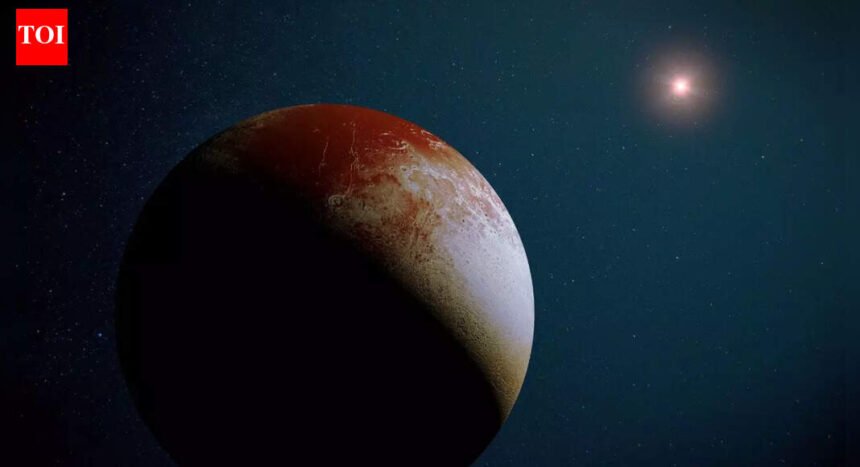
Pluto’s largest moon, Charon, has become central to research on how small worlds form and evolve in the outer Solar System. The pair orbits a shared centre of mass that lies outside Pluto’s surface, a feature that sets the system apart from typical planet and moon relationships. This distinctive arrangement has raised long standing questions about how Charon came to be bound to Pluto and what the process reveals about early conditions in the Kuiper Belt. As scientific interest in dwarf planets grows, the Pluto Charan system continues to inform discussions on gravitational interactions, orbital growth and the mechanisms that shape planetary environments far from the Sun.The research paper published in the Monthly Notices of the Royal Astronomical Society, examined potential capture scenarios using the mass ratio, orbital behaviour and angular momentum of the system.
What the early Kuiper Belt looked like when Pluto met Charon
During the early stages of Solar System formation, the Kuiper Belt was filled with icy bodies that frequently interacted as they moved through overlapping orbits. Pluto travelled within this environment as a mid sized object with enough gravity to disturb nearby paths. Charon, believed to have formed independently rather than from material surrounding Pluto, would have moved through this region as one of many comparable bodies. The crowded conditions increased the likelihood of close encounters, particularly at relative speeds low enough for gravitational interactions to alter long term trajectories. Limited sunlight at that distance reduced the influence of solar tides, giving Pluto a greater ability to affect passing objects. These factors produced a setting where temporary captures were possible, even if most did not develop into long term orbital partnerships. For Charon, the combination of relative proximity, repeated encounters and gradual orbital migration created an environment in which a short lived gravitational hold could turn into a lasting association.
What allowed Charon to stay instead of escaping Pluto’s pull
A capture could only become permanent if Charon lost enough orbital energy to remain bound to Pluto. Lissauer’s analysis considered how three body encounters, in which a third object interacted with Pluto and Charon during their close approach, could extract excess energy from Charon’s path. Such an encounter would have shifted Charon onto a slower, altered trajectory, increasing the chances that it would remain near Pluto rather than escaping back into heliocentric orbit. After this initial interaction, repeated close passes between Pluto and Charon would have generated strong tides that distorted the shapes of both bodies. These tidal bulges acted as a source of friction, converting orbital motion into heat and gradually reducing the system’s overall energy. Over time, Charon’s orbit became more circular and more tightly bound, transforming a once chaotic encounter into a stable gravitational relationship. This long term evolution explains how an initially irregular orbit may have settled into the predictable configuration observed today.
Why the Pluto-Charon system spins in perfect harmony
One of the most striking features of the Pluto Charan system is its high angular momentum, which is greater than would be expected if Charon had formed from a simple disc of debris. Capture models propose that this angular momentum came from the geometry of the initial encounter. If Charon approached Pluto at a glancing angle instead of a direct path, the gravitational exchange would have transferred rotational energy to both bodies. This process could have placed Charon into a rapidly evolving orbit while simultaneously speeding Pluto’s rotation. As tidal forces continued to act, rotational energy was redistributed, causing Charon’s orbit to expand while Pluto’s spin slowed. NASA’s New Horizons mission later revealed surface and interior structures that align with long term tidal activity, supporting the idea that the rotational state of the system reflects ongoing adjustments that began during the capture process. Eventually, both bodies became tidally locked, each perpetually showing the same face to the other as they orbit their shared centre of mass.
Why Charon’s size turned the system into a planetary duo
Because Charon is approximately half the diameter of Pluto, the system functions more like a binary pair than a primary body with a secondary moon. After the initial capture, tidal interactions would have driven Charon outward from a tighter, more elongated orbit. This outward movement slowed once Pluto and Charon reached mutual locking, a state in which their rotation periods matched their orbital period. Throughout this process, Charon may have experienced interior heating that influenced its geological features. Observations from New Horizons revealed tectonic fractures and surface variations that suggest a history shaped partly by tidal stresses. The final configuration, where both bodies orbit a point well outside Pluto, reflects a long sequence of adjustments that stabilised the system. The distinctive mass ratio, shared rotational state and wide separation all point to an evolutionary path that began with capture rather than co formation.
Why astronomers study Pluto and Charon to understand distant worlds
The capture model remains influential because it aligns with modern measurements of density, orbital distance and rotational behaviour. Other binary systems in the Kuiper Belt also show high angular momentum and relatively equal sized components, suggesting that capture events may have been common during the region’s early history. By studying how Pluto captured its largest moon, researchers gain insight into the broader dynamics of the distant Solar System and the conditions that shaped many small worlds. The Pluto Charan system continues to provide a valuable reference point for understanding how gravitational encounters, energy loss and tidal evolution can combine to create long lasting binary configurations at the edge of the Sun’s influence.Also Read | When and how you can see the 2025 Leonid meteor shower in November 2025