
For years, Donald Trump mocked Democrats for “changing” the character of American cities. But this week, as he launched fresh attacks on Somali immigrants in Minnesota, an old question returned to the national conversation: why does a cold Midwestern state have the largest Somali population in the United States?The answer is neither accidental nor mysterious. It’s a mix of history, war, employment, cultural alignment and the simple power of word-of-mouth. This is how Minnesota became the heart of Somali America.
Driving the news
Minnesota’s Somali community — nearly 80,000 strong — has been thrust back into the spotlight after Trump labelled Somali immigrants “garbage” and said they should be sent “back to where they came from.” He also threatened to withdraw temporary legal protections, and conservative commentators have linked the entire community to isolated welfare-fraud investigations, fuelling a wave of political attacks.With fresh immigration-enforcement operations reportedly being planned in the state, Somali Minnesotans say they feel targeted again.
How it started: War, refuge and a meat-packing plant
The story begins in the late 1990s, far from Minneapolis or St Paul, in Marshall — a small Minnesota town about 150 miles west.Somalia was in the grip of a devastating civil war, forcing hundreds of thousands to flee. When a meat-packing plant in Marshall needed workers, the earliest Somali refugees found jobs there. Word spread quickly. Others followed, attracted by steady work in the plant as well as in hotels, taxi services and local businesses.This early cluster created Minnesota’s first Somali community — long before the Twin Cities became the primary hub.
The chain migration effect
As the first workers settled, they brought their families. Families brought children. Children grew up, went to school and established the next generation.The pattern was simple but powerful: once a community was rooted, new arrivals no longer had to start from nothing. They had relatives, friends, interpreters, religious centres, halal shops and social networks waiting for them. The more Somalis arrived, the easier it became for others to choose Minnesota over anywhere else in the US.
Why Minnesota worked: Martisoor and shared values
Minnesota’s reputation for warmth and social support played a huge role. Somalis often use the term martisoor, meaning hospitality. For many refugees, Minnesota’s political culture — progressive, community-oriented and practical — felt surprisingly compatible with Somali social values.Refugees reported that navigating schools, healthcare and local services was easier in Minnesota than in other states. Religious communities, mosques and cultural organisations formed quickly. Over time, this alignment created a sense of belonging that went beyond employment.
The Twin Cities effect
By the early 2000s, Minneapolis and St Paul became the gravitational centre. Neighbourhoods like Cedar-Riverside developed robust Somali ecosystems — groceries, restaurants, community centres, legal clinics, women’s groups, youth associations and financial-assistance networks. For new arrivals, this meant fewer hurdles and more stability. For the second generation, it meant identity formation in a community large enough to feel secure. Today, about 78 percent of Minnesota’s Somali population lives in the Twin Cities.
Challenges on the way
The transition was not friction-free. Somali Muslims sometimes struggled to find workplaces accommodating prayer timings or hijab-friendly policies.The community also battled stigma after extremist groups tried to recruit young Somalis more than a decade ago. And as with many immigrant groups, they have faced periodic moral panics, political attacks and stereotyping. But despite setbacks, the community grew, supported by local civic leaders and strengthened by its own institutions.
Political representation and rising confidence
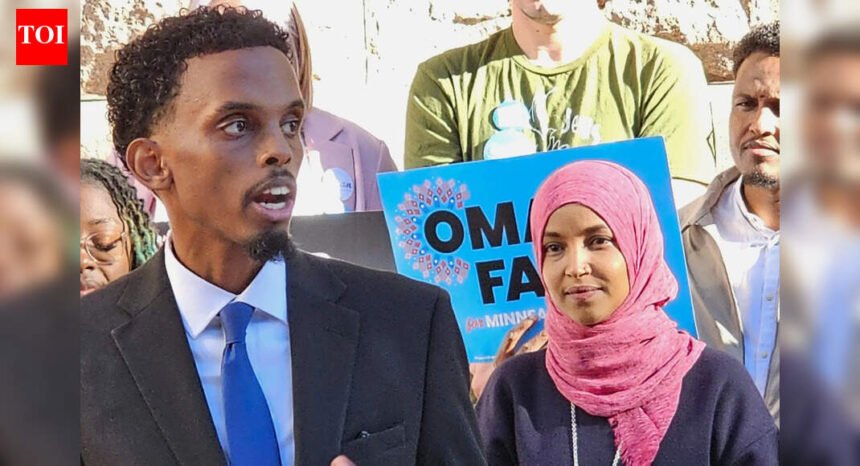
The biggest turning point came in 2018: Ilhan Omar, herself a former refugee, became the first Somali-American elected to the US Congress.For many Minnesotans of Somali descent, this was more than representation — it was proof of permanence. A signal that Somalis weren’t just residents, but part of the state’s political fabric.Community leaders today emphasise that Somali Minnesotans contribute heavily to local business, transport, public services, healthcare and education.So why Minnesota? The nutshell answer
- A civil war pushed people out of Somalia.
- Jobs pulled the first arrivals into Minnesota.
- Family networks strengthened the settlement.
- Cultural compatibility made assimilation easier.
- The Twin Cities provided infrastructure and support.
- Political visibility made the identity durable.
It wasn’t a government programme or a special migration path. It was a combination of circumstance, opportunity and community resilience.
The big picture
Minnesota did not try to become the heartland of Somali America. It happened through a series of small but decisive events — one hiring decision in Marshall, one family following another, one neighbourhood offering refuge, one generation building on the last. Today, Somali Minnesotans are a deeply embedded part of the state’s identity, economy and political life. And as national rhetoric intensifies again, the real story of how they arrived and why they stayed matters more than ever.