
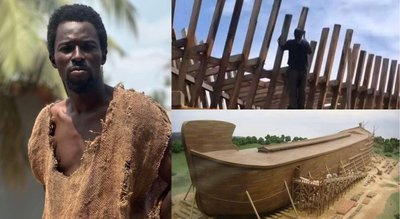
If the book of Genesis is taken literally, the flood story is meant to be a one-time event. In Genesis 9:11 and Genesis 9:13–15, God promises in the text itself that He will never again destroy the world with a flood. “I establish my covenant with you, that no more flesh shall be cut off by the waters of the flood, and there shall be no more flood to destroy the earth.”“I will make my rainbow in the cloud, that it may be a sign of the covenant between me and the earth… and there will be no more floods to destroy all flesh.” Which makes the latest viral prophecy doing the rounds on TikTok, Instagram, Facebook and X a little awkward. If a self-styled Ghanaian “Noah” is right, the Bible is wrong, or God is about to break his own promise on Christmas Day. Either way, something doesn’t quite add up.
A modern ‘Noah’ and his deadline: 25 December 2025
The videos began circulating in late August 2025 and have since bounced between platforms with the kind of velocity that only apocalyptic content and algorithms can generate.They show a man in Ghana, variously labelled Noah, Prophet Ebo Noah, EboJesus or Igbo Noah, standing beside or inside large wooden boats, preaching in a local language while subtitles and captions do the heavy lifting for global audiences. He looks the part, too, often dressed in a brown, repurposed jute-style vest that has become part of his visual signature. He also maintains an active presence across TikTok, Facebook and Instagram, where much of the momentum now comes from.The claim is simple and dramatic. According to him, God has told him that beginning on 25 December 2025, rain will fall without stopping for three to four years, submerging the entire world. If you’ve heard the parable before, you’ll recognise the blueprint instantly, he has more or less torn it straight from Noah’s page: the warning, the deadline, and even the instruction to gather animals in pairs. In preparation, he says he has been told to build arks, not just one, but as many as ten, to shelter those who join him before the rain begins, including anyone from anywhere in the world, so long as they enter into a covenant with God.Among many other such posts, one on X claims that Ghanaian Prophet Ebo Noah has completed the ark God allegedly instructed him to build,a vessel he says can carry at least 5,000 people and took more than 11 months to finish. Other videos go further, asserting that as many as eight additional arks are already underway, built from 250,000 pieces of “special” wood personally selected and prayed over.Then there is a separate, more dramatic figure: one narration mentions a “grand ark” allegedly capable of carrying 600 million people. That vessel does not appear in any of the available videos, and no footage so far matches anything remotely close to that scale. Even commenters who believe the prophecy note the gap, with one joking that the prophet “is a builder, not a calculator.” What is clear is that the story has found an audience. One TikTok account in his name has reportedly reached around 200,000 followers. Comments range from fearful agreement to open mockery, with some users asking if there will be Wi-Fi, phone chargers or Cash App on board. He appears to take the insults in a notably patient, almost Christ-like posture, pleading for God to have mercy and reminding viewers that, in the Bible, people mocked Noah too, yet the work went on.
A flood that breaks the covenant
For many Christian viewers, the first red flag isn’t digital but theological. Genesis 9:11 and 9:13–15 are already circulating in reply threads, pasted into comments and stitched into reaction videos. The logic is straightforward: if God has publicly promised never again to destroy the world with a flood, any prophecy of a three-year, planet-wide deluge is on shaky scriptural ground. That doesn’t stop people believing, of course. But it does mean the prophet’s pitch asks for more than trust; it quietly asks believers to accept that either the covenant no longer holds or that they have misunderstood it for centuries. So far, no major church body, theologian or recognised Christian authority has endorsed his warning. The only voices treating 25 December as the start date for a literal, global flood are those boosting the videos themselves.
What the videos actually show
Strip away the captions and the English-language commentary, and the footage looks more like a local construction effort than the end-times epic it’s being sold as. There are clips of long wooden hulls under construction, with carpenters working on ribs and planks. Truckloads of timber arrive in some shots; in others, the man identified as Noah is filmed handing out donations to children or schools, reinforcing a persona as local benefactor as well as prophet. One widely shared clip shows dozens of people from his community pushing a painted boat into the sea. The language spoken on camera appears to be regional, and most of the posts are dubbed or layered with background music. That makes it hard for outside viewers to know precisely what is being said without translation. It also raises a practical question: if this really is an open invitation to “anyone from anywhere in the world”, as some captions claim, posting primarily in a local language with music over the top is a curious recruitment strategy. Visually, the boats look real enough: real wood, real labour, real sweat. They do not, however, look capable of housing thousands of people, let alone hundreds of millions. The hulls seen so far resemble large open wooden boats more than multi-deck, sealed vessels. There is no sign of the kind of superstructure, compartments or lid associated with classic Noah’s Ark imagery. If each one truly had space for 6,000 people, those people would be standing very close together.So far, no independent news outlet in Ghana or abroad has verified how many boats exist, where exactly they are being built, or who is funding them. Most reposts vaguely describe the location as “a small community in Ghana,” but even that remains unconfirmed. Fact-checkers in West Africa and the UK have flagged the trend, yet none has been able to establish whether a prophet called Ebo Noah or EboJesus is constructing a functional fleet, as opposed to a handful of large community boats framed, online, as an end-times operation.
The AI question that never quite goes away
This is the point in 2025 where the obvious suspicion kicks in: is any of this AI?Some of the clips are credited to a now-deleted TikTok account, @EboJesus1. Others appear as reposts across Instagram, Facebook, X and newer short-video platforms, often re-edited to fit each site’s format. Many of them use the same voice-over, a smooth, flattened narration that resembles the AI-generated audio now common in viral prophecy content, stitched over slightly different footage. Analysts who monitor religious and apocalyptic trends online point to the familiar markers: consistent narration across unrelated clips, tightly curated edits, identical background music and almost no ambient sound. None of this proves fabrication, but it does suggest a level of post-production that goes beyond spontaneous documentation.Could parts of the footage be AI-enhanced, the boats made larger than they are, crowds duplicated, construction elements altered or filled in? Possibly. Modern generative tools can extend structures, invent missing details, or blend fabricated segments into real phone footage convincingly enough to pass a quick scroll test. And these clips do look convincingly real; nothing jumps out as artificial unless a digital-forensics expert begins analysing the files frame by frame. That is the challenge in 2025: the most persuasive fakes leave nothing obvious to question.At the same time, the boats, timber, people and mud look exactly like the sort of thing a real village project would produce. If this ever turned out to be entirely AI-generated, it would be both a technical and cultural shock. If it is entirely real, the editing still shapes how the project is perceived, turning slow local construction into a global end-times spectacle. It is also possible that the whole thing began as something far more ordinary, a community boatbuilding effort, a personal project, even an attempt to attract a bit of local curiosity, and only later grew into a prophetic narrative once he realised how quickly the story travelled online. In an era where virality can bring attention, influence, validation and even status within a community, it would not be unusual for someone to lean into a larger, more apocalyptic framing once the views started climbing. In the absence of forensic analysis, the only honest position is a careful one: the footage may include algorithmic enhancements or templated edits, but there is no public proof yet that the scenes themselves were wholly fabricated. Scepticism is warranted; certainty, on either side, is not.
The logistics problem nobody in the comments is solving
Even if every plank in every video is real, the numbers don’t sit quietly. Building ten arks big enough for thousands of passengers is not a weekend carpentry project. It is an industrial effort. The timber alone would represent a substantial bite out of local forests or a serious purchase from commercial suppliers. A small community pooling funds would quickly hit financial limits. Then there is labour. Modern shipyards use engineers, cranes, dry docks and safety inspections to build far smaller vessels. The idea that a handful of believers in one village could produce a ship big enough for 600 million people, a figure mentioned in at least one clip, is logistically impossible. Even the quieter claim of 6,000 people per boat would stretch beyond what any of the visible hulls could realistically carry. None of this disproves the existence of the project. It simply highlights the gap between the scale being preached and the scale that appears on screen. As online jokes have already noted, this Noah may be a builder, but the maths needs divine intervention.
Faith, fear, memes and DMs
The reaction to the Ghanaian ark says as much about the internet as it does about the man at its centre. Some users appear genuinely frightened, sending direct messages asking how to reserve a seat. Others admire his faith, comparing sceptics to those who allegedly mocked the original Noah until it was too late. A sizeable portion of the comments, however, are firmly in meme territory: questions about Wi-Fi, charging ports, cabin class, and whether mobile payments are accepted at the gangway. That mix, anxious belief, cautious curiosity, outright mockery, is standard for modern prophecy content. What is different now is the speed and reach. A man who, by all visible evidence, lives in a relatively small Ghanaian community can now position himself as a global saviour with a smartphone, some timber and an upload schedule.So far, established news organisations have mostly stayed away, which is telling in itself. The story, at this point, is shaped almost entirely by the man’s own videos, by the captions strangers attach when they repost them, and by the countless pages that continue to reshuffle and reshape the clips across different platforms. There is, importantly, no evidence from any recognised meteorological, scientific or religious authority that a three-year, world-engulfing flood will begin at Christmas. The biblical text he cites as inspiration contains a direct divine promise in the opposite direction. And beyond scripture, no regional weather service in West Africa, nor any global climate body, has issued projections resembling anything close to what he describes.