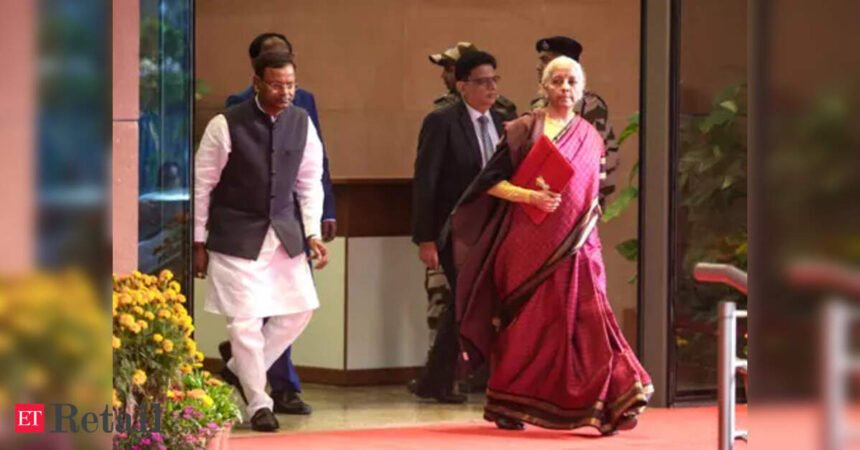
Positioning textiles as a key pillar in India’s manufacturing expansion, Finance Minister Nirmala Sitharaman on Sunday announced an integrated programme aimed at scaling up the country’s labour-intensive textile sector as part of the government’s plan to grow manufacturing across seven strategic and frontier sectors.
“The textile sector has immense potential for employment generation and value-added manufacturing,” Sitharaman said, while unveiling a five-part Integrated Textile Programme focused on fibre self-reliance, cluster modernisation, skilling, sustainability, and artisan support.
At the core of the plan is the proposed National Fibre Scheme, aimed at strengthening India’s self-reliance across natural fibres such as silk, wool, and jute, along with man-made and new-age fibres. The move is expected to reduce import dependence, support domestic fibre producers, and enable manufacturers to tap into evolving global demand for performance and sustainable textiles.
To address productivity gaps in traditional hubs, the Finance Minister announced a Textile Expansion and Employment Scheme, under which clusters will receive capital support for modern machinery, technology upgrades, and the creation of common testing and certification centres. “This will help traditional clusters modernise and become globally competitive,” she noted.
Recognising the fragmented nature of artisan-led segments, Sitharaman proposed a National Handloom and Handicraft Programme to integrate and strengthen existing schemes. The initiative aims to provide targeted support to weavers and artisans, improve access to markets, and ensure better income stability for craft-based livelihoods.
Sustainability also emerged as a key theme, with the announcement of the Tex-Eco Initiative, designed to promote environmentally responsible, globally competitive textiles and apparel. With global brands increasingly tightening ESG norms, the initiative is expected to help Indian manufacturers align with international sustainability benchmarks.
On the skilling front, the Finance Minister announced Samarth 2.0, a revamped version of the existing scheme, to modernise the textile skilling ecosystem. “Samarth 2.0 will upgrade skills through deeper collaboration between industry and academic institutions,” Sitharaman said, signalling a stronger industry-led approach to workforce readiness.
To further strengthen manufacturing scale and value addition, Sitharaman proposed setting up Mega Textile Parks in challenge mode, with a sharper focus on technical textiles. These parks are expected to support integrated manufacturing, attract investments, and enhance India’s position in high-growth textile segments.
In a parallel push to revive village-based industries, the Finance Minister announced the Mahatma Gandhi Gram Swaraj initiative, aimed at strengthening khadi, handloom, and handicrafts. “This will support training, skilling, quality improvement, global market linkage, and branding,” she said. The initiative is expected to benefit weavers, village industries, the One District–One Product programme, and rural youth.
Taken together, the announcements underline the government’s intent to position textiles not just as a heritage sector, but as a modern, scalable, and globally competitive manufacturing engine, one that can deliver employment, exports, and sustainable growth in the years ahead.
Industry hails the Budget announcements made for the textile sector:
Rahul Kakkad, Tax Partner, Consumer Products and Retail Sector, EY India said, “The Union Budget 2026–27 firmly positions textiles as a growth and employment engine for India. Through initiatives such as the National Fibre Scheme, cluster modernisation, Samarth 2.0 skilling, and sustainability-led TEX-ECO, the Budget addresses the sector holistically—from raw materials and technology to skills and green manufacturing. Support for khadi and handlooms further strengthens inclusive growth. Collectively, these measures are expected to enhance global competitiveness, boost exports, and generate large-scale employment across the textile value chain.”
“The Union Budget 2026–27 takes a meaningful step towards strengthening India’s textile and apparel ecosystem, with a clear focus on modernisation, skilling, and sustainability. For contemporary fashion brands, the emphasis on fibre self-reliance, upgraded manufacturing clusters, and initiatives like Text-ECON and SAMARTH 2.0 will support more agile, responsible, and design-led growth. Importantly, the renewed push for handloom, handicrafts, and rural employment has the potential to increase women’s economic participation across the value chain,” said Akhil Jain, CEO & MD, Madame
Darshan Dudhoria, CEO, Indian Silk House Agencies added, “The Union Budget 2026 offers a thoughtful and forward-looking vision for India’s handloom and textile ecosystem, reaffirming textiles as a sector where heritage, livelihoods, and economic growth converge. By positioning textiles as a strategic, employment-intensive pillar, the Budget recognises the quiet strength of a craft legacy that has sustained communities for generations and now stands ready to scale with purpose. This Budget lays a durable foundation for private investment, resilient rural livelihoods, and globally admired Indian textile brands. It marks a defining moment to weave India’s handloom and heritage sectors into the fabric of the nation’s consumption-led growth story.”
Rajeev Gupta, Joint Managing Director, RSWM Limited stated, “The Union Budget 2026–27 presents a decisive and reform-led roadmap for the textile sector, firmly positioning it within India’s strategy to scale manufacturing, reduce import dependencies, and generate employment. The announcement of an Integrated Programme for Textiles, with clearly defined sub-parts, reflects a holistic policy approach that addresses the entire value chain, from fibre security to skilling, sustainability, and global competitiveness.”
“The consolidation of handloom and handicraft interventions, along with the Mahatma Gandhi Gram Swaraj Initiative, reinforces inclusive growth by strengthening artisans, weavers, and rural enterprises through market access, branding, and skilling,” he further added.
Adding to this, Ranganath Kuppur, CEO, Globus Fashion, said, “The Union Budget 2026–27 reinforces India’s growth story with continued emphasis on consumption, GST rationalisation, and structural reforms that support trade and enterprise. For organised fashion retail, this creates a stronger runway, one where simpler tax structures, improved logistics, and clearer frameworks for digital commerce can unlock faster responsiveness to consumer trends.”
Siddharth Dungarwal, Founder of Snitch, said, “Budget 2026 takes a decisive step towards making India a global textile and apparel powerhouse. The focus on export enablement, duty rationalisation for leather and synthetic goods, and the removal of the courier export value cap will significantly benefit brands and manufacturers looking to scale internationally. The integrated approach towards fibres, skilling, cluster modernisation, sustainability, and technical textiles reflects a long-term vision that supports both innovation and employment. For new-age D2C brands and exporters, this budget creates the right foundation to compete globally while building value-added manufacturing capabilities in India.”
“We welcome the Union Budget 2026’s strong and much-needed focus on the textile and apparel ecosystem. The Government’s push towards modernising traditional clusters, setting up Mega Textile Parks, supporting technology upgradation, and strengthening skilling through initiatives like Samarth 2.0 will significantly enhance India’s competitiveness as a global manufacturing hub. The extension of export timelines and improved infrastructure will also ease supply chain challenges for organised apparel brands. These measures not only encourage domestic production but also create large-scale employment and consumption growth, which are critical for the retail sector,” Shivendra Nigam, CFO, Cantabil Retail India Ltd added.
Sumit Arora, President – Apparel, Fabindia Ltd. stated, “The Union Budget 2026 presents a positive and purposeful roadmap for India’s textile and apparel sector, with a strong focus on strengthening the artisan and craft ecosystem. At Fabindia, we see this as an important step towards building a resilient, inclusive, and future-ready value chain. The integrated measures announced such as the National Fibre Scheme, the Textile Expansion and Employment Scheme, and the National Handloom Programme will reinforce domestic manufacturing while enabling sustainable livelihoods. The emphasis on eco-conscious production, enhanced skilling through Samarth 2.0, and the development of mega textile parks will drive value addition, improve competitiveness, and ensure that artisans remain central to India’s growth story and the Make in India vision.”