Last Updated:
Ravindra Jaiswal alleged large-scale irregularities in the voter list revision process in Varanasi, claiming that nearly one lakh votes were reduced from his assembly segment




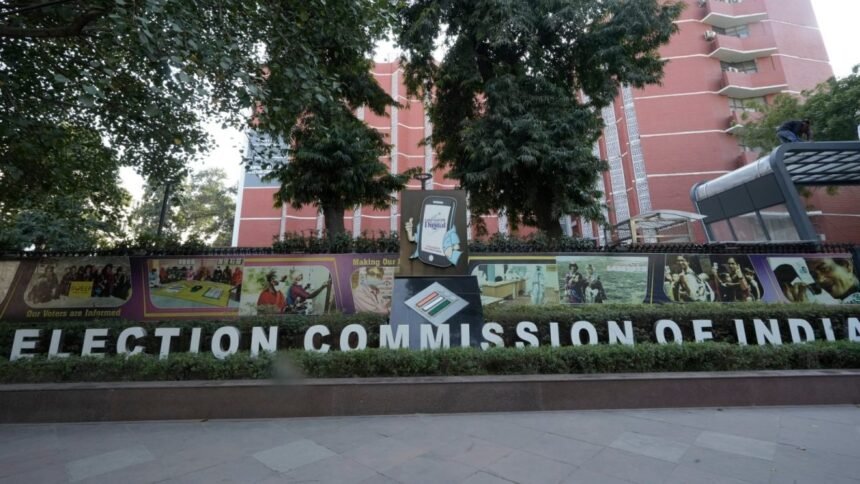
Election Commission (Photo: PTI)
Did nearly one lakh votes mysteriously disappear from a Varanasi constituency in what was described as “vote jihad”, or do the official numbers tell a very different story?
A political controversy has erupted in Uttar Pradesh after state minister Ravindra Jaiswal alleged large-scale irregularities in the voter list revision process in Varanasi, claiming that nearly one lakh votes were reduced from his assembly segment. The Election Commission of India, however, has rejected the allegation following preliminary verification.
The row began on February 12 when Jaiswal held a press conference in Varanasi, questioning the ongoing Special Intensive Revision (SIR) of electoral rolls. He alleged that married women aged between 30 and 40 were registered under their father’s names and that some voters were listed two to three times across different booths with identical details. Calling it a “major irregularity”, he submitted a memorandum to District Magistrate Satyendra Kumar, demanding a comprehensive review.
Amid mounting political heat, Uttar Pradesh Chief Electoral Officer (CEO) Navdeep Rinwa visited Varanasi and addressed the media. He said the list of allegedly fake or duplicate voters provided by the minister had been examined.
“In the first phase of verification, around 4,500 voters were checked. Only nine were found to be duplicate,” Rinwa said, effectively countering claims of widespread manipulation.
According to officials, a total of 9,000 names had been submitted for scrutiny. Most discrepancies found were attributed to double form submissions or technical overlaps rather than deliberate fraud. The CEO maintained that there was no evidence of any organised attempt to tamper with the voter list.
Statewide Revision Exercise
Detailing the scale of the ongoing voter list revision across Uttar Pradesh, Rinwa said in the draft list published on January 6, notices are being issued to a total of 3.26 crore voters identified under two categories—1.04 crore under ‘No Mapping’ and 2.22 crore under ‘Logical Inconsistencies’. ‘No Mapping’ refers to cases where a voter’s name exists in the current electoral roll but cannot be matched with records from 2002 or 2005, placing them in the unmapped category. ‘Logical inconsistencies’ include discrepancies such as the same individual being registered at multiple locations or mismatches in age, address, or family details. So far, around 1.09 crore notices have been served, and hearings are being conducted simultaneously. Officials said action will be taken only after due verification, stressing that the objective of the exercise is to ensure accuracy and transparency in the electoral rolls.
Legal Action and Assurances
The CEO clarified that strict action would be taken only if it is proven that false information was deliberately furnished. Any attempt to manipulate the system by submitting incorrect forms could invite proceedings under Section 31 of the Representation of the People Act.
“No innocent voter will be harassed. Action will be based strictly on concrete evidence,” Rinwa said, stressing that maintaining the integrity of the electoral roll and public trust remains the administration’s top priority.
In the first draft, 12.55 crore names have been listed across Uttar Pradesh. More than 86 lakh applications have already been heard and processed. The deadline for corrections has been extended by a month to ensure eligible voters are included.
The final electoral roll will be published on April 10, 2026, and will serve as a permanent record for future elections, he said.
Varanasi, India, India
February 17, 2026, 15:13 IST
Read More