Last Updated:
Basavaraj Rayareddy blamed the state’s financial burden on the previous BJP & JDS regime, saying the legacy burden, and not guarantees alone, had created much financial strain




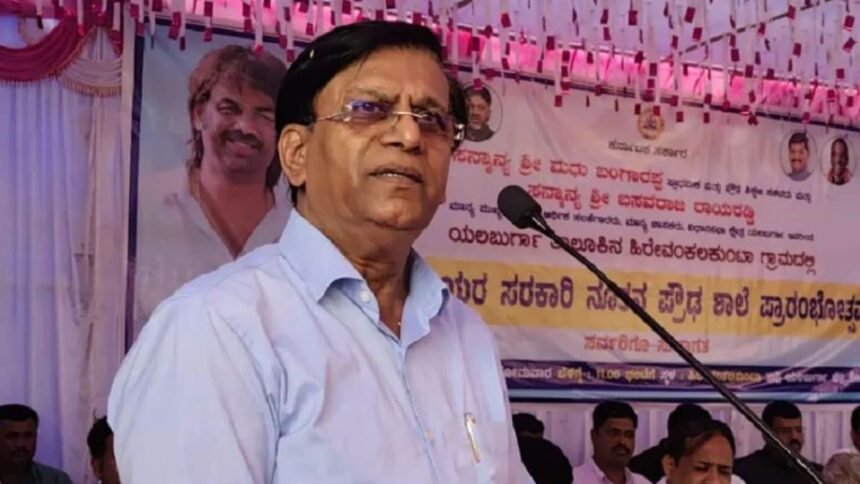
Karnataka chief minister’s economic adviser Basavaraj Rayareddy. (X)
The Karnataka government has been facing renewed internal pressure from its legislators and ministers, who have once again urged chief minister Siddaramaiah to re-examine the flagship guarantee schemes ahead of the March 6 state budget.
The Congress leaders have also asked Siddaramaiah to consider “riders” or “restrictions” on ensuring only BPL samplers avail the guarantees so that the state—which is under heavy financial strain—can find some relief and funds can be diverted to constituencies for development.
To fund the guarantees, the state has attempted to raise additional revenue through a series of measures, including increases in bus fares, fuel prices, stamp duty, property guidance values, liquor prices and vehicle cess. Proposals have also been floated to revise water tariffs, milk prices and transport fares. The government introduced a mineral rights tax and a one-time settlement scheme as well, though these have yielded limited returns.
However, according to the Karnataka chief minister’s economic adviser Basavaraj Rayareddy, “if you want development and welfare, prices will increase”. Speaking to News18, Rayareddy said: “Those who have money must pay taxes. If you compare with other countries, they provide more welfare and collect more taxes. In that sense, we are still moderate. Development work is going on in Karnataka.”
Concerns over the guarantee schemes’ impact on development spending have had ministers and MLAs complaining about shrinking funds for constituency projects. Siddaramaiah, however, ruled out scrapping the guarantees.
It is learnt that close to 25 legislators and a few ministers in the Siddaramaiah cabinet have expressed the view that the benefits should be restricted to economically weaker sections to ease the mounting fiscal burden.
Rayareddy said, “Yes, we agree that some APL families, government employees and even income-tax payers are benefiting from the schemes. Sometimes this happens. Let us see what has to be done regarding APL families and better-off sections. No decision has been taken yet in the budget,” he said.
Asked if eligibility checks will be part of the upcoming budget exercise, he said the matter would be decided on the ‘party platform’. The issue has repeatedly surfaced in Congress legislature party meetings.
The state economic adviser squarely blamed the state’s financial burden on the previous BJP and JDS regime, saying that when Basavaraj Bommai was chief minister, works worth about Rs 2.42 lakh crore were approved without adequate budgetary provision. Of this, he said, only around Rs 42,000 crore had been allocated, forcing the present government to continue paying over Rs 2,000 crore for those commitments since the Congress came to power.
Rayareddy told News18 that the legacy burden, and not the guarantees alone, had created much of the financial strain.
A section of Congress MLAs feels the schemes, which were central to the party’s sweeping victory in the 2023 assembly elections, are currently too expansive and are reaching households that may not actually need state support. Public works minister Satish Jarkiholi had earlier indicated that removing wealthy beneficiaries could save the state at least Rs 10,000 crore annually.
Industries and infrastructure minister MB Patil has also spoken in favour of tightening eligibility so that the schemes focus primarily on below-poverty-line households. Some leaders have suggested a voluntary “give-it-up” model, similar to the LPG subsidy surrender, so that financially secure beneficiaries step aside and funds can be redirected to poorer families.
On whether the government was facing pressure from Congress MLAs to restrict guarantee schemes to BPL families, Rayareddy said that while they acknowledged that economically better-off groups were benefiting, no decision had been taken on any restrictions yet. “Let us see what has to be done. It has to be discussed in the party forum, and the party has to take a decision on that,” Rayareddy said.
He claimed that the state was comfortable financially, but pointed out that the government had multiple commitments to meet and that the guarantee schemes were only one part of its welfare spending. He said the state was providing nearly Rs 1.20 lakh crore in subsidies to various sections of people, with the guarantees forming only a portion of that amount.
He explained that around Rs 52,000 crore was being spent on the guarantee schemes, of which nearly Rs 28,000 crore went towards Gruha Lakshmi, while the rest was distributed among Shakti, Anna Bhagya, Yuva Nidhi and other programmes.
Rayareddy said the government was also spending close to Rs 26,000 crore on providing free electricity to farmers’ pump sets, noting that there were about 36 lakh pump sets in the state and the entire power cost was borne by the government and paid to power corporations.
He added that nearly Rs 11,000 crore was being spent on social security pensions, including old-age and widow pensions, of which the Centre contributed only around Rs 4,000 crore.
Apart from this, he said the government was also funding student welfare measures such as mid-day meals, milk and uniforms, along with several other schemes. Taken together, he said, the state’s total direct welfare spending was close to Rs 1.20 lakh crore and such expenditure was necessary, as any government had a responsibility to support people.
In the 2025–26 budget, about Rs 51,034 crore was set aside for the five guarantees, slightly lower than the Rs 52,009 crore allocated the previous year. Overall expenditure for the year was estimated at a little over Rs 4 lakh crore, including revenue spending of around Rs 3.1 lakh crore, capital expenditure of Rs 71,336 crore, and Rs 26,474 crore towards loan repayments. The state planned borrowings of roughly Rs 1.2 lakh crore, with total liabilities projected to touch Rs 7.6 lakh crore.
The discussion has gathered momentum in the backdrop of recent Supreme Court observations on state-funded welfare measures, prompting speculation on whether Siddaramaiah’s government may introduce eligibility filters or new conditions.
The five guarantees—200 units of free power under Gruha Jyoti, free bus travel for women under Shakti, monthly assistance to women heads of households through Gruha Lakshmi, unemployment benefits under Yuva Nidhi, and additional food grains through Anna Bhagya—together impose a yearly burden of roughly Rs 55,000–Rs 60,000 crore on the exchequer.
Rayareddy said that the financial strain was not only because of subsidies and guarantee schemes, but also due to other commitments such as the implementation of the 7th Pay Commission, which had added nearly Rs 25,000 crore to the state’s salary expenditure. However, he added that capital expenditure this year would increase compared to the previous year and that development works would continue alongside welfare spending.
February 23, 2026, 16:26 IST
Read More