Last Updated:
Analysts suggest these ‘unique’ protests often gain international traction because they provide a ‘visual hook’ that is difficult for mainstream media to ignore




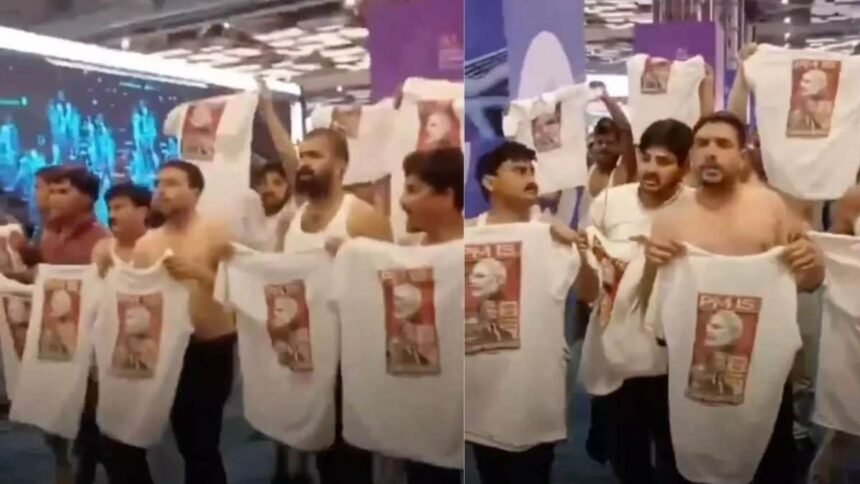
Indian Youth Congress protest at Bharat Mandapam, Delhi. (Image: X)
The Indian Youth Congress (IYC) staged a dramatic “shirtless protest” at the India AI Impact Summit in New Delhi this week. Dressed only in matching white trousers and holding t-shirts emblazoned with slogans like “Compromised PM” and “Pax Silica”, the activists disrupted the high-profile event at Delhi’s Bharat Mandapam. They were protesting against unemployment and the recently signed India-US trade deal, claiming it compromises national interests.
This “disrobing” tactic—which has received flak from several quarters and has been linked by the Delhi Police to recent Gen Z-led movements in Nepal—is part of a long tradition of unorthodox political theatre. Here are five of the most unique political protests from around the globe that turned the “mundane” into a message.
1. The Bed-In for Peace (Netherlands & Canada, 1969)
At the height of the Vietnam War, John Lennon and Yoko Ono used their celebrity status to stage one of the most famous non-violent protests in history. Instead of a traditional march, the newly married couple invited the world’s media into their hotel rooms in Amsterdam and later Montreal for a week-long “Bed-In”. Surrounded by hand-drawn posters reading “Bed Peace” and “Hair Peace”, they spent the entire week in white pyjamas, discussing global harmony with reporters. It was a masterclass in using the “honeymoon” trope to subvert war-mongering headlines.
2. Washing the Flag (Peru, 2000)
When Alberto Fujimori was re-elected amidst allegations of corruption and human rights abuses, Peruvian citizens did not just shout; they cleaned. Every Friday, hundreds of protesters gathered in front of the Presidential Palace in Lima to wash the Peruvian flag in buckets of soap and water. This symbolic act of “cleaning the nation’s honour” from “dirty politics” became a powerful, quiet ritual that lasted for months, eventually contributing to the public pressure that led to Fujimori’s resignation and flight to Japan.
3. The Pothole Gardeners (Canada & UK, Various)
Frustrated by government inaction over crumbling infrastructure, citizens in several countries have turned to “guerrilla gardening”. In 2025, activists in various UK municipalities began planting bright seasonal flowers and even small shrubs inside the deep potholes that local councils had failed to fix. By turning a traffic hazard into a miniature garden, the protesters forced the authorities into an embarrassing choice: either fix the road or be seen as the “villains” who destroyed a community flowerbed.
4. The Sex Strike for Peace (Liberia, 2003)
In one of the most effective displays of “soft power,” Nobel Peace Prize laureate Leymah Gbowee organised a sex strike among Liberian women to force an end to the country’s brutal civil war. The Women of Liberia Mass Action for Peace brought together thousands of Christian and Muslim women who refused intimacy with their partners until the violence stopped. This move, combined with non-violent sit-ins, successfully forced the warring factions to the negotiating table, eventually leading to the election of Ellen Johnson Sirleaf, Africa’s first female president.
5. The Umbrella Revolution (Hong Kong, 2014)
What began as a defensive measure became a global symbol of defiance. During the 2014 pro-democracy protests in Hong Kong, students used brightly coloured umbrellas to shield themselves from police pepper spray and tear gas. The image of a sea of yellow umbrellas against the grey urban backdrop transformed a common household item into a badge of the “Umbrella Movement”. It highlighted the disparity between the peaceful, unarmed protesters and the heavily equipped security forces, sparking a visual language of resistance that resonated worldwide.
Political analysts suggest that these “unique” protests—including the recent IYC display—often gain more international traction than traditional rallies because they provide a “visual hook” that is difficult for mainstream media to ignore.
February 22, 2026, 07:00 IST
Read More