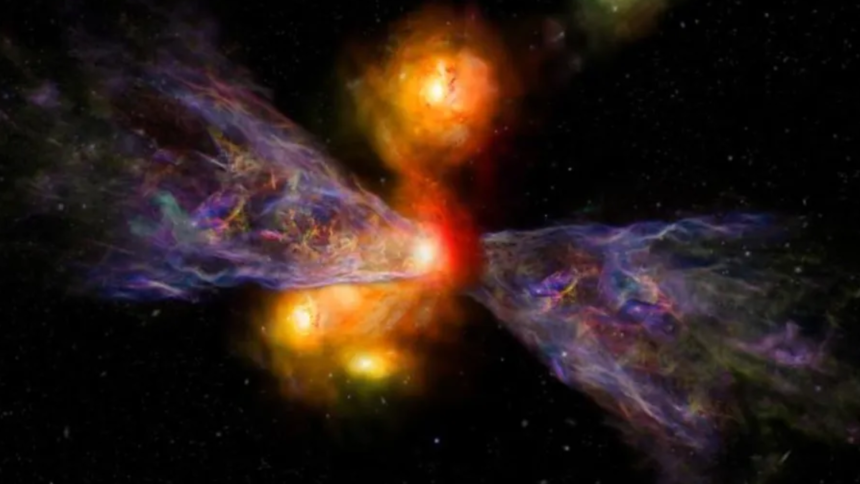
Early galaxies were supposed to be bursting with stars – but for decades now, researchers have wondered how many huge galaxies seem to have died out less than two billion years after the Big Bang. Now, with the help of the James Webb Space Telescope and the Atacama Large Millimeter/submillimeter Array, researchers believe they’ve uncovered the reason: an immensely strong galaxy killer wind that stops any future star formation in its tracks.
Caught in the Act: A Galaxy Devouring Itself
Published June 10 in Monthly Notices of the Royal Astronomical Society, the study by Rebecca Davies of Swinburne University of Technology presents the first direct evidence of such a wind. The team targeted CRISTAL-02, a merging galaxy system seen 1.1 billion years after the Big Bang. Combining ALMA’s [C II] observations with JWST’s NIRSpec spectrograph, they detected a cold gas plume extending 7 kiloparsecs at 640 kilometres per second — removing gas at twice the star formation rate. At this pace, the galaxy’s molecular fuel could be exhausted in under 100 million years.
A Cosmic Chain Reaction
It is not because of supermassive black holes; rather, it is supernovae that blow themselves up as exploding stars powered by star formation via mergers. The CRISTAL-02 system involves colliding galaxies with star formation happening at a rate of around three times higher than the usual one for such mass and cosmic epoch. With the largest stars exploding, their energies gave rise to the wind blowing away from the galaxy. In fact, about half of the massive galaxies during this period went through significant mergers. If such winds were common, they could account for the dead galaxies in the cosmos.
Get your daily dose of tech news, reviews, and insights, in under 80 characters on Gadgets 360 Turbo. Connect with fellow tech lovers on our Forum. Follow us on X, Facebook, WhatsApp, Threads and Google News for instant updates. Catch all the action on our YouTube channel.
JWST, James Webb Space Telescope, ALMA, CRISTAL-02, Galaxy Evolution, Star Formation, Supernovae, Early Universe, Astronomy, Astrophysics, Cosmic Winds, Galaxy Mergers