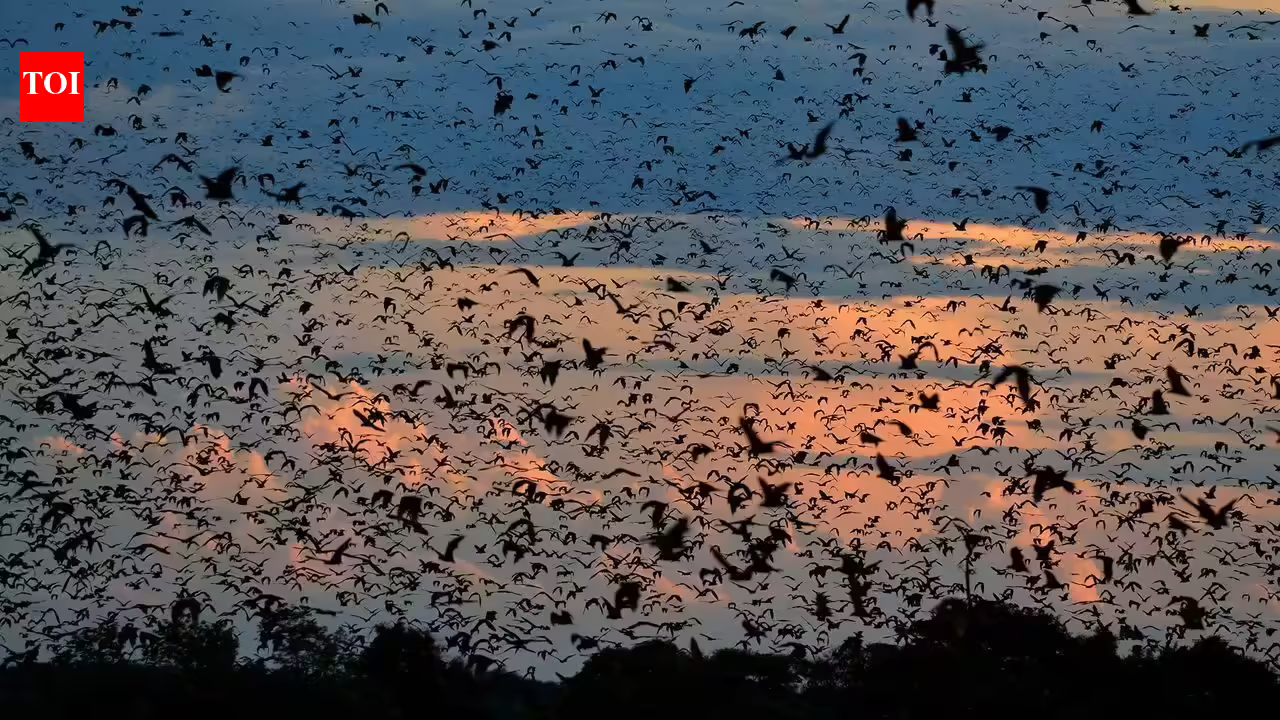
On certain evenings in late October, the central Zambezi woodlands in northern Zambia begin to feel slightly off balance. Not visibly at first. It is more a change in pressure, as if the forest has taken in too much air and is holding it. Deep inside Kasanka National Park, branches dip under unseen weight and the canopy starts to carry sound before anything else moves.As reported by The BBC, from the platform at Musola Hide, the roost is partly visible, though “visible” is generous. The trees are packed so tightly that the bats only become clear in motion. At rest they merge into the wood and shadow. Then, slowly, the first breakaway happens. One or two lift, hesitate, and are gone. After that, the hesitation disappears.
The seasonal arrival of Africa’s largest bat gathering
The roost sits in dense swamp woodland where daylight barely reaches the ground in any consistent way. Trees grow close together, branches interlock, and the entire space feels slightly compressed even in daylight. When the bats settle during the day, they are not easily distinguished as individuals. They become mass first, detail later. At certain angles, the weight alone gives them away. Branches bend in ways that look too deliberate to be natural, sagging under what appears to be nothing until the eye adjusts.Then the evening changes everything. Not suddenly, but in steps that are easy to miss unless you are already watching closely. The straw-coloured fruit bats, or Eidolon helvum, arrive at Kasanka seasonally, drawn by fruiting cycles across Central Africa. By the time they settle in the park, numbers are often estimated in the millions, though no one presents the figure with much confidence. It is too large, too fluid.They feed heavily, then move again. In a single night, large colonies can strip vast amounts of fruit from the surrounding woodland, consuming and dispersing seeds across wide distances. The process is less tidy than it sounds. It is messy, repetitive, and constant.
Discovering Kasanka’s lesser-seen wildlife
Away from the main roost, the landscape shifts into papyrus channels and flooded grassland. Morning is the best time to notice anything here, when mist sits low and the water feels closer than it should. This is where sitatunga appear, usually without warning. A female first, careful and slow. Then younger animals, and sometimes a male with spiralled horns that catch on reeds as he moves. They do not stay long. Once the space feels acknowledged, they withdraw again into vegetation that seems to close behind them.The wetland holds more than antelope. Hippos shift in deeper water nearby, mostly unseen except for sound and the occasional break on the surface. Birdlife carries much of the visible activity, with hundreds of recorded species moving through different layers of the park.
The comeback of Zambia’s hidden wilderness
By the late 1980s, Kasanka had changed drastically. Wildlife numbers had dropped sharply due to poaching, and large sections of the park were nearly empty. For a period, its status as a functioning national park was uncertain. Rebuilding happened in stages rather than through a single intervention. Under renewed management, infrastructure was slowly restored, basic routes reopened, and protection strengthened. Wildlife began to return, though unevenly. Some species recovered faster than others.Today, visitors often stay at Wasa Lodge, a lakeside base where water and woodland meet without a clear boundary. Nights there are rarely quiet in the conventional sense. Hippos, insects, distant movement in reeds. The forest never fully settles into silence.