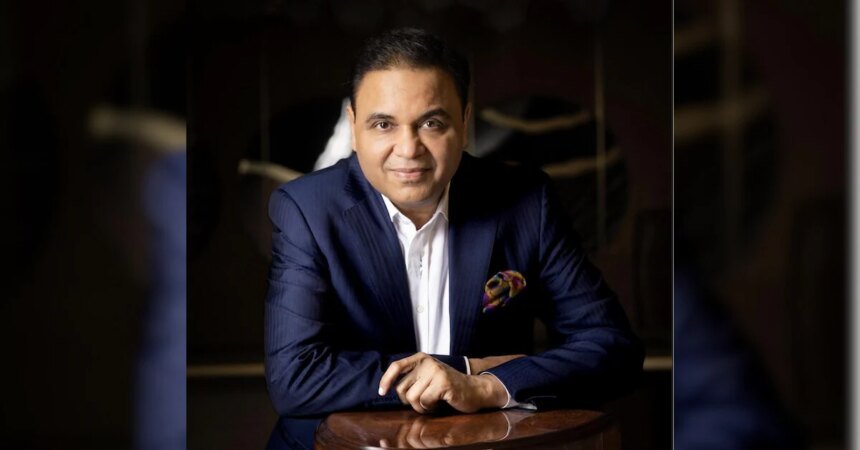
Himadri Speciality Chemical Ltd plans to deploy around Rs 1,300 crore in capital expenditure over the next year, as the speciality chemicals maker accelerates investments in lithium-ion battery materials, carbon-based advanced materials and other high-value products, said CMD and CEO Anurag Choudhary.
The company is also preparing another investment cycle of around Rs 1,500 crore in the following year and setting up India’s first commercial carbon nanotube manufacturing plant with an initial investment of Rs 70 crore, Choudhary said in an exclusive conversation with Business Standard.
The Kolkata-headquartered company completed the acquisition of a 100 per cent stake in Odisha’s Balasore-based Birla Tyres Limited, making it a wholly owned subsidiary effective April 2025. Having resumed production in May last year, the tyre unit, now running at 100 tonnes of production per day, is ramping up capacity every month. It has already recorded a top line of Rs 126 crore in Q1FY27.
Himadri has already outlined Rs 1,125 crore capex for its lithium iron phosphate (LFP) project, Rs 170 crore for super speciality carbon black and Rs 70 crore for a carbon nanotube project. “We are targeting Rs 30,000 crore in revenue from battery chemicals over the next six years with a series of investments to be rolled out in phases,” Choudhary said.
The company is positioning itself to build what Choudhary described as a raw-material component hub for lithium-ion cells, with capabilities spanning both cathode and anode materials. The strategy is aimed not only at meeting India’s rapidly growing battery manufacturing requirements but also at supplying global customers looking to diversify their sourcing away from China.
Unlike companies that specialise in either cathode or anode materials, Himadri intends to develop capabilities across both sides of the battery ecosystem. On the cathode side, it is setting up an LFP plant with an initial 2,000-tonne-per-annum capacity, followed by a 40,000-tonne-per-annum facility. The company is ultimately looking at capacity equivalent to around 100 GWh in five years.
Choudhary said the strategy could give India a stronger position in the global lithium-ion component manufacturing landscape, particularly because China currently dominates LFP production. “Today 100 per cent capacity of LFP is in China only. No company outside China in the world is making LFP. So, Himadri is going to pioneer this,” he said.
On the anode side, Himadri is developing capabilities in synthetic graphite, natural graphite and silicon-carbon materials. Choudhary said this combination could make Himadri a “one-stop shop” for battery manufacturers, with the ability to supply cathode materials as well as different types of anodes and customised blends.
Himadri is stepping up its focus on silicon-carbon materials, which could be a potential game changer for lithium-ion batteries. The company has developed its own technology and intends to establish a manufacturing plant. “We are evaluating potential locations for the project in Odisha, Andhra Pradesh and West Bengal,” he said.
Another emerging area for Himadri is carbon nanotubes. Choudhary described carbon nanotubes as a high-potential material because of their combination of strength, conductivity and light weight. “We will start with a 200-tonne plant in West Bengal and go for larger expansion subsequently. Targeted for commissioning in Q4FY27, the unit is expected to position Himadri among a select group of few global manufacturers serving this high-growth market,” he said.
Himadri is evaluating additional investments and capacity expansions across several states, with Odisha, Andhra Pradesh and West Bengal emerging as key locations for future growth. Choudhary said the company is evaluating a number of capex opportunities across different products and that West Bengal has increasingly moved to the top of its consideration for new capacity.
“We are advancing our entry into premium speciality applications through Super Speciality Carbon Black (SSCB), leveraging our fully integrated carbon black platform. SSCB is expected to deliver significantly higher value realisation across niche applications such as lithium-ion batteries, engineered plastic, fabrics, fibres, coating and conductive black. Supported by a proposed capex of Rs 170 crore, the project is targeted for commissioning in Q4FY28,” Choudhary said.
The company is also examining how artificial intelligence can be integrated across its operations, particularly manufacturing. “Himadri is looking at AI not as a standalone technology investment but as an integral part of business operations that can improve efficiency and sustainability,” he added.