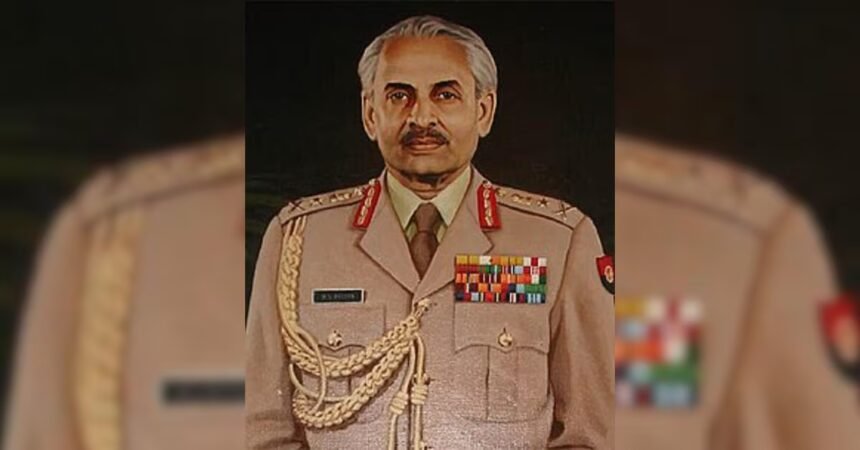
General Douglas MacArthur immortalised the line “Old soldiers never die, they just fade away.” This week, however, an Indian soldier, among the greatest and most decorated, personified this irony. Just that he did die to hostile fire, and was then allowed to fade away. It should raise some questions.
Some more facts. He was one among only six Indians to be awarded two Maha Vir Chakras (MVCs). His MVCs were earned in the most intense battlefields, 1965 and 1971. He rose to become India’s 13th Army chief. He retired on January 31, 1986, and yet died in the line of duty on August 10 later that same year as two assassins shot him at the wheel of his Maruti 800 in Pune.
The 40th anniversary of his assassination passed unnoticed. No commemoration, no memorials, not even a social media post from the ever-so-active Army handles. It’s as if there was a “corporate” call to erase all memory of General Arun Shridhar Vaidya.
Vaidya commanded his 9 Cavalry (Deccan Horse) with elan in the Battle of Asal Uttar (Khem Karan), where the pride of Pakistani Army, its 1 Armoured Division, was decimated. He then followed this up as commander of 16 (Independent) Armoured Brigade in the withering tank battles of Basantar, and Chakra and Dehira, with even greater distinction.
Somewhat more importantly, it was under his watch that two of the most storied cavalry regiments, 17 (Poona) Horse and 4 (Hodson’s) Horse, collected a Param Vir Chakra (2nd Lt. Arun Khetarpal, posthumous, whose story featured in Hindi film Ikkis), two more MVCs besides Vaidya’s, and three Vir Chakras (VrCs) for 4 (Hodson’s) Horse squadron commanders, and two (both posthumous) for his engineering support group. Clearing minefields under fire is as dangerous as fighting from inside a tank, if not more so.
If Basantar was the battle of all tank battles, Asal Uttar/Khem Karan is the most fateful and decisive battle in the subcontinent’s warfare. Vaidya’s regiment was at the forefront, though its Shermans were outranged, outgunned and out-protected by the Pakistani Pattons. The regiment won two more Vir Chakras. Indira Gandhi’s government cited this “battle experience” to make him the chief in 1983, superseding Lt Gen S K Sinha, although the decision was likely political. Sinha, a brilliant mind, was punished for his proximity with JP or Jayaprakash Narayan.
Soldiers, however senior, can’t determine their destinies, and especially so in democracies. Punjab deteriorated and although the Army had nothing to do with law and order there, the responsibility for clearing the Golden Temple fell on Vaidya’s shoulders.
Operation Bluestar remains the most traumatic event in the Army’s history, besides the debacle of 1962. Sikh militants drew up hit lists. Indira Gandhi was assassinated first. The generals who led Bluestar were next on the list. Vaidya, Gen Krishnaswamy Sundarji (western Army commander during Bluestar), his Chief of Staff Lt Gen Ranjit Singh Dyal and the division commander Major Gen K S “Bulbul” Brar.
Of the Delhi Congress politicians held responsible for the massacre of Sikhs, Lalit Maken and Arjun Das were assassinated within months of the massacres. Two assassins from the “Khalistan Commando Force”, Harjinder Singh “Jinda” and Sukhdev Singh “Sukha”, were now looting banks, killing policemen, and hunting for the targeted generals.
A bank robbery in Bombay by Jinda-Sukha showed they were closing in on Vaidya. His security was left casually to the Pune Police. So callous was the security that all he was given was a solitary police gunman. Constable Ramchandra Kshirsagar was left dazed in the back seat of the tiny Maruti as the assassins pulled along on an Ind-Suzuki motorcycle and shot Vaidya in the head. Kshirsagar, dazed, tried to get out of the car, but his foot got caught in the door. India’s greatest war hero was abandoned.
His wife Bhanu, sitting next to him, took four bullets but fortunately survived. Sukha and Jinda were caught subsequently, tried in Yerwada jail and hanged on October 9, 1992. They pleaded “not guilty” because they argued Vaidya deserved to be killed. I tracked the story along with Maseeh Rahman for India Today.
The Jinda-Sukha trial took place during the worst months of terror in Punjab. All institutions had collapsed, and the “media capitulation was complete,” as former Punjab chief secretary Ramesh Inder Singh writes in his magisterial Turmoil in Punjab (HarperCollins India, 2022) wrote. How complete, he explains with the example of a 21-page letter from Jinda and Sukha given to all publications with orders to publish in full on July 26, 1990. The UNI and PTI, he writes, circulated the full text. V N Narayanan, editor of The Tribune, visited by armed militants, published the entire text, across three pages.
There was shock and embarrassment within the Army. The rest were now fully protected. The need to keep the Army out of a Bluestar-type operations was acknowledged. The National Security Guard, founded on October 16, 1984 found new priority. It also culminated in the founding of the lightly-armed Rashtriya Rifles for the Kashmir Valley on October 1, 1990. Yet, Lt Gen Brar — by then retired — faced an attempt on his life (on September 30, 2012) while walking in London’s Mayfair. He fought down his attackers and featured in a WalkTheTalk with me at his home in Mumbai’s highest security zone.
My first conversation with Vaidya came fortuitously on a fraught morning. The previous day (February 19, 1982) Naga rebels had ambushed a convoy of the 21st battalion of the Sikh Regiment and killed 20 soldiers, including a Major. There was still only one hopping flight between Calcutta and Imphal, via Gauhati.
Vaidya, then eastern Army commander, was on it from Calcutta. I hopped in at Gauhati and was seated next to him. Both of us were drawn by the same “story” and headed for the ambush site, Namthilok on the highway to Ukhrul. Trying to engage an unhappy general, I used some commiseration, even indignation at the loss of life.
Vaidya turned, deadpan, and said, you won’t understand our profession. People die and sometimes the bodies are not found. In the same forests and mountains during World War II, thousands of bodies were not found, probably eaten by jackals. Soldiering is not for the faint-hearted.
Later, he featured in a cover story on India’s defence modernisation that I wrote for India Today’s November 15, 1985 edition. The story contained interviews with all three chiefs. Two things endure from that conversation with Vaidya. The first, on the dilemma of taking on your own countrymen. He had clarity: “Any person who takes up arms against his country’s lawfully elected government is a traitor. That is our definition of the word enemy.”
On post-Bluestar desertions: “This was a case of tribal loyalties getting the better of national loyalties in some cases. Don’t forget that of the 75 predominantly Sikh units I have, there was trouble in only 8…trouble only took place in those units where the propaganda and instigation was stronger and the command weaker.”
Vaidya was warned multiple times of the threat to his life. He was philosophical. “I fought two wars and came out without a scratch, and if a bullet has my name on it, it will find me.” That’s what happened on August 10, 1986. Did our “system” fail him in making the assassins’ task so easy? And did it fail him yet again this week by not even taking note of the 40th anniversary of his supreme sacrifice? Should all old soldiers, even your greatest war heroes, be made to fade away into anonymity like Vaidya? It’s a question also for the Army as an institution.
Postscript: The line MacArthur immortalised is originally drawn from a World War I British Army marching song. It’s loaded with cynical humour. As if, who cares for us soldiers once we are gone. Vaidya deserved this fate least of all.
By special arrangement with ThePrint