Last Updated:
BJP’s Nitin Nabin ushers in a younger, more diverse national team, signalling major organisational changes from the JP Nadda era.




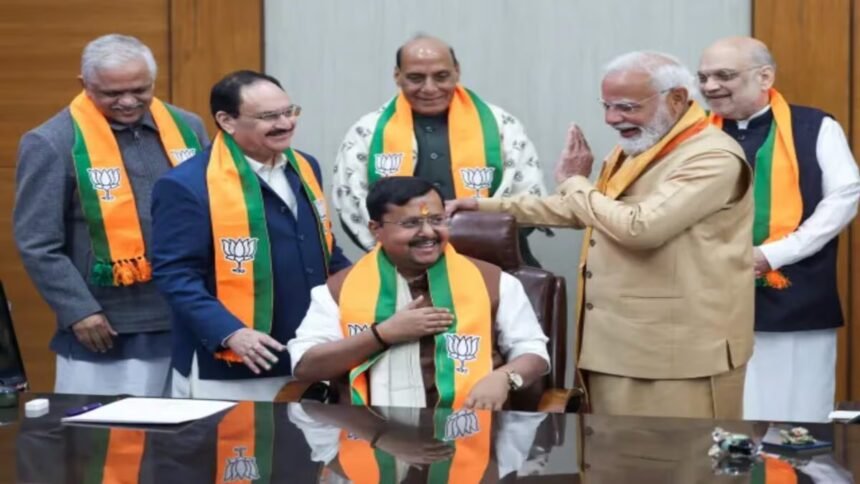
Newly elected BJP National President Nitin Nabin takes charge in the presence of Prime Minister Narendra Modi, Union Ministers Amit Shah, Rajnath Singh, Nitin Gadkari, and Union Minister and outgoing BJP National President JP Nadda, at the party headquarters in New Delhi on Tuesday. (Narendra Modi Photo Gallery/ANI Photo)
The Bharatiya Janata Party on Monday announced a major organisational reshuffle under party president Nitin Nabin.
The new national team under Nabin marks a shift from the organisational style associated with former president JP Nadda, bringing a mix of experienced leaders and younger faces into the party’s national structure.
The transition towards a younger team had been expected after the BJP elevated Nabin, 46, as the youngest president in the party’s 46-year history. The BJP was established on April 6, 1980, while Nabin became its 12th president on January 19 this year.
From Nadda Era To Nabin Team
The two phases represent successive periods of BJP organisational leadership. Nadda served as national president from January 2020 until early 2026, after previously working as the party’s working president and as a close organisational associate of Amit Shah.
Nadda oversaw the BJP’s 2024 Lok Sabha campaign and several state elections. He was often used as the party’s crisis manager and negotiator, including during the 2026 CJP protests in Ladakh.
His style was largely low-profile and focused on organisational control, candidate selection and alliance management.
Nabin, meanwhile, is a five-time Bihar MLA and former state minister. He became the BJP’s youngest-ever national president after the party’s organisational elections, known as ‘Sangathan Parv’, in January 2026.
Within the party, he is being projected as a next-generation leader who can combine organisational discipline with a more visible and outreach-focused approach ahead of the 2027 Assembly elections and the longer run-up to 2029.
What Defined Team Nadda
Under Nadda, the BJP’s national organisation relied on tight central control through a small group of trusted general secretaries. B L Santhosh, the party’s general secretary (organisation), remained a key organisational figure.
The party also made strategic changes to its leadership, moving some high-profile leaders out of important positions while promoting relatively low-profile but loyal organisational workers.
Nadda was frequently deployed as the government’s face during sensitive negotiations, including with protest groups and in restive regions. This allowed governmental resolution to remain separate from overt political messaging.
The team was also heavily focused on the 2024 Lok Sabha election and subsequently on retaining the BJP’s position in key Hindi-belt states, with established state chiefs and regional coordinators playing an important role.
Nabin’s Younger, Broader Team
The contours of Team Nitin Nabin point towards a generational and representational reset.
The new national team is expected to have an average age of below 55, with greater space for leaders in their 40s and early 50s. The reshuffle is also being presented as more inclusive, with increased representation for women and OBC, SC and ST communities.
At the same time, the new team retains experienced organisational figures. B L Santhosh remains general secretary (organisation), while seasoned leaders such as Vasundhara Raje, Ram Madhav and others have been brought in as national vice-presidents.
The BJP has also begun reorganising its state units. In election-bound Uttar Pradesh, all six regional chiefs were replaced and a new team of vice-presidents, general secretaries and secretaries was announced.
Smriti Irani Returns, Amit Malviya Replaced
The national appointments announced by Nabin include 13 national vice-presidents, among them Vasundhara Raje Scindia, Ram Madhav, Tirath Singh Rawat, D Purandeshwari, Bharti Pawar, Manpreet Singh Badal and Tariq Mansoor.
The general secretary list includes Gajendra Patel, Harish Dwivedi and Sanjay Bhatia, while B L Santhosh has been retained in the organisation role.
Eight national general secretaries have been appointed in the political and coordination stream, including former Union minister Smriti Irani, marking her return to a top organisational role after leaving the Cabinet in 2024.
The party has also appointed 16 national secretaries and several joint general secretaries to handle regions, communities and organisational fronts.
The reshuffle has also brought a change in the BJP’s IT organisation. Amit Malviya has been replaced as the party’s IT cell chief by Deepak Mhaskey of Chhattisgarh.
Malviya had headed the BJP’s national IT cell for more than a decade. He had also served as co-incharge of West Bengal, where the party recorded a landslide victory in the Assembly polls.
2027 And 2029 In Focus
The difference between the two teams is also visible in their strategic priorities. Team Nadda was built around the 2024 Lok Sabha election and consolidation in key states.
Team Nabin is being shaped around the 2027 Assembly battles and longer-term positioning for 2029, alongside a state-level organisational overhaul beginning with Uttar Pradesh.
The Nabin team is being projected as younger, more visible and more focused on outreach and narrative, while the Nadda era was marked by a low-profile, control-room style and crisis management.
The reconstituted parliamentary board, chaired by Prime Minister Narendra Modi and including Nadda, Amit Shah, Rajnath Singh and others, will set the strategic line for the run-up to 2029.
Key Questions Answered
 Ask News18
Nitin Nabin’s leadership is expected to bring a generational and representational reset to the BJP’s strategy, focusing on a mix of younger leaders and experienced figures. The new national team is anticipated to have an average age below 55, with increased representation for leaders in their 40s and early 50s. This reshuffle signals a renewed focus on organisation, leadership, and long-term political strategy ahead of the 2029 Lok Sabha elections.
Ask News18About the Author

Shuddhanta Patra is an Indian journalist with about nine years of experience in covering national politics, geopolitics, defence, diplomacy and international affairs. Her reporting focuses on South As…Read More
Delhi, India, India
August 17, 2026, 17:20 IST
Read More