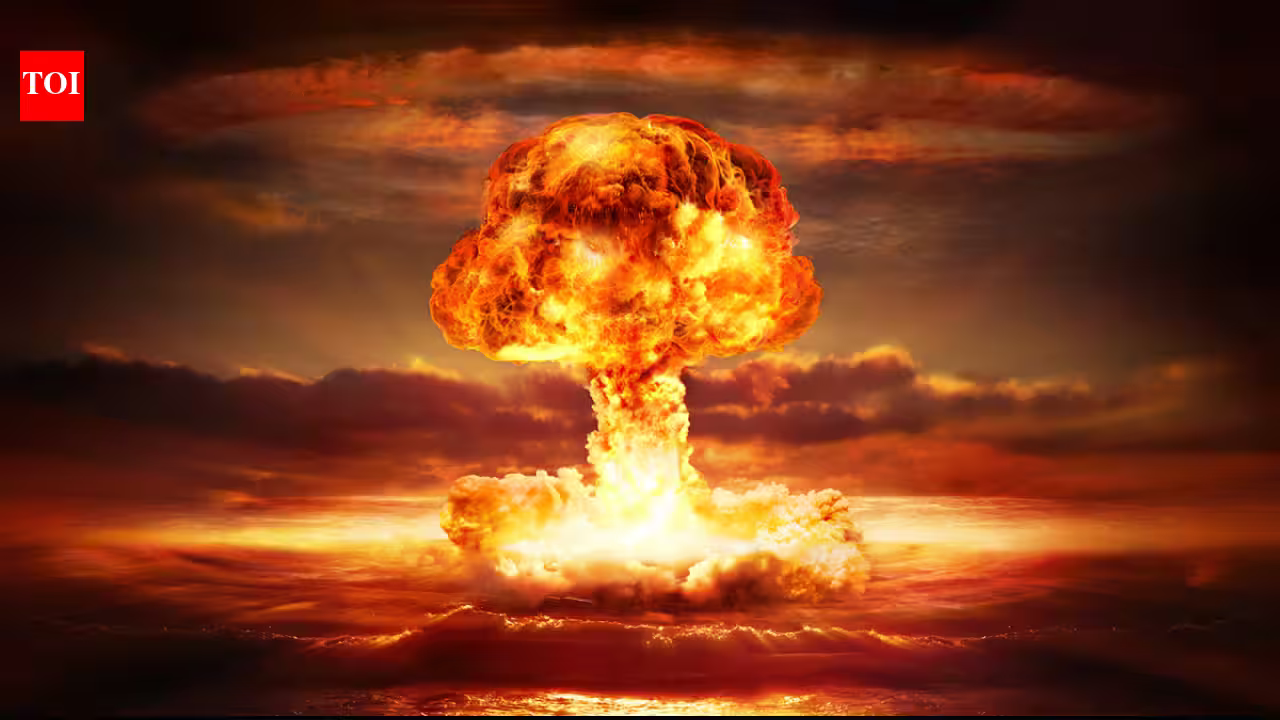
In August and September 1958, the United States military carried out a secret series of high-altitude nuclear tests in the remote upper reaches of the South Atlantic Ocean. Code-named Operation Argus, the operation involved launching three low-yield nuclear devices between 100 and 500 kilometres into space. The explosions created artificial auroras that appeared across the night sky and produced temporary radiation belts around the Earth that lasted for weeks. The tests were designed to investigate an idea proposed by physicist Nicholas Christofilos. He believed that detonating nuclear weapons above the atmosphere would release high-energy electrons that could become trapped by the Earth’s magnetic field.According to educational material maintained by NASA’s Goddard Space Flight Center, this cloud of charged particles could form a shell around the Earth, creating an artificial radiation barrier. Military planners hoped such a high-altitude radiation belt could damage the guidance electronics of incoming Soviet intercontinental ballistic missiles or interfere with radar systems during a nuclear war.To carry out the tests, the US Navy formed Task Force 88, a secret fleet of nine ships centred around the research vessel USS Norton Sound. Operating about 1,800 kilometres southwest of Cape Town, South Africa, the fleet launched three modified X-17A rockets carrying 1.7-kiloton W-25 nuclear warheads. The South Atlantic location was chosen because the Earth’s magnetic field is unusually weak there, a feature known as the South Atlantic Anomaly. This allowed the injected electrons to become trapped more easily above the atmosphere.
A high-altitude laboratory in space
The first warhead, Argus I, was detonated on 27 August at an altitude of about 200 kilometres. Argus II followed on 30 August at 256 kilometres. Argus III was launched on 6 September and reached an altitude of 539 kilometres. For years, the final launch remained the highest-altitude nuclear explosion ever carried out by the United States. The explosions released large amounts of radioactive material that produced energetic electrons through beta decay. Almost immediately, bright artificial auroras appeared along magnetic field lines. They were also seen in the region near the Azores islands in the North Atlantic. Scientists used the Explorer 4 satellite to study the effects. The satellite had been placed into an inclined orbit shortly before the tests. Aircraft and ground stations equipped with magnetometers, radar systems and radio receivers also tracked the trapped particles and their movement over time. Data recorded by NASA’s Goddard educational archives confirmed that the explosions had created artificial belts of trapped electrons around the Earth. The electron shell remained for several weeks before gradually disappearing into the upper atmosphere.
Limitations of the Christofilos effect
Operation Argus showed that nuclear explosions could change the space environment around Earth, but it also revealed major practical limits. The artificial radiation belts disappeared much faster than Christofilos had expected. This meant that using such a belt as a missile defence would require repeated nuclear explosions in space. The tests also showed that high-altitude nuclear explosions could cause major radio blackouts and radar interference. This disruption affected long-distance radio communications, showing that an attempt to interfere with enemy weapons could also damage friendly radar systems and satellite communications. Details of Operation Argus remained secret until March 1959, when reports of the South Atlantic explosions reached the press. The US government later released scientific papers about the tests, describing them as research experiments aimed at studying the Earth’s magnetic field and space environment.The lessons from the 1958 operation helped prepare the way for later high-altitude nuclear tests, including the much larger Starfish Prime test over the Pacific Ocean in 1962. However, the harmful effects of nuclear explosions in space, including satellite damage and long-lasting radiation, also helped build support for international limits on space-based nuclear testing. In 1963, the United States, the Soviet Union and the United Kingdom signed the Limited Test Ban Treaty. It banned nuclear tests in the atmosphere, outer space and underwater, bringing an end to efforts to create artificial radiation belts above the Earth.