Sports
oi-Swastika Sruti

India made an impressive batting effort in the second ODI match between India and the West Indies, where India managed to score 406 runs in the second ODI match.

India successfully chased 406 runs against West Indies in the second ODI, marking the second-highest successful run chase in history, featuring Shubman Gill’s second ODI double century and Rohit Sharma’s century.
It was the biggest run chase that India ever did, and this achievement also marked yet another record in the name of Shubman Gill, who scored the second ODI double century in his career. This double century was made possible by Gill’s successful partnership with Rohit Sharma.
India Pull Off Second-Highest Chase In ODI History
West Indies managed a mammoth score of 405 runs, and India needed 406 runs to win.
But India was not perturbed by the size of the total set by West Indies. India started playing aggressively right from the start and maintained a reasonable required run rate.
This successful chase is the second-largest run chase ever seen in ODIs. The only larger run chase in ODIs was recorded in the unforgettable ODI in 2006 between South Africa and Australia in the New Wanderers Stadium, Johannesburg.
A night for the 𝗵𝗶𝘀𝘁𝗼𝗿𝘆 𝗯𝗼𝗼𝗸𝘀 📚✨#TeamIndia register their highest successful ODI run chase to take an unassailable 2️⃣-0️⃣ lead in the series 👏👏
Scorecard ▶️ https://t.co/6XCYRtZLAi#INDvWI | @mflone_ pic.twitter.com/wiEGxX2pCt
— BCCI (@BCCI) September 30, 2026
In that game, South Africa managed to chase Australia’s huge total of 434 runs, which made it one of the most famous run chases in ODI cricket.
Moreover, this game was also significant for being the first time that Australia had managed a 400-plus score in an ODI innings.
Shubman Gill Scores His Second ODI Double Century
The biggest individual highlight of India’s chase was captain Shubman Gill’s second ODI double century.
Gill had earlier scored his first ODI double hundred against New Zealand in Hyderabad in January 2023. He repeated the achievement against West Indies in Guwahati.
While chasing 406, Gill reached his century in just 62 balls and continued attacking even after reaching three figures.
He eventually brought up his double century from 117 balls, producing another extraordinary innings in a high-pressure chase.
Gill has now joined an exclusive group of players to score multiple double centuries in ODI cricket.
Gill Breaks Ishan Kishan’s Record For Fastest 150
Gill also created another record during his breathtaking innings.
He reached 150 runs in only 89 balls, breaking the previous Indian record held by Ishan Kishan.
Kishan had scored 150 runs from 103 balls against Bangladesh in 2022. Gill bettered that mark by reaching the landmark 14 balls faster.
His aggressive approach meant that West Indies struggled to find a way to stop India’s scoring during the chase.
Gill And Rohit Put India In Command
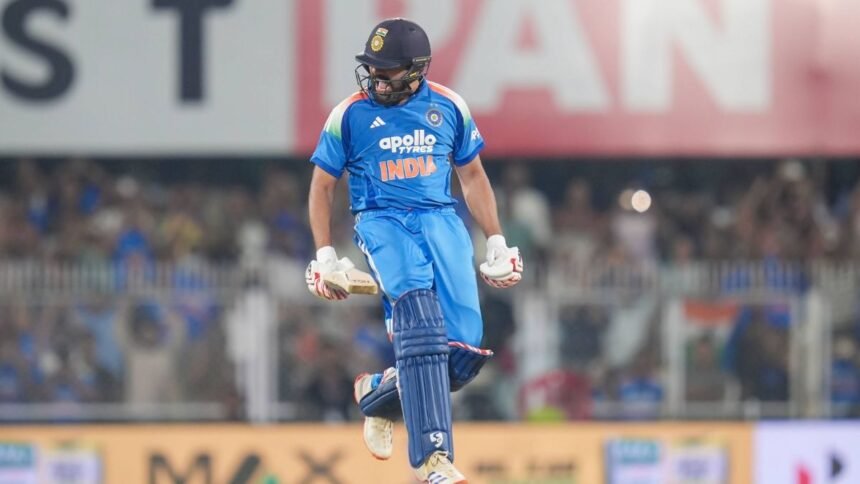
Gill received excellent support from experienced opener Rohit Sharma.
The two openers put together a huge 255-run partnership, which ranks among the highest opening partnerships by an Indian pair in ODI cricket.
Rohit scored 101 runs from 75 balls before his innings came to an end. His century gave India a strong platform and allowed Gill to continue playing aggressively at the other end.
Even after Rohit’s dismissal, Gill did not slow down and continued to push India closer to the massive target.
Rohit Still Holds The Record For Most ODI Double Centuries
Gill’s second double century puts him closer to Rohit Sharma’s unique ODI record.
Rohit remains the only batter to have scored three double centuries in men’s ODI cricket. He achieved the feat against Australia in 2013 and twice against Sri Lanka, in 2014 and 2017.
With Gill now having two ODI double centuries, the Indian captain has moved into an elite group and has the opportunity to challenge Rohit’s record in the future.