Last Updated:
The three engagements come at a time when the Constitution and Ambedkar’s legacy have become important political battlegrounds between the BJP and the Opposition.




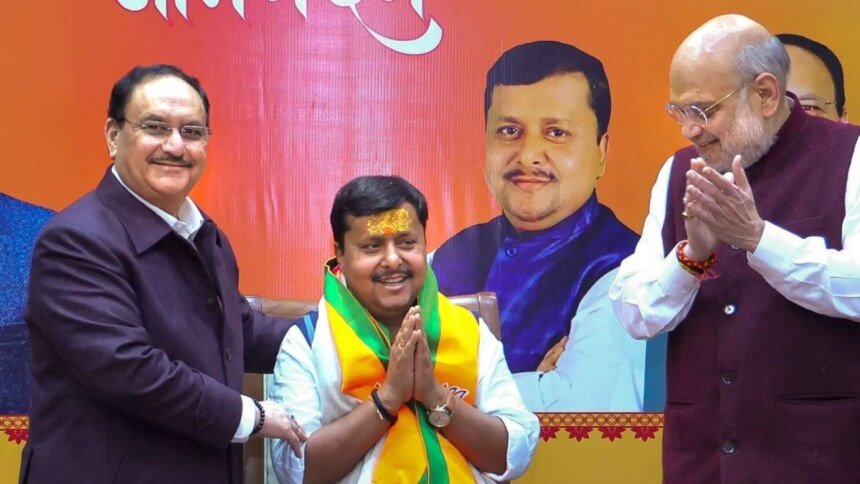
The political significance of the occasion has grown over the years, particularly as the BJP and the Opposition have increasingly contested the question of who represents Ambedkar’s legacy and who can claim to be the defender of the Constitution. (File Photo: X/Amit Shah)
On Constitution Day, the BJP will deploy its current national president and two of his predecessors across three regions of the country, underlining the political importance the party attaches to the occasion and its effort to shape the national discourse around the Constitution and its chief architect, Dr BR Ambedkar.
Union Home Minister Amit Shah will lead the party’s programme in Delhi, BJP national president Nitin Nabin will be in Patna, while former party president and Union Health Minister JP Nadda will attend an event in Gujarat.
The three engagements, spanning north, east and west India, come at a time when the Constitution and Ambedkar’s legacy have become important political battlegrounds between the BJP and the Opposition. The party’s decision to involve its present and two former national presidents also signals that the exercise is being accorded importance beyond routine commemorative events.
In Delhi, Shah will be the chief guest and keynote speaker at the BJP’s ‘Samvidhan Gaurav Diwas Samaroh’ at the Civic Centre. Chief Minister Rekha Gupta will also address the gathering, which is expected to include MPs, intellectuals, professionals, teachers and students.
In Patna, Nitin Nabin will inaugurate the Constitution Day programme at Gyan Bhawan at 2 pm. The event is expected to bring together representatives from different fields, including education, law, industry, commerce and sports, to discuss constitutional values and social justice.
In Gujarat, Nadda is expected to participate in the BJP’s main programme at Ahmedabad’s Tagore Hall, alongside Chief Minister Bhupendra Patel and state BJP president Jagdish Vishwakarma.
Significance Of November 26
November 26 marks the day the Constituent Assembly adopted the Indian Constitution in 1949. It came into force on January 26, 1950.
The Narendra Modi government formally designated November 26 as Constitution Day in 2015, coinciding with the 125th birth anniversary year of Ambedkar, who chaired the Constitution’s Drafting Committee. Before that, the date was observed as National Law Day, primarily by the legal fraternity.
The decision to institutionalise the occasion also gave the BJP an opportunity to foreground Ambedkar’s contribution to nation-building and take the Constitution beyond the traditional observance of Republic Day.
The political significance of the occasion has grown over the years, particularly as the BJP and the Opposition have increasingly contested the question of who represents Ambedkar’s legacy and who can claim to be the defender of the Constitution.
In 2024, then BJP president JP Nadda declared: “We can say with pride that we are the champions of the Constitution.” He also questioned why it had taken 65 years after Independence for the country to begin formally celebrating Constitution Day, taking a swipe at the Congress.
Last year, Amit Shah, in his Constitution Day message, said the Constitution provides every Indian with equal opportunities, a dignified life, national duties and rights. He credited Modi with initiating Constitution Day to make citizens more aware of democratic values.
Delhi BJP president Harsh Malhotra has also described the Constitution as “not just a book” but “a document of the faith and aspirations of 140 crore Indians”.
Who Owns Ambedkar’s Legacy?
For the BJP, the Constitution Day exercise is also about making a larger political argument: that Ambedkar’s legacy and the constitutional ideals he championed cannot be viewed through the prism of any one political party or family.
The party has sought to highlight initiatives such as the constitutional status granted to the National Commission for Backward Classes and the 10 per cent reservation for economically weaker sections as examples of its commitment to constitutional principles.
The Opposition, particularly the Congress, has meanwhile sought to make the defence of the Constitution a central political plank, raising questions about institutional independence, federalism, civil liberties and the protection of constitutional rights.
This makes November 26 more than a ceremonial occasion. It has become a platform for competing political claims over who best represents the Constitution’s founding ideals.
At the heart of the contest are three questions: who represents Ambedkar’s legacy, who is genuinely defending the Constitution, and what kind of Republic did the members of the Constituent Assembly envision?
By sending its current and two former national presidents to Delhi, Patna and Gujarat, the BJP is seeking to make its own case on all three.
Quick Answers
 Ask News18
On Constitution Day, the BJP deployed top leadership across three regions to underline the occasion’s political importance. Union Home Minister Amit Shah led the event in Delhi as the chief guest at the Civic Centre, BJP national president Nitin Nabin inaugurated the programme at Gyan Bhawan in Patna, and Union Health Minister JP Nadda attended the main event at Ahmedabad’s Tagore Hall in Gujarat.
Ask News18About the Author

Anindya Banerjee, Associate Editor brings over fifteen years of journalistic courage to the forefront. With a keen focus on politics and policy, Anindya has garnered a wealth of experience, with deep …Read More
November 25, 2026, 21:57 IST
Read More