Last Updated:
For treasury benches, speed and surprise solve a stubborn political deadlock by pairing a written 50 per cent seat expansion with a 25-year freeze on state-wise ratios until 2051




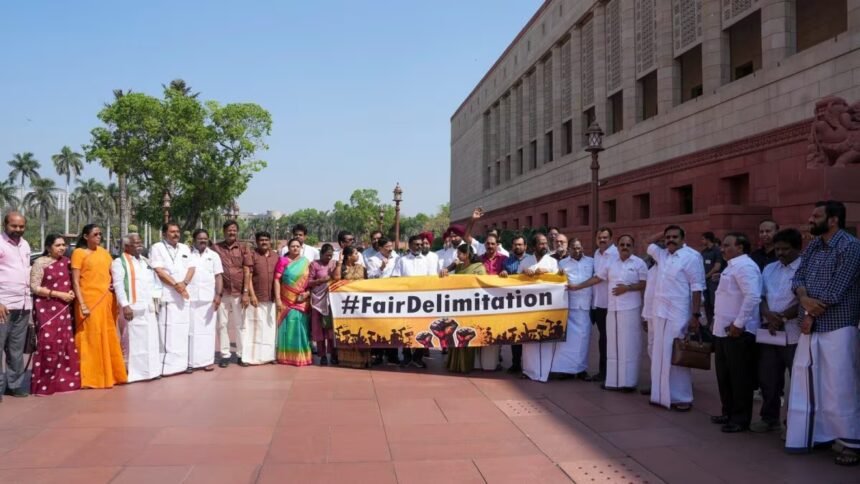
DMK MPs stage a protest over the issue of delimitation of parliamentary constituencies during the Budget session of Parliament. File pic/PTI
When Parliament reconvenes on November 30, 2026, for a four-day sitting ending December 3, it will not be a newly summoned Winter Session—nor, strictly speaking, a standalone special session. Procedurally, it is an extended continuation of the 2026 Monsoon Session, which was adjourned sine die on August 13 but never formally terminated.
That single constitutional distinction explains how the Union government summoned MPs on just four days’ notice to push through its revamped delimitation and 33 per cent women’s reservation package. It also raises pressing questions about why the Centre bypassed a full-fledged Winter Session, kept the legislative text tightly guarded until the final weekend, and opted for a compressed floor schedule.
The Constitutional Mechanics: Adjournment vs Prorogation
In parliamentary procedure, an adjournment sine die merely suspends a sitting indefinitely, whereas prorogation by the President formally brings a session to an end. Because the President never issued a prorogation notification after August 13, the Monsoon Session remained technically alive for 109 days—shattering the previous 87-day record set during the 2008 nuclear deal trust vote.
Calling a fresh Winter Session requires a Presidential summons and, by convention, at least 14 to 21 days’ advance notice for MPs. By keeping the Monsoon Session unclosed, Lok Sabha Speaker Om Birla and Rajya Sabha Chairman CP Radhakrishnan could reconvene both Houses immediately under existing rules. Moreover, keeping the session alive preserved the parliamentary status of the two companion bills held back in April—the Delimitation Bill and the Union Territories Laws (Amendment) Bill—allowing the government to withdraw and swap them mid-debate without starting the legislative process from scratch.
Under Article 85 of the Constitution, the only hard requirement is that no more than six months may elapse between two sittings. Extending the Monsoon Session is therefore entirely constitutional, though it has fuelled speculation in New Delhi over whether Parliament could skip a separate Winter Session altogether this year—a rare step previously taken only in 1975, 1979, 1984, and 2020.
Why the Secrecy and Urgency?
At A Glance
Parliament reconvenes from November 30 to December 3, 2026, as an extended continuation of the 2026 Monsoon Session.
The Monsoon Session remained technically alive for 109 days because the President never issued a prorogation notification after August 13.
Extending the Monsoon Session allowed the government to bypass the customary 14 to 21 days’ advance notice required for a fresh session.
The Constitution mandates under Article 85 that no more than six months may elapse between two sittings.
Parliament previously skipped a separate Winter Session in the years 1975, 1979, 1984, and 2020.
The Centre’s decision to announce the sitting on November 26 simply for “essential government business”—holding back the draft text of the Constitution (132nd Amendment) Bill until Friday evening—stems directly from its setback seven months earlier. In April 2026, the government’s earlier Constitution (131st Amendment) Bill fell 54 votes short of the mandatory 352 two-thirds threshold in the Lok Sabha after intense Opposition mobilisation over missing written safeguards for southern states.
In a regular three-week Winter Session, Opposition parties get weeks to coordinate floor protests, stall proceedings over unrelated controversies, and whip hesitant regional allies. By contrast, a tightly controlled four-day sitting—with Question Hour, Zero Hour, and Private Members’ Business suspended—locks the parliamentary agenda strictly to one decisive vote before political resistance can snowball.
At the same time, the electoral clock is ticking. With Uttar Pradesh assembly elections due in early 2027 and the next general election scheduled for 2029, constituting a Delimitation Commission immediately is critical if new boundaries and women’s quota seats are to be drawn in time.
The Democratic Trade-Off
For the treasury benches, speed and surprise solve a stubborn political deadlock by pairing a written 50 per cent seat expansion with a 25-year freeze on state-wise ratios until 2051. Yet Opposition leaders argue that rushing a sweeping constitutional amendment—one that reshapes parliamentary representation and state assemblies across India—without wider pre-legislative consultations or regular parliamentary scrutiny carries a steep institutional cost. Whether that gamble pays off will become clear when both Houses vote next week.
Quick Answers
 Ask News18
Because the 2026 Monsoon Session was adjourned sine die on August 13 but was never formally prorogued by the President, keeping it technically alive for 109 days under parliamentary procedure.
Ask News18About the Author

Pathikrit Sen Gupta is a Senior Associate Editor with News18.com and likes to cut a long story short. He writes sporadically on Politics, Sports, Global Affairs, Space, Entertainment, And Food. He tra…Read More
November 28, 2026, 01:56 IST
Read More