Asal Uttar translates to “the real answer”. In 1965, it was in a village of this name that a battle, which would turn a war decisively in India’s favour and deal “a fitting reply” to an armada of Pakistani tanks rolling towards Amritsar, Punjab, played out.
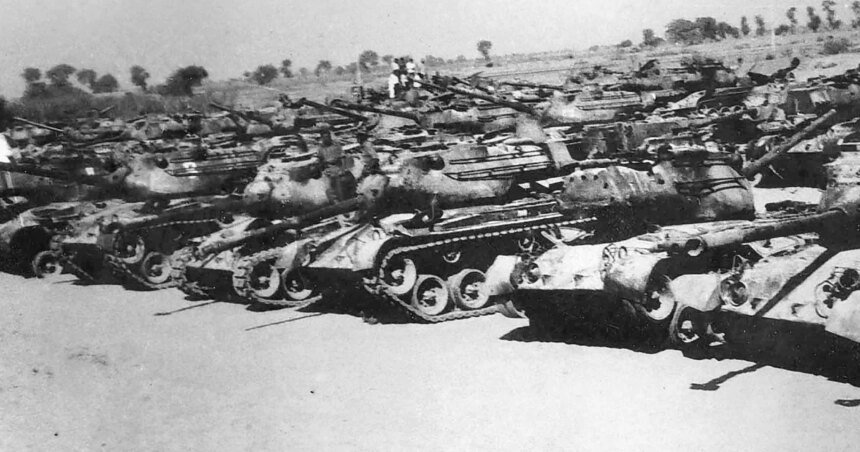
The Battle of Asal Uttar, one of the largest tank battles since World War II, took place from September 8 to 10 or 11. It was short but intense. When it ended, what remained was a graveyard of Pakistani tanks.
The year had begun with skirmishes in the salt marshes of Rann of Kutch, Gujarat, which escalated after Pakistan launched Operation Desert Hawk in the area. In the months that followed, Pakistani soldiers infiltrated Jammu and Kashmir (J&K) in Operation Gibraltar to spark an insurgency. A full-blown India-Pakistan war broke out, covering J&K, Punjab, Rajasthan, and, to some extent, West Bengal. In scale, it was far bigger than the wars of 1947-48, 1962, 1971, and 1999 (Kargil), with Indian troops marching well into Pakistan-occupied Kashmir to capture the Haji Pir Pass.
On September 8, equipped with American M47 and M48 Patton tanks, Pakistan’s 1st Armoured Division and 11 Infantry Division crossed the border at Punjab and started advancing towards Khemkaran, 5 kilometres into India. The objective was to capture
Amritsar and the bridge over the Beas River towards Jalandhar. Not only were the United States-supplied Pakistani tanks superior (the Patton tank was considered invincible), they also outnumbered India’s. The attack initially caught India’s 4 Mountain Division, positioned at Khemkaran, off guard, but the troops quickly reorganised themselves. Lieutenant General Harbaksh Singh, commander of the Western Command, ordered reinforcements, which included 2 (Independent) Armoured Brigade, commanded by Brigadier Thomas Krishnan Theogaraj. However, it soon became evident that force alone wouldn’t win the battle. The threat demanded strategic thinking and tactical execution.
Theogaraj ordered the troops to fall back. This was a tactical retreat, a strategy to lure Pakistani tanks deeper into Indian territory and use Asal Uttar’s geography to India’s advantage. The sugarcane fields were in a low-lying area. At night, Indian troops breached a canal and flooded them, creating a marshy trap. Then they hid in a horseshoe formation around those fields, and waited. The unsuspecting Pakistani tanks landed in the slush, and were jammed. It was an ingenious checkmate. Over 95 tanks were destroyed, and more than 40 were captured.
The Battle of Asal Uttar had many heroes, among them Company Quarter Master Havildar Abdul Hamid of 4 Grenadiers. Between September 8 and 10, Hamid took down several Patton tanks with his Jonga-mounted recoilless rifle before falling in the line of duty. He was awarded the Param Vir Chakra, posthumously.
The site of the battle, meanwhile, came to be known as “Patton Nagar”, given the sheer number of Pakistani tanks left behind.