Kolkata: Gold coins, sometimes weighing even less than a gram, are emerging as the new asset of choice for Gen Z buyers looking to join the runway rally in the bullion without breaking the bank.
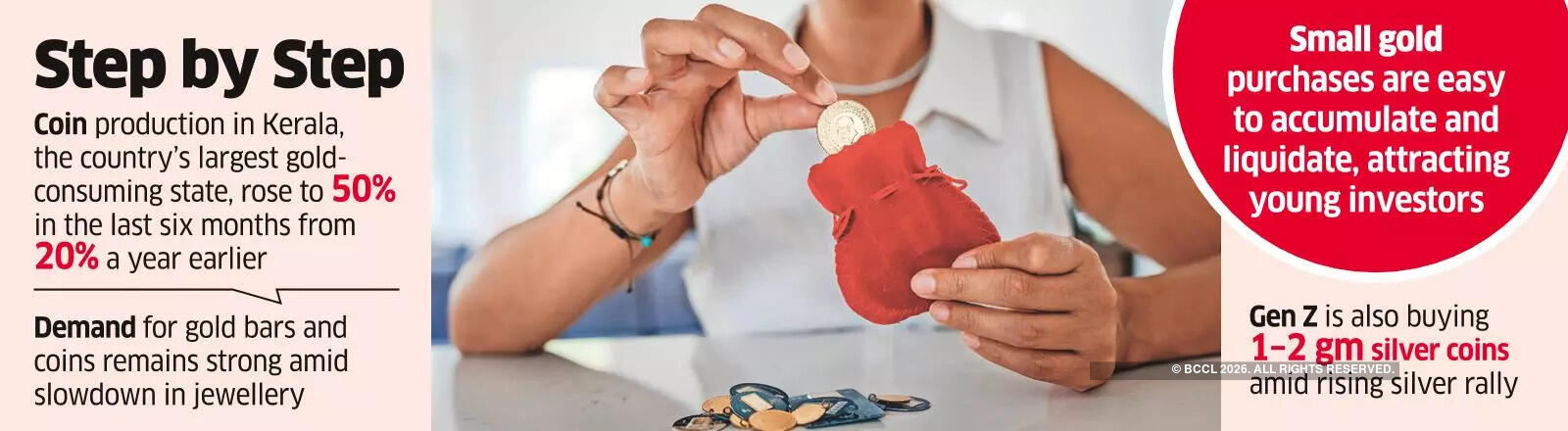
Manufacturers in Kerala, the country’s largest gold-consuming state, said gold coin production has jumped to 50% in the past six months, from 20% a year earlier, with demand for 100 milligram or 0.1 gm coins accelerating since Diwali, said James Jose, managing director, CGR Metalloys, a gold refiner and bullion manufacturing firm.
Micro-coins or gold beans currently make up nearly 5% of coin sales, from being virtually negligible a year earlier.
On Tuesday, gold was retailing at ₹1.37 lakh per 10 gm excluding 3% goods and services tax (GST). Including GST, the price tag for 10 gm, 24 karat gold is ₹1.41 lakh.
“Gold as an investment product is attracting the young generation as it is becoming an asset class,” said Suvankar Sen, MD at Senco Gold & Diamond. “Awareness has increased, and Gen Z is witnessing gold more as an investment product. Our 0.5-gram gold beans are also gaining traction in Delhi, Bengaluru and Kolkata, indicating that despite a gold rally, investors are still keen to participate.”
While physical gold can be accumulated easily by purchasing in small quantities, it is also relatively easier to liquidate for immediate cash, driving young investors to gold.
Gold has surged more than 70% in the last one year, while silver has soared 150%.
Gen Z buyers are also joining the silver rally. “While on the one hand, we are receiving queries for micro gold coins from our young customers, there is demand for 1gm and 2 gm of silver coins from them too,” said Varghese Alukkas, MD of Jos Alukkas, which runs more than 65 retail outlets across South India. “Demand had gone up by 20% in the last four months of 2025 compared to the same period of 2024. And the trend is continuing.”
Gold demand in India continues to diverge- sustained strength in investment demand contrasts with weakness in the jewellery segment, according to the World Gold Council (WGC).
Industry stakeholders, mainly manufacturers and retailers, say gold jewellery volumes have fallen year-on-year despite the wedding season, as higher prices and affordability weigh on consumption. “Price volatility is further constraining discretionary and everyday jewellery purchases. Meanwhile, demand for gold investment products, particularly bars and coins, remains strong,” said Kavita Chacko, research head-India at WGC.
Fund managers meanwhile remain bullish on both the precious metals. “In the near term, silver and gold are expected to remain well supported due to strong safe-haven demand arising from geopolitical uncertainty and global economic risks,” said Satish Dondapati, fund manager, Kotak Mutual Fund. “Industrial demand for silver and continued central bank interest in gold add to the positive outlook. However, upside may be capped at higher levels as investors stay cautious and book profits after sharp rallies.”
Price volatility is likely to remain high, with frequent geopolitical developments, trade policy updates, supply-related news, margin changes, and speculative activities potential triggers for sudden price swings. “Investors can follow a disciplined asset allocation approach, with around 15-20% allocation to precious metals, and consider systematic investments, which may be a better option at current elevated price levels,” he said.
India is the second-largest physical silver investment market, but it has occasionally eclipsed the US, which has traditionally been the largest physical silver market.
India has a long-standing tradition of owning physical silver, typically in the form of silver bars, which in 2024, comprised 70% of total retail demand.>