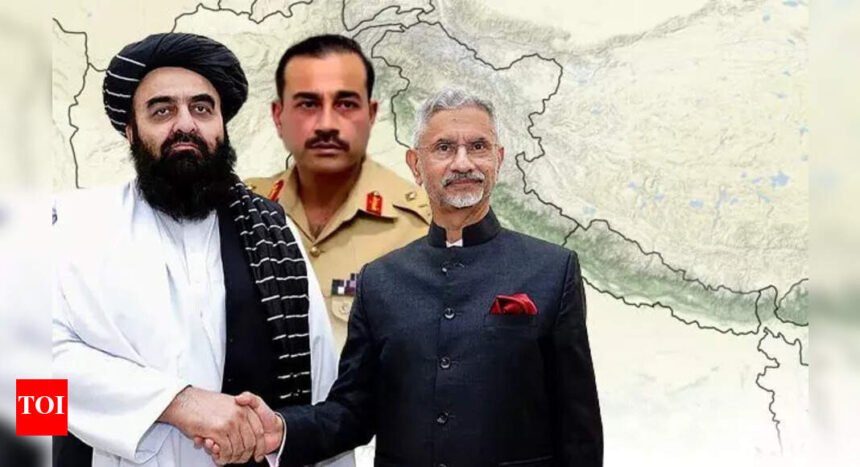
NEW DELHI: In a diplomatic manoeuvre that could reshape regional equations, India announced on Friday that it will upgrade its technical mission in Kabul to a full-fledged embassy. The decision was announced during Taliban foreign minister Amir Khan Muttaqi’s high-profile visit to New Delhi. On the same day, the Afghan foreign minister, from Indian soil, condemned Pakistan for bombing civilian areas in Paktika, Afghanistan — the first of its kind that came against the backdrop of escalating tensions between Kabul and Islamabad.During the meetings, external affairs minister S Jaishankar underlined that India’s engagement “contributes to Afghanistan’s national development, as well as regional stability and resilience,” while announcing a fresh round of development projects across Afghan provinces. The upgrade of India’s technical mission to a full-fledged embassy signals a significant deepening of diplomatic ties without extending formal recognition to the Taliban regime.Later the same day, Muttaqi held a press briefing in New Delhi, sharply condemning Pakistan for bombing civilian areas in Paktika, calling it a “provocative act” and a violation of Afghanistan’s sovereignty. “Such issues cannot be resolved by strength. Countries with disputes should resolve them internally. Peace and prosperity are good for all,” he said, stressing the widening rift between Kabul and Islamabad.
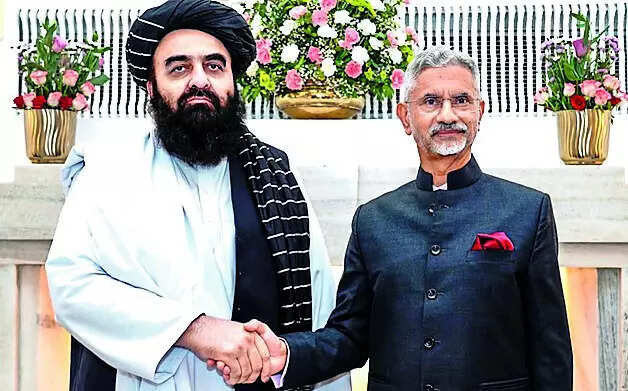
India had shut its Kabul embassy in August 2021 after the Taliban’s return to power, maintaining only a skeletal presence through a technical team since June 2022 to oversee humanitarian aid. The embassy upgrade marks the deepest level of engagement between India and the Taliban since the fall of the Ashraf Ghani government. This move stops short of formal recognition but signals a decisive shift in India’s Afghanistan strategy.
Clear messaging to Pakistan
The timing of the announcement was significant. It came just hours after Afghanistan’s defence ministry accused Pakistan of bombing civilian areas in Paktika near the Durand Line. “Pakistan violated Afghanistan’s airspace, bombing a civilian market in the Marghi area of Paktika near the Durand Line and also violating Kabul’s sovereign territory,” the ministry said in a post on social media. Calling it “an unprecedented, violent, and provocative act”, Kabul warned that defending its territory is its right.From Indian soil, Muttaqi chose to respond sharply. “I think it’s a wrong step by the Pakistan government. Such issues cannot be resolved by strength. Countries with disputes should resolve them internally. Peace and prosperity are good for all,” he told reporters in Delhi. “Some attacks happened in border areas, and we condemn them. We have opened doors for dialogue and diplomacy.”The unusually strong language stressed the widening rift between the Taliban and Pakistan, their uneasy patron for decades. Relations have deteriorated over Islamabad’s military operations against Tehreek-e-Taliban Pakistan (TTP) fighters allegedly sheltering in Afghanistan. In March 2024, Pakistani airstrikes in Khost and Paktika killed several civilians, triggering warnings from Kabul of “consequences”. This fracture, analysts say, has created a new strategic opening for India.
Strategic recalibration: Delhi steps in
India has historically had a fraught relationship with the Taliban. During the 1990s, New Delhi backed the anti-Taliban Northern Alliance while Islamabad openly supported the Taliban regime. After 2001, India became one of Afghanistan’s largest regional donors, pledging over USD 3 billion for development projects. But the Taliban’s return to power in 2021 disrupted India’s presence and leverage in the country. New Delhi maintained limited contact, focusing on humanitarian assistance and regional coordination with Iran and Central Asian partners.Now, with Pakistan–Taliban ties fraying, India is recalibrating. By reopening its embassy, hosting Muttaqi, and accepting Taliban-appointed diplomats (though not at the ambassadorial level), India is signalling a willingness to engage without granting formal recognition. Strategic analysts describe this as “hedging” — positioning itself to gain influence should Pakistan’s grip weaken further, while safeguarding its own security concerns.Professor Rajan Kumar of the School of International Studies at Jawaharlal Nehru University says this evolving situation presents India with a rare diplomatic opening.“The ongoing conflict with Afghanistan and Pakistan certainly offers an opportunity for India can be a stabilising factor even in the ongoing conflict with Pakistan. India’s presence matters a lot to Afghanistan because it will provide some kind of legitimacy to the Taliban government, even though India is unlikely to recognise the regime as such,” he says.
Economics, connectivity and regional stakes
The engagement carried clear economic undertones as well. Muttaqi invited Indian companies to invest in Afghanistan’s mining sector and called for the opening of the Attari–Wagah border for direct India–Afghanistan trade. “Pakistan and India should open the Wagah border to facilitate trade between Afghanistan and India. It will benefit the people of all three countries,” he said.Currently, India trades with Afghanistan primarily via Iran’s Chabahar port due to Pakistan’s denial of overland access. But the route faces uncertainty after the United States revoked India’s sanctions waiver for Chabahar in September 2024, complicating transit. While Chabahar remains a strategic hedge, its operational limitations make direct India–Afghanistan connectivity via Pakistan attractive in theory — though politically fraught.India also announced a new slate of development projects: a Thalassemia Centre and 30-bed hospital in Bagrami district, oncology and trauma centres in Kabul, maternity clinics across Paktika, Khost and Paktia, and donations of ambulances, medical equipment and vaccines. These announcements draw on India’s legacy of over 500 development projects across all 34 Afghan provinces, including the Parliament building and the Salma Dam.
Security calculus: Terrorism and recognition
Security remains at the core of India’s engagement. Without naming Pakistan, both sides “unequivocally condemned all acts of terrorism emanating from regional countries” in their joint statement. Jaishankar said, “We have a common commitment towards growth and prosperity. However, these are endangered by the shared threat of cross-border terrorism that both our nations face. We must coordinate efforts to combat terrorism in all its forms and manifestations.” Muttaqi, meanwhile, pledged that Afghanistan “won’t allow any group to use the country against others”, identifying Daesh (ISIS) as the main regional threat.For India, the key is ensuring Afghan soil is not used for anti-India activities — a core concern since the IC-814 hijacking in 1999. Prof. Kumar explains this strategic bottom line:“What can happen, and what India is probably thinking, is that the land of Afghanistan may not be used for terrorist activities against India. That would be a huge achievement from the Indian perspective,” he says.India has so far avoided pressing the Taliban hard on human rights. Muttaqi remained vague when asked about women’s rights, saying, “All countries have their own customs and traditions and these should be respected.” While India has consistently raised rights issues at multilateral forums, officials have avoided making them a precondition for engagement.
Presence restored, recognition withheld
Perhaps the most consequential element of India’s strategy is its decision to reopen its embassy in Kabul without formally recognising the Taliban regime — a nuanced diplomatic line that gives New Delhi both flexibility and leverage. By restoring a physical diplomatic presence, India can deepen engagement on the ground and signal its relevance in Afghanistan’s evolving power dynamics, without extending official legitimacy to a government that remains internationally unrecognised and controversial for its human rights record.This approach reflects a clear distinction between establishing an embassy and granting diplomatic recognition. India has previously maintained similar diplomatic arrangements, such as with Palestine, where the presence of an embassy does not automatically translate into full diplomatic recognition of a government. In the Afghan context, this allows India to engage pragmatically while aligning its policy with the broader stance of the United Nations, the European Union and Western countries, most of which have opted for functional engagement without recognition.By doing so, New Delhi positions itself strategically. It can build channels of communication, potentially shape outcomes on critical security and connectivity issues, and apply pressure on regional actors like Pakistan and China, both of which are wary of India expanding its influence in Afghanistan. At the same time, India avoids prematurely endorsing a regime whose policies on women’s rights and governance remain at odds with international norms.
Regional balancing act
India’s outreach is also informed by broader regional considerations. Russia and China have already established working relationships with the Taliban. Western governments are engaged in dialogue on counterterrorism and aid. New Delhi, analysts say, does not want to be the outlier.As Prof. Kumar notes, “Since Russia is talking, China is already there, and American and Western governments are also talking, India should not be left out. We may have ideological differences with the Taliban regime, but since other countries are talking to the Taliban in different forms, we should also try to moderate our policy and engage on several issues.”This balancing act is not without challenges. The Taliban regime remains ideologically rigid, especially on women’s rights and governance. Connectivity through Chabahar faces geopolitical headwinds. And there is no guarantee that the Taliban will limit anti-India groups indefinitely. Yet, by opening formal diplomatic channels, India aims to secure a seat at the table rather than watch from the sidelines as others shape Afghanistan’s future.
Strategic hedging, not endorsement
Muttaqi’s visit to Delhi, marked by strong rhetoric against Pakistan, overtures for trade, and assurances on terrorism, reflects Kabul’s attempt to diversify its diplomatic bets. For India, the outreach is less about endorsing the Taliban regime and more about strategic positioning: insulating itself against security risks, reasserting influence in a region long dominated by Pakistan, and adapting to a shifting geopolitical landscape.New Delhi’s approach remains cautious but deliberate. It is engaging the Taliban to pursue its security and strategic objectives, without abandoning its normative concerns or rushing into recognition. In the complex triangle of India–Afghanistan–Pakistan, this marks the beginning of a new phase — one where India is no longer merely reacting to developments in Kabul, but actively shaping them.