Last Updated:
Sources indicate that the final level talks will also cover civic control in Kalyan-Dombivli, Thane, and Ulhasnagar—municipal corporations where the alliance has emerged strong



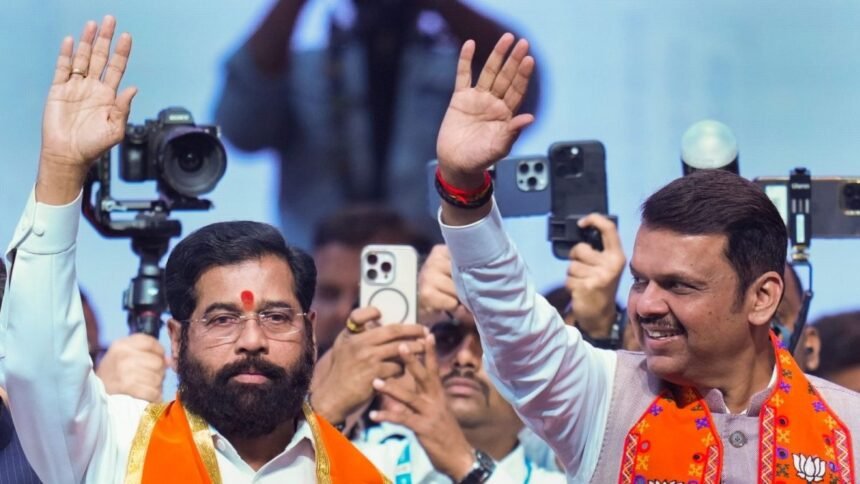
Maharashtra CM Devendra Fadnavis (right) with deputy CM Eknath Shinde. (File)
Power-sharing talks between the Bharatiya Janata Party (BJP) and the Shiv Sena led by Eknath Shinde over control of the Brihanmumbai Municipal Corporation (BMC) have entered a decisive phase, with a near-final understanding emerging on the distribution of key civic posts, including the mayor and standing committee chairperson.
The imminent announcement of the mayoral reservation category is expected to formalise the arrangement rather than reshape it, as both alliance partners have already aligned their strategies based on numerical strength and administrative priorities.
The reservation for the mayor’s post, to be decided through the rotational system, is expected to determine the final contours of negotiations. In the previous term, the post was reserved for a Scheduled Caste woman and later for the open category. With the category set to be announced shortly, parties are already mapping their numerical strength across reservation segments to assess where they stand. According to sources familiar with the talks, discussions between the BJP and Shinde-led Shiv Sena on the distribution of key civic positions are at an advanced stage. The broad understanding emerging from these negotiations suggests a strategic division of authority rather than a winner-takes-all approach.
The Shiv Sena may demand half tenure of the Mayor post but it is unlikely that the BJP will accept the demand. Once BJP stakes claim on the Mayor’s post, the Shinde Sena is likely to demand the influential Standing Committee chairperson’s post. The BJP, on the other hand, is expected to retain control over crucial committees such as Improvements, BEST, and Health—panels that significantly influence infrastructure spending, transport policy, and public health governance in the city. In return, Shinde’s Sena is likely to claim the Education, Law, Markets, and Gardens committees, ensuring a visible presence in civic administration while maintaining alliance balance. The arrangement reflects the BJP’s intent to avoid friction within the ruling coalition while retaining command over Mumbai’s key administrative levers.
Senior leaders from both parties are expected to hold a final round of discussions in Mumbai soon. Once chief minister Devendra Fadnavis is back from Davos, he will hold a final meeting with Shinde and iron out the remaining details. Sources indicate that these talks will also cover civic control in Kalyan-Dombivli, Thane, and Ulhasnagar—municipal corporations where the alliance has emerged strong.
The final BMC results underline why negotiations have taken centre stage. The BJP emerged as the single-largest party with 89 seats, followed by the Shiv Sena (Uddhav Balasaheb Thackeray faction) with 65. Shinde’s Shiv Sena secured 29 seats, while the Congress won 24. Smaller parties, including MNS, AIMIM, and NCP factions, accounted for the remaining numbers in the 227-member House. With no single party commanding a majority, coalition arithmetic will ultimately shape Mumbai’s civic leadership. The mayoral reservation announcement is now the trigger point that could swiftly move negotiations from backrooms to formal power-sharing.
January 22, 2026, 12:33 IST
Read More