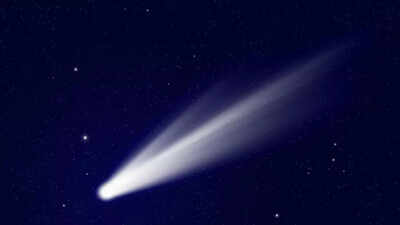
The discovery of comet C/2025 V1 (Borisov) has sparked intense global interest among astronomers and space enthusiasts. Found in early November 2025, the comet’s peculiar orbit and chemical makeup have raised questions about whether it is a visitor from beyond the Solar System or a distant traveller returning after millions of years. Scientists believe studying its trajectory and structure could uncover key details about the Solar System’s early formation and the dynamics of icy celestial bodies. As telescopes track its approach, C/2025 V1 continues to capture the curiosity of researchers eager to unravel the mysteries hidden within its faint glow.
What makes comet C/2025 V1 so unique
C/2025 V1 (Borisov) was discovered on 2 November 2025 by amateur astronomer Gennadiy Borisov, who had previously identified 2I/Borisov, the first known interstellar comet. What immediately stood out about C/2025 V1 was its highly tilted and nearly hyperbolic orbit, with an inclination of about 112 degrees and an eccentricity slightly greater than one. Such characteristics usually indicate that a comet might not be gravitationally bound to the Solar System. However, further analysis suggests the orbit’s unusual shape may have resulted from solar heating and gravitational interactions, rather than true interstellar origin.This makes C/2025 V1 an intriguing outlier, potentially belonging to the Oort Cloud, a vast spherical shell of icy bodies surrounding the Solar System. Its path towards the inner planets provides scientists with a rare chance to study a comet on its first inward journey, offering clues about the pristine materials that formed long before the planets existed.
C/2025 V1: Interstellar visitor or oort cloud wanderer
According to a recent report published by the Minor Planet Center (MPEC 2025-V40), early spectroscopic analysis suggests that C/2025 V1 is likely an Oort Cloud comet rather than an interstellar object. It was first spotted in the constellation Virgo with a magnitude between 12 and 14, faint but visible through advanced amateur telescopes. The comet will make its closest approach to Earth around 11 November 2025, at approximately 103 million kilometres away, providing a valuable observation window for astronomers.Unlike the interstellar 2I/Borisov detected in 2019, C/2025 V1’s chemical signature appears consistent with known Solar System comets. Early infrared observations have revealed volatile compounds such as water ice, carbon dioxide, and carbon monoxide, elements typically found in long-period comets originating from the outer Solar System. The data indicates that this comet, while faint, holds the potential to deepen our understanding of how icy objects evolve when exposed to sunlight after long periods in deep space.
What can this comet teach us about the early solar system
Comets like C/2025 V1 are often described as frozen time capsules, preserving materials that existed during the Solar System’s birth over 4.5 billion years ago. Each time one enters the inner Solar System, the Sun’s heat releases gases and dust that reveal its chemical composition. By analysing the light reflected and emitted from these materials, astronomers can trace the building blocks that formed planets and moons.For C/2025 V1, studying the ratios of isotopes and volatile substances could offer vital information about its origin point within the Oort Cloud. Its interactions with solar radiation may also reveal how gravitational forces from larger planets, such as Jupiter and Neptune, influence cometary trajectories. Understanding these factors helps researchers model how material from the outer Solar System migrates inward, shaping the evolution of planetary systems.Recent advances in space observation technology have made such research more precise. Facilities like the Vera C. Rubin Observatory in Chile are expected to detect thousands of long-period comets over the next decade, potentially identifying patterns that link comets like C/2025 V1 to the Solar System’s formative years.
How amateur astronomers are contributing to major discoveries
The discovery of C/2025 V1 also highlights how accessible space science has become. With high-quality digital imaging tools and open-access data from global surveys, amateur astronomers are now playing a crucial role in finding new celestial objects. Gennadiy Borisov’s detection of this comet serves as a reminder that many significant astronomical discoveries begin with a single observer scanning the skies.After the comet’s initial sighting, amateur observers worldwide contributed positional data that allowed professional astronomers to refine its orbit within days. This collaboration between citizen scientists and research institutions has become a cornerstone of modern astronomy. It enables quicker validation of discoveries, greater sky coverage, and more comprehensive data collection than professional observatories could achieve alone.Such participation not only expands the reach of scientific observation but also keeps public engagement in astronomy alive. The growing role of these observers demonstrates how global cooperation can accelerate scientific understanding of the universe.
Why C/2025 V1 matters for the future of astronomy
While C/2025 V1 might appear faint and distant, its study carries immense scientific value. Analysing how it reacts to solar radiation can help refine models of cometary activity, orbital evolution, and the chemical diversity of the early Solar System. It also serves as a benchmark for identifying future interstellar objects by comparing their motion and composition with known Solar System comets.Every newly discovered comet adds another piece to the puzzle of cosmic history. C/2025 V1 reminds scientists that even small, icy bodies on obscure orbits can hold answers to some of astronomy’s biggest questions: Where did our Solar System’s raw materials come from, and how have they evolved over billions of years?Also Read |