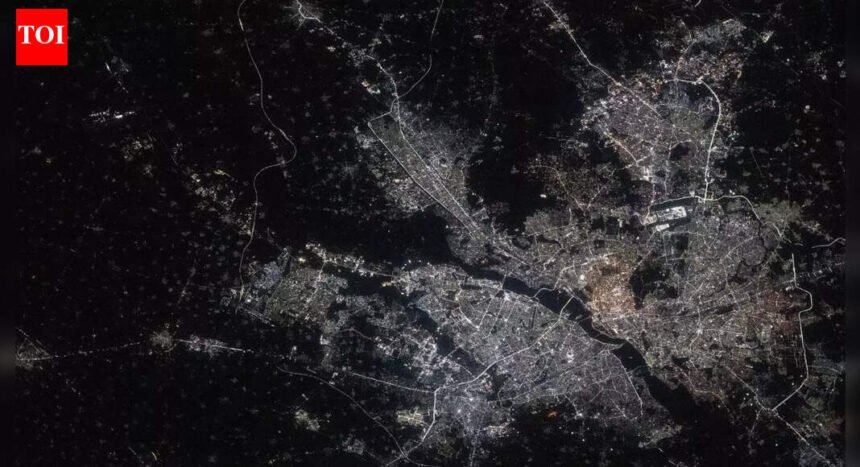
The latest nighttime photograph shared by the International Space Station offers a striking view of how human activity shapes the Earth after dark. The image highlights cities across Asia and South America that stand out because of their dense networks of artificial light. Delhi appears especially radiant, its interconnected roads and neighbourhoods forming vivid patterns that are clearly visible from orbit. The photograph also places the Indian capital within a wider global context, where the appearance of city lights often reflects population growth, expanding infrastructure and rapid urban development. These visual signatures from space provide a compelling way to understand how some urban centres have grown into luminous landscapes that define the planet at night.
How the ISS captured Delhi’s glow in a global lineup of bright megacities
The Twitter post shared by the International Space Station serves as the primary source for the global lineup of cities that shine most vividly at night. In its note, the station grouped Delhi with Singapore, Tokyo and São Paulo, describing them as some of the most luminous urban centres visible from low Earth orbit. This categorisation is significant because such observations usually highlight cities with overlapping characteristics, including high population density, widespread electrification and complex built environments. The image of Delhi was recorded at approximately 10:54 pm local time, showing the Yamuna River dividing the city and a bright rectangular zone marking Indira Gandhi International Airport. These visual cues are consistent with how satellite imagery captures urban intensity, especially when artificial lighting forms clear geometric patterns.The ANI report supports this interpretation by describing Delhi’s nightscape as one of the most striking among the newly released photographs, adding population estimates and context about surrounding regions. When combined with the details shared by the ISS, the information helps explain why the capital appears so distinct from above. The city’s large metropolitan footprint, evolving transport routes and expanding suburbs all contribute to its presence in orbit-based imagery, allowing it to be compared with long-established global megacities.
Why Delhi’s illumination stands out in orbital imagery of Asia
Delhi’s visibility from space reflects a combination of demographic expansion and the rapid spread of urban infrastructure. With a metropolitan population now estimated at over 34 million, the region has grown into one of the world’s largest continuously inhabited zones. The dense distribution of households, commercial areas and transport corridors produces extensive lighting across many districts. These illuminated regions tend to cluster around major economic hubs, highways and residential sectors, and they form a continuous band rather than scattered pockets of brightness. This continuous glow is what makes Delhi’s outline so recognisable from the ISS, especially on clear nights when light escapes directly upward into space.The illumination also reveals details about movement across the city. Well-lit expressways trace the transport spine of the region, linking old neighbourhoods with newer satellite towns. Certain stretches appear more sharply defined because they support constant traffic flow even late at night. Industrial areas, commercial districts and airport infrastructure contribute additional layers of brightness that help create the distinctive geometry recorded in the ISS photograph. These features allow orbital images to map the intensity of activity without needing daytime context, making Delhi a model example of how modern megacities transform the nocturnal landscape.
Comparing Delhi with Singapore, Tokyo and São Paulo in the night sky
The comparison with Singapore, Tokyo and São Paulo highlights how different regions create similar luminous footprints for entirely different reasons. Singapore appears as a concentrated island of light separated from Malaysia by the narrow Johor Strait. Its compact size produces a bright, unified glow shaped by vertical development, dense zoning and consistent lighting across its districts. Tokyo, on the other hand, spreads around Tokyo Bay in a wide arc, combining older neighbourhoods with vast suburban rings that extend far beyond the city centre. Its lighting patterns reveal decades of expansion that merge multiple municipalities into a continuous metropolitan blanket.São Paulo, the largest city in the Southern Hemisphere, presents a different type of radiance defined by its extensive urban reach. From the ISS, its lights form a sprawling web that stretches across valleys and elevated regions, reflecting both planned and organic development. In all three cities, the brightness reveals infrastructure, economic activity and social behaviour on a scale that remains visible long after sunset.Delhi’s presence among these global urban giants shows how the Indian capital has grown into a megacity whose nighttime signature is as recognisable as those of long-established metropolitan regions. Although their geographies, histories and planning models differ, their nocturnal luminosity forms a shared indicator of how modern cities continue to evolve under rising population pressures and expanding development.
What orbital images reveal about the future of brightly lit cities
Images like the one shared by the ISS hint at larger questions about how cities will be shaped by changing energy use, population movement and infrastructure planning. Artificial lighting patterns tend to grow as urban areas expand, and these changes often become visible from orbit before they are fully documented on the ground. For regions like Delhi, which continue to experience rapid construction and increasing migration, nighttime images may offer early clues about emerging corridors of development and shifting urban boundaries. They can also highlight areas where infrastructure becomes more integrated, reflecting long-term investment in housing, transit and commercial growth.Urban illumination also connects to broader research themes involving energy consumption, environmental impact and patterns of human settlement. As more cities grow into megaregions, their nighttime signatures may increasingly resemble one another, even if they differ culturally and geographically. Understanding these patterns helps scientists and planners track changes that shape daily life, from transport to public services. The ISS images, therefore, serve not only as a visual record but also as a continuing reference point for observing how the modern world adapts and expands after dark.Also Read | AI just found the oldest evidence of life on Earth and scientists are stunned