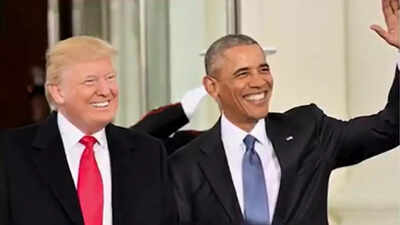
The Nobel Committee has made its choice — and it wasn’t Donald Trump. In Oslo, the 2025 Peace Prize was awarded to María Corina Machado, the Venezuelan opposition leader who has spent decades fighting for democracy under one of Latin America’s most entrenched authoritarian regimes. Forced into hiding, barred from elections, and threatened with imprisonment, Machado has become a symbol of civic resistance against President Nicolás Maduro’s rule — a movement that has endured despite every attempt by the world’s most powerful country to remove him from power.The decision to give the award to a Venezuelan opposition figure carries a distinctly Obama-era echo — just as Trump’s obsession with the Nobel stems partly from his belief that Obama did not deserve his 2009 prize. Ironically, Obama — and every subsequent US administration — has tried and failed to topple Maduro. Sanctions, covert deals, diplomatic isolation, and even a dramatic attempt to trigger a military uprising have all been deployed. None of them worked. And now, with Machado being honoured for pursuing “ballots over bullets”, the contrast with Washington’s more muscular and often chaotic interventions could not be clearer.
The early days: Obama builds the pressure
The United States’ modern campaign against Maduro began quietly under Barack Obama. As Venezuela slid deeper into crisis following Hugo Chávez’s death in 2013, Washington’s strategy was one of incremental pressure. In 2015, Obama signed an executive order declaring Venezuela a “national security threat” — a technical step that enabled targeted sanctions against top regime officials accused of corruption and human rights abuses.The logic was straightforward: squeeze the inner circle, cut off their access to foreign assets, and increase the cost of loyalty. The sanctions were designed to peel away elite support without provoking a nationalist backlash. It was a slow, legalistic approach — one that left the military untouched but aimed to weaken the regime’s patronage networks from within.The problem was that Maduro adapted. With oil prices low and the economy collapsing, his government tightened control over state resources, deepened ties with Russia and China, and relied on Cuba’s security apparatus to monitor and neutralise dissent. Washington’s early pressure may have isolated Caracas diplomatically, but it did not bring the regime closer to collapse.
Trump’s escalation: “All options” and Operation Freedom
If Obama’s approach was methodical, Donald Trump’s was maximalist. By 2019, the White House was openly calling for Maduro’s removal and backing Juan Guaidó, the National Assembly speaker who declared himself interim president with the support of more than 50 countries. The message from Washington was clear: Maduro’s time was up.The boldest moment came on 30 April 2019. Guaidó appeared at a military base in Caracas, flanked by soldiers and opposition leader Leopoldo López — who had been freed from house arrest — and announced the start of the “final phase” of a plan to oust Maduro. Behind the scenes, US officials believed they had secured secret agreements with key figures in Maduro’s inner circle, including Defence Minister Vladimir Padrino, to facilitate a transfer of power.The plan unravelled almost immediately. The promised defections never materialised. The security forces remained loyal. Russian advisers reportedly persuaded Maduro to stay in Caracas. By nightfall, López had fled to the Spanish embassy, Guaidó’s call for a military uprising had fizzled, and Maduro appeared on television declaring victory. Washington was left red-faced, with its supposed inside partners now exposed and vulnerable.It was a pivotal moment. The Trump administration had shown its hand too soon, overestimated its leverage, and underestimated the regime’s resilience. The promise that “all options” were on the table rang hollow — there was no appetite in Washington for military intervention, and sanctions had already hit their limits. The “Operation Freedom” gamble had failed.
Why Maduro survived
The failure to dislodge Maduro was not just the result of miscalculation — it was rooted in the nature of the regime itself. Venezuela’s power structure rests on a tightly bound coalition of military leaders, party loyalists, and foreign backers. Cuba’s security services have deeply embedded themselves in the intelligence apparatus, helping the regime detect and dismantle plots before they pose a serious threat. Russia’s involvement has provided diplomatic cover, economic lifelines, and strategic deterrence against Western pressure.At the same time, the opposition has faced relentless repression. Leaders have been exiled, imprisoned, or banned from politics. Protest movements have been infiltrated and crushed. Elections have been manipulated to maintain the appearance of legitimacy without risking a real transfer of power. And while millions of Venezuelans have fled the country, the regime has tightened its grip on those who remain.The result is a system that has proved far more durable than many in Washington expected. Maduro’s government, despite presiding over economic collapse and mass emigration, has outlasted five US presidents and remains firmly in control of the levers of power.
Machado’s rise — and Oslo’s message
It is against this backdrop that María Corina Machado’s Nobel Peace Prize takes on deeper significance. A veteran opposition leader and founder of the electoral watchdog Súmate, Machado has spent over two decades campaigning for free and fair elections, judicial independence, and democratic reforms. In 2024, she was barred from running for president, but continued to organise and support the opposition from hiding — inspiring millions with her refusal to leave the country.Her recognition in Oslo is more than a personal honour; it is a rebuke to the failed strategies of external pressure and covert engineering. The Nobel Committee praised her commitment to “ballots over bullets” — a reminder that authoritarian regimes are rarely toppled by foreign diktats or spectacular one-day gambits. They fall when internal movements, no matter how battered, persist long enough to make repression costlier than reform.
The irony of 2025
The symbolism of this year’s Nobel announcement is hard to miss. As Donald Trump raged against the committee for awarding the prize to Machado instead of him — despite his claims of “ending seven wars” — the world was reminded that the most enduring challenges to authoritarian power are often domestic, not imported. It was also a lesson in patience: a decade after Washington first declared Maduro’s days numbered, he remains in the presidential palace, while the dissident he sought to crush now holds one of the world’s most prestigious honours.For all the billions spent, the sanctions imposed, and the coups imagined, the story of Venezuela’s democratic struggle is still being written by Venezuelans themselves. And in that story, María Corina Machado — not the architects of failed regime-change plans in Washington — is the one history will remember.