Last Updated:
Bahujan Samaj Party has announced four candidates for 2027 Uttar Pradesh polls, aiming for a Brahmin-Muslim-Dalit alliance to regain ground.




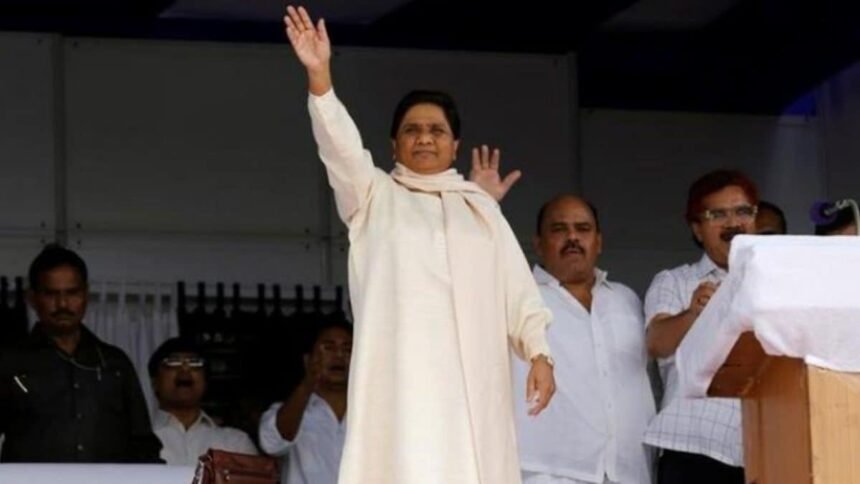
Former Uttar Pradesh Chief minister Mayawati. (Photo Credit: X)
With the 2027 Uttar Pradesh Assembly elections still over a year away, the Bahujan Samaj Party (BSP) has begun early preparations, signalling a renewed focus on social engineering under party chief Mayawati.
The Mayawati-led party has so far announced four candidates from different regions of Uttar Pradesh — Purvanchal, Bundelkhand, and Western UP. Among them are two Muslim and two Brahmin leaders, indicating the party’s attempt to build a Brahmin-Muslim-Dalit political combination for the 2027 polls.
The move comes after a disappointing performance in the 2022 Assembly elections, when the BSP managed to win just one seat, though it finished second in 18 constituencies. Determined to regain lost ground, the party plans to declare candidates for more than 100 seats by March 2026.
Who Are These Candidates?
Abul Qais Azmi (Didarganj)
In Azamgarh’s Didarganj seat, the BSP has fielded Abul Qais Azmi, a long-time party leader who previously contested from Phulpur Pawai in 2012 and 2017. He secured 46,000 and 61,000 votes respectively in those elections, finishing second both times by narrow margins. He skipped the 2022 polls but will now test his prospects on a new seat.
The constituency has has a sizeable Muslim and Dalit population. It has around 95,000 Muslim and 80,000 Dalit voters. Among OBCs, Rajbhars (38,000), Chauhans (14,000) and Nishads (7,000) form a sizeable bloc. In 2022, the Samajwadi Party won the seat with 37% vote share, while the BJP secured 30% and the BSP 23%. The BSP hopes to consolidate these votes.
Firoz Aftab (Saharanpur Rural)
From Saharanpur Rural in western UP, the BSP has nominated Firoz Aftab, who recently joined the party after quitting the Samajwadi Party. His grandfather Chaudhary Zafar Ahmad was elected to UP’s first Assembly from the Congress. Aftab himself has contested multiple elections, including as an Independent in 1996 when he lost by mere 90 votes to the BJP despite polling around 40,000 votes.
The seat has a significant Muslim and Dalit voter base, along with influential OBC and upper-caste voters. Saharanpur Rural has nearly 1.25 lakh Muslim and 90,000 Dalit voters, alongside Saini (32,000), Gurjar (18,000) and around 24,000 Brahmin-Thakur voters. In 2022, SP’s Ashu Malik won with 1.07 lakh votes, BJP’s Jagpal Singh got 76,000 and the BSP candidate polled 62,000.
Vinod Mishra (Mungra Badshahpur)
In Jaunpur’s Mungra Badshahpur, Brahmin leader Vinod Mishra has been chosen. Mishra began his career with the BJP before moving to the SP, where he remained until 2022. He joined the BSP six months ago and will be contesting his first election.
The constituency has a strong Brahmin presence along with Dalit and OBC voters. Among OBCs, Patels (60,000) and Yadavs (40,000) are influential, alongside 30,000 Muslims. In 2022, SP’s Pankaj Patel won with 92,000 votes, BJP’s Ajay Shankar Dubey got 86,000 and the BSP candidate trailed at 32,000.
Ashish Pandey (Madhaugarh)
In Bundelkhand’s Madhaugarh seat, the party has fielded Ashish Pandey, banking on a Dalit-Brahmin equation in the region. After being denied a ticket in 2017 and 2022, he has secured the nomination on his third attempt.
Madhaugarh has about 90,000 Dalit voters — the largest bloc — followed by 44,000 Brahmins, 40,000 Rajputs and 20,000 Muslims. OBC voters, including Kushwahas and Kurmis, number around 1.5 lakh. The BJP won the seat in 2022 with 41% vote share, while the BSP secured 27% and the SP 24%.
The Larger Strategy
Mayawati has repeatedly stressed the importance of social arithmetic in recent meetings. Dalits constitute roughly 20% of Uttar Pradesh’s population, Muslims around 19%, and Brahmins between 9–11%. The BSP leadership believes that consolidating these groups could significantly boost its vote share in many constituencies.
The party has also assigned senior leaders to manage caste outreach efforts, aiming to rebuild its support base across communities.
Political observers say the BSP’s early announcements are aimed at strengthening booth-level organisation and countering both the Bharatiya Janata Party (BJP) and the Samajwadi Party (SP), which currently dominate the state’s political landscape.
With early candidate announcements across eastern, western and Bundelkhand regions, the BSP is attempting to regain lost ground and reassert itself as a decisive player in Uttar Pradesh’s complex caste-driven politics.
February 27, 2026, 12:41 IST
Read More