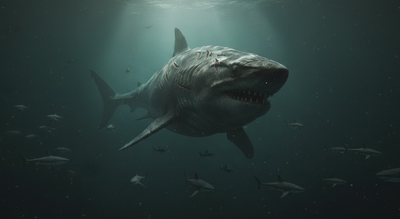
Nearly 30 years after it was first recorded, people are still arguing about a single sound from the deep ocean. The “Bloop,” a strange, powerful underwater noise picked up in 1997, has been folded into YouTube conspiracies, Lovecraft memes and endless comments insisting that Megalodon must still be out there.The science says otherwise. But the route from mystery to explanation is exactly why this sound has stayed lodged in people’s heads for so long.
The shark everyone wanted it to be
As one of the largest predators ever to live, megalodon was always going to be the prime suspect in any “monster noise” story.The earliest fossils of Otodus megalodon (previously known as Carcharodon or Carcharocles megalodon) date back around 23 million years. For close to 20 million years, the shark ruled global oceans, disappearing only about 3.6 million years ago.A 2025 study written by 29 fossil shark experts estimated that megalodon may have grown up to 24.3 metres long. That would make it roughly four times longer than the biggest recorded great white shark and even longer than today’s largest whale sharks, which come in at about 18.8 metres.
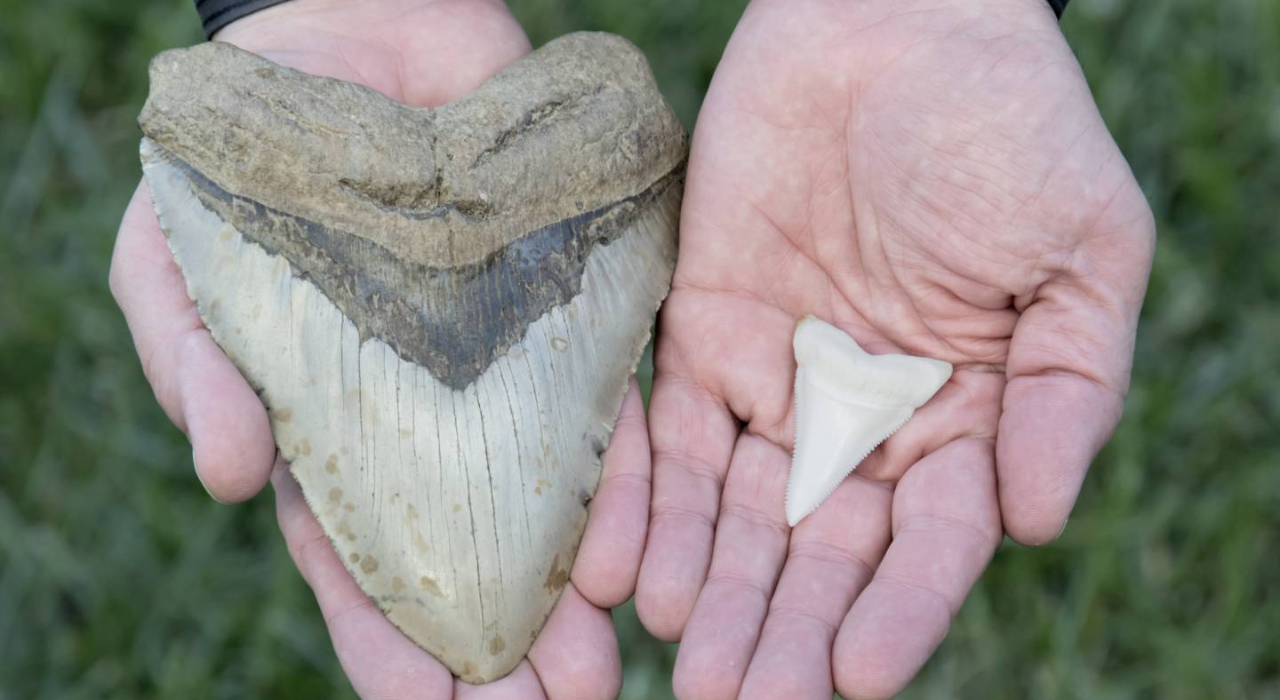
A 6-inch megalodon tooth (left) dwarfs a 2-inch great white tooth (right), each inch marking roughly 10 feet of shark/ Photo by iStock.com
With an animal that size in the cultural background, it didn’t take much for people to hear an unexplained underwater sound and jump straight to “giant prehistoric shark”.
A sound that travelled across the Pacific
The Bloop was first detected in the summer of 1997 by hydrophones operated by the US National Oceanic and Atmospheric Administration (NOAA) in the southern Pacific Ocean. Researchers were listening for underwater volcanic activity when they picked up something very different.Using hydrophones, underwater microphones, spaced more than 3,219 kilometres apart across the Pacific, they recorded multiple instances of the same noise. It was extremely loud and had a distinct rising pattern. The sound was unlike anything they had heard before, and the signal was strong enough to be tracked across a huge distance. It quickly picked up a nickname: the Bloop.According to Discovery UK, several scientists noted that the sound resembled an amplified whale call, which led some to suggest it might have been produced by a living creature. The problem was scale: it was significantly louder than any known animal.Others suggested more mundane geophysical explanations, such as underwater volcanic activity or tectonic plate movement, both of which are known to create unsettling low-frequency sounds.In the absence of a confirmed source, speculation filled the gap. As Mirror US reported, online theories ranged from an undiscovered ocean giant to H. P. Lovecraft’s fictional Cthulhu. Megalodon was the obvious real-world candidate: huge, already famous and conveniently extinct.For years, the sound sat in that uneasy space between data and guesswork.
What NOAA eventually found in Antarctica
The answer didn’t arrive quickly. Throughout the early 2000s, NOAA’s Pacific Marine Environmental Laboratory kept deploying hydrophones closer to Antarctica as part of a long-term effort to study the sounds of seafloor volcanoes and earthquakes.It was only in 2005, after years of gathering more recordings nearer to the Antarctic, that the origin of the Bloop was finally pinned down.NOAA later explained:“As the years passed, PMEL researchers continued to deploy hydrophones ever closer to Antarctica in an ongoing effort to study the sounds of seafloor volcanoes and earthquakes.It was there, on Earth’s lonely southernmost landmass, that they finally discovered the source of those thunderous rumbles from the deep in 2005.The Bloop was the sound of an icequake, an iceberg cracking and breaking away from an Antarctic glacier! With global warming, more and more icequakes occur annually, breaking off glaciers, cracking and eventually melting into the ocean.”So the Bloop turned out not to be a call from a colossal animal, but the sound of ice under stress: an iceberg fracturing and tearing away from a glacier.The mystery didn’t reveal a hidden predator. It revealed a planet warming fast enough to make the ice itself noisy.
Why scientists don’t buy a living megalodon
Even without the icequake explanation, researchers have had a consistent view on the “megalodon is still alive” theory: it doesn’t fit what we know about sharks, food webs or the fossil record.Big predatory sharks, including great whites, shed large numbers of teeth throughout their lives, and those teeth wash up on beaches around the world. An animal up to 24 metres long, eating huge marine mammals, would leave fresh evidence behind, not just ancient fossils. If a shark that size were still roaming the oceans, we would expect to find recent teeth, not just ones that are millions of years old.There is also the question of food. The darkest, deepest parts of the ocean are relatively poor in prey. A shark as large as megalodon would be drawn to places where big animals are concentrated, such as whale migration routes or seal colonies, many of which are closer to coasts. That kind of activity would be hard to miss, especially in a world of satellite tracking, commercial shipping and industrial fishing.Put simply: for megalodon to be alive today, it would have to be both enormous and strangely invisible. That combination is extremely unlikely.
Why people were disappointed by the truth
When NOAA confirmed that the Bloop was an icequake, not a living creature, some people felt let down.On Reddit, one user admitted as much:“No kidding. I was looking forward to scientists discovering a new, previously unknown life form in the deep ocean.I know there’s a ton of species down there we haven’t discovered, but they’re probably all going to be tiny or not much bigger than a small dog. I want science to discover something HUGE.”Another commenter was more sceptical than disappointed, asking why it had taken so long to settle on ice as the answer:“Wasn’t there a bunch of experts saying that it was almost certainly organic in nature? Is there any explanation as to why this instance of iceberg cracking was so loud?Why did it take NOAA so long to attribute it to icebergs cracking? Not saying it’s Cthulu or anything (just desperately hoping), just wondering what took so long.”Part of that delay is practical: the ocean is vast, hydrophones don’t cover every corner, and it takes time to collect enough comparative recordings to say, with confidence, that two sounds have the same source. Another part is cultural: dramatic theories spread faster than slow, methodical explanations.
What the Bloop really left us with
By 2025, the Bloop is no longer a fresh mystery. The recording is old, the explanation is published, and megalodon remains comfortably extinct. But the story still matters, partly because of what it reveals about us.Faced with an unexplained sound from the deep ocean, people reached for creatures, not climate. The real answer, an iceberg cracking away from a glacier in a warming world, is less cinematic but far more pressing.The ocean is still full of mysteries. There are certainly species we haven’t found yet. But if the Bloop taught us anything, it’s that the most unsettling noises from the deep may not be from monsters at all, but from the planet itself shifting under the strain we’ve put on it.