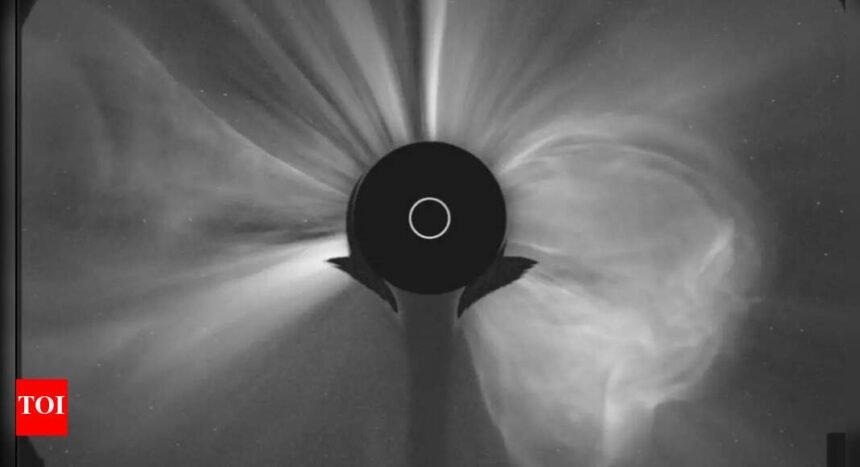
Interstellar comet 3I/ATLAS has captivated astronomers as it makes a rare and dramatic passage around the Sun. Although currently hidden from Earth’s view, NASAand international spacecraft have continued to track its journey, revealing that the comet brightened rapidly as it neared perihelion, its closest approach to the Sun, on 30 October 2025. This interstellar traveller, moving at extraordinary speed and exhibiting active gas emissions, offers scientists a unique opportunity to study material from beyond our solar system. By analysing its composition, brightness, and trajectory, researchers hope to uncover clues about the origins of comets from distant star systems and gain insight into how interstellar objects evolve as they interact with our Sun’s intense heat and radiation.
Interstellar comet 3I/ATLAS monitored by Earth and space observatories
Comet 3I/ATLAS, the third interstellar comet ever discovered, has been a challenging object to follow. As it moved behind the Sun this week, its position made it impossible to view from Earth. However, spacecraft positioned around the solar system continued to monitor its progress, offering scientists a rare opportunity to study an interstellar object in real time.Amateur astronomer and comet hunter Worachate Boonplod successfully detected 3I/ATLAS in images captured by the U.S. National Oceanic and Atmospheric Administration’s (NOAA) GOES-19 weather satellite on 18 October. Using the CCOR-1 instrument, which normally tracks the Sun’s outer atmosphere for space weather, Boonplod observed the comet shining with a magnitude of around 11, too faint for the naked eye but easily visible in spacecraft imagery. He reported that the comet’s brightness was comparable to nearby stars and that it would remain in the satellite’s view until 24 October as it travelled across the solar field.The GOES-19 satellite was not alone in tracking the comet. NASA’s Polarimeter to Unify the Corona Heliosphere (PUNCH) mission, consisting of four small satellites aimed at studying solar structures, also monitored the event. Additionally, NASA and the European Solar and Heliospheric Observatory (SOHO), orbiting the Sun about 1.5 million kilometres from Earth, observed the comet until 26 October using its LASCO C3 coronagraph, a device that blocks the Sun’s bright light to reveal the surrounding corona and nearby objects like comets.
Comet 3I/ATLAS brightens sharply near the Sun, revealing signs of intense gas activity
Just before its closest approach to the Sun, comet 3I/ATLAS underwent a striking increase in brightness. According to a preprint study published on 28 October 2025 on arXiv by Qicheng Zhang and Karl Battams, the comet 3I/ATLAS brightened rapidly as it neared perihelion, increasing in brightness with heliocentric distance at a rate of r⁻⁷·⁵. While still too faint to be seen without a telescope, this brightening was significant for astronomers tracking its evolution.The study, which used data from GOES-19 and SOHO, revealed that the comet appeared noticeably bluer than the Sun, an indication that gases, released as its surface ices sublimated, were contributing to the glow. When comets approach the Sun, solar heat causes their icy nuclei to release gas and dust, forming a glowing coma and tail. These gases become ionised by solar radiation, producing an even brighter appearance. This behaviour is consistent with what scientists expect from active comets, but its detection in an interstellar object makes 3I/ATLAS particularly fascinating.
3I/ATLAS: Ancient interstellar comet races through the solar system at record speed
Although hidden from Earth-based telescopes at the moment, comet 3I/ATLAS will soon reappear. NASApredicts that it will become visible again in early December, when it moves out from behind the Sun. By then, astronomers will have a clearer view of its tail and residual activity as it moves farther from the Sun.Despite occasional online speculation that the comet could be an artificial or alien object, experts agree that 3I/ATLAS is a natural interstellar body, a frozen remnant from another star system. Its extreme velocity suggests it has been journeying through space for billions of years, propelled by gravitational interactions with stars and nebulae encountered along the way.NASA scientists believe this could be the oldest comet ever observed. Preliminary estimates suggest that 3I/ATLAS formed around 3 billion years before our solar system, making it roughly 7.6 billion years old. Its size is also remarkable; data from the Hubble Space Telescope indicate that the comet may be up to 5.6 kilometres wide, potentially making it the largest interstellar object ever detected.
Comet 3I/ATLAS is set to reappear in December as it continues its journey through the solar system
Although hidden from Earth-based telescopes at the moment, comet 3I/ATLAS will soon reappear. NASA predicts that it will become visible again in early December, when it moves out from behind the Sun. By then, astronomers will have a clearer view of its tail and residual activity as it moves away from the solar heat.The comet’s journey is far from over. In March 2026, 3I/ATLAS is expected to pass near Jupiter, giving spacecraft orbiting the gas giant a potential opportunity to observe it up close. These future observations could help scientists understand how interstellar comets differ from those born within our solar system, shedding light on the chemical diversity of planetary systems across the galaxy.Each new discovery about 3I/ATLAS deepens humanity’s understanding of the vast, dynamic environment beyond our solar neighbourhood. With every image captured by NASA’s and ESA’s solar observatories, astronomers are piecing together the story of a comet that has travelled for billions of years across interstellar space, only to make a fleeting, brilliant visit near our Sun.Also Read: 3I/ATLAS sending mysterious Fibonacci-pattern pulse signal 8 • 13 • 8 • 5 • 13 • 8 at 1420 MHz; could it be a message from deep space