

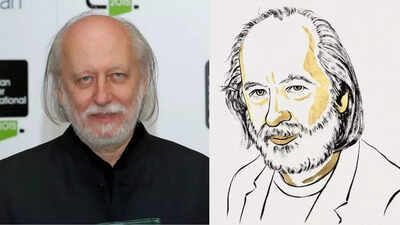
“Literature can only ever hope to hold chaos together, perhaps only by a comma,” said Laszlo Krasznahorkai in his acceptance speech for the Man Booker International Prize — a sentiment that now resonates even more deeply with his 2025 Nobel Prize in Literature win. The Hungarian novelist, long revered for his labyrinthine sentences and apocalyptic vision of the modern world, has been recognised by the Swedish Academy for a body of work that “confronts chaos and finds meaning through art.”For decades, Krasznahorkai has been a literary enigma — a writer of vast, uninterrupted sentences and haunting philosophical depth. His novels, often bleakly comic and hypnotically long, explore despair, beauty, and endurance in a world teetering on collapse. Hailed by Susan Sontag as “the Hungarian master of the apocalypse” and praised by W.G. Sebald for his universality, Krasznahorkai’s prose captures both the absurdity and awe of human existence. His win marks a moment of long-overdue recognition for one of Europe’s most uncompromising literary visionaries.
Laszlo Krasznahorkai: A visionary voice in a chaotic world
Born in Gyula, Hungary, in 1954, Laszlo Krasznahorkai grew up under the shadow of a communist state, witnessing societal collapse and human suffering firsthand. These early experiences profoundly shaped his worldview, infusing his writing with an acute awareness of moral fragility and the impermanence of social and political systems. He began his career as an editor before turning to fiction in the 1980s, emerging as a literary force whose narratives explore humanity’s tension between absurdity and transcendence, chaos and grace.Critics often call him “the Hungarian master of the apocalypse,” a phrase coined by Susan Sontag, highlighting his ability to depict the slow unraveling of human order while remaining attuned to fleeting beauty and existential reflection. W.G. Sebald praised his universality, noting that his work rivals Gogol’s Dead Souls in its philosophical breadth and narrative ambition. Krasznahorkai’s prose resists conventional plot structures, demanding that readers engage with language as both a vehicle of meaning and a mirror of life’s disorder.His debut novel, Satantango (1985), established his signature style: sprawling, unbroken sentences that flow like slow rivers of thought. Set in a grim, rain-soaked village inhabited by con artists, drunks, and dreamers clinging to illusion, the novel paints a haunting portrait of societal decay. Béla Tarr’s seven-hour film adaptation brought this apocalyptic vision to the screen, cementing Krasznahorkai’s international reputation.
Notable works and overview: Laszlo Krasznahorkai
Krasznahorkai’s novels are distinguished by their almost obsessive sentence structure, sparse punctuation, and fusion of despair and humour. Each work demonstrates a mastery of rhythm, creating an immersive experience where the syntax mirrors the inner states of characters and societies.The Melancholy of Resistance (1989): Expands his apocalyptic vision to an entire town disrupted by a mysterious circus. A meditation on the fragility of civilization, it blends prophetic insight, dark satire, and metaphysical reflection, exploring the tensions between collective hysteria and individual morality.War & War (1999): Chronicles a minor archivist obsessed with a mysterious manuscript, journeying to New York to preserve it online before taking his own life. The narrative prefigures modern anxieties about the digital preservation of meaning and the human urge to leave a trace amidst chaos.Seiobo There Below (2008): Through interconnected vignettes spanning Japan, Renaissance Italy, and beyond, the novel examines perfection, art, and impermanence. It is both meditative and philosophical, highlighting fleeting encounters with beauty and the impermanence of human achievement.Baron Wenckheim’s Homecoming (2016): Portrays the return of a failed aristocrat to his chaotic hometown. The narrative combines comic chaos, philosophical reflection, and social commentary, cementing Krasznahorkai’s reputation for blending bleakness with dark humour.Chasing Homer (2020): An experimental blend of prose, painting, and music, this novella explores memory, flight, and creative collaboration, demonstrating Krasznahorkai’s interest in multidisciplinary artistic expression.A Mountain to the North, a Lake to the South, Paths to the West, a River to the East (2021): A meditative prose-poem that reflects on stillness, contemplation, and the search for meaning in both nature and self.Herscht 07769 (2024): A single, unbroken sentence allegory on neo-Nazism, moral paralysis, and the physics of chaos in contemporary Europe, demonstrating his capacity for linguistic virtuosity and philosophical depth.
Philosophy and themes
Krasznahorkai’s writing revolves around the interplay of entropy, futility, and transcendence. His landscapes, whether Hungarian villages, Japanese monasteries, or urban European settings, serve as metaphysical theatres where human delusion, brutality, and longing for divinity intersect.In his work, apocalypse is not a sudden event but a persistent state—a condition reflecting the daily erosion of meaning and structure. Yet beneath despair, Krasznahorkai uncovers glimpses of beauty and sacredness, often fleeting but profoundly affecting. His narrative style mirrors this philosophy, with sprawling sentences that capture obsessive thought, spiritual yearning, and human frailty, inviting readers to inhabit uncertainty and confront chaos directly.
Collaborations, translations, and global reach
Krasznahorkai’s global recognition is intertwined with his translators, notably George Szirtes and Ottilie Mulzet, who preserve the hypnotic cadence of his Hungarian prose in English. Their careful work ensures that the rhythm, tension, and philosophical depth of his writing remain intact for international audiences.His collaborations with filmmaker Béla Tarr, especially on Satantango and Werckmeister Harmonies, translated his literary vision into cinematic form. These slow, meditative films extend the themes of despair, beauty, and moral ambiguity that pervade his novels, allowing his apocalyptic worlds to reach new sensory and emotional dimensions.
Quotes and reflections
Krasznahorkai’s work is filled with reflections on the human condition, often articulated through memorable lines:“Whatever you try to do, your efforts will always be in vain; it is impossible to preserve anything, nothing remains, every moment is captured only once and then never again.” — War & War“Dance is my one weakness.” — Satantango“Literature can only ever hope to hold chaos together, perhaps only by a comma.” — Man Booker International Prize speechThese statements exemplify his lifelong meditation on impermanence, human striving, and the fragile beauty embedded in the smallest acts.Krasznahorkai’s Nobel Prize honours an author whose radical faith in art confronts chaos without seeking easy consolation. Reviewers celebrate his ability to blend catastrophic vision with paradoxical warmth, dark humour, and philosophical reflection. Susan Sontag hailed him as “the Hungarian master of the apocalypse,” while W.G. Sebald emphasized his universal reach. His literature does not promise comfort but challenges readers to find meaning in the inexorable flow of entropy and human folly.Through four decades of work, Krasznahorkai has established himself as a literary visionary, a chronicler of disintegration, and a master of language whose sentences do not merely tell stories but embody the rhythms of thought, despair, and fleeting transcendence. His Nobel recognition is a tribute to an oeuvre that continues to shape contemporary literature and redefine the possibilities of the novel.

