Last Updated:
Sonia Gandhi argued that such silence reflected a departure from India’s long-standing foreign policy based on sovereignty, non-intervention and adherence to international law.




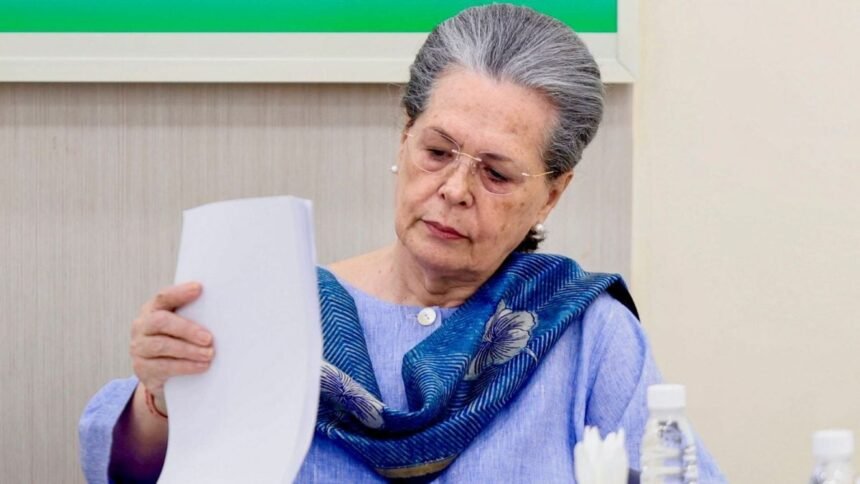
Congress leader Sonia Gandhi | File Image
As the West Asia war entered its fourth day, Congress Parliamentary Party Chairperson Sonia Gandhi questioned the Indian government’s response to the killing of Iran’s Supreme Leader Ayatollah Seyed Ali Hosseini Khamenei in a US-Israel strike, in an editorial published in The Indian Express.
What Sonia Gandhi said?
In her article titled “Government’s silence on killing of Iran leader is not neutral, it is abdication,” Sonia Gandhi wrote that Iran confirmed on March 1 that its Supreme Leader had been assassinated in a targeted strike carried out the previous day by the United States and Israel.
She said the killing of a sitting head of state during ongoing negotiations marked a grave rupture in international relations, adding that New Delhi’s silence stood out as strongly as the event itself.
According to her, the Government of India refrained from condemning the assassination or the violation of Iranian sovereignty. She noted that the Prime Minister’s Office issued only a brief condolence message, avoiding reference to the circumstances of the killing, and that this ambiguity later turned into “conspicuous quiet” despite global diplomatic reactions.
Sonia Gandhi on India’s foreign policy
Gandhi argued that such silence reflected a departure from India’s long-standing foreign policy based on sovereignty, non-intervention and adherence to international law. She wrote that India had historically opposed targeted assassinations and extra-territorial use of force across regions including West Asia and Latin America.
She added that India’s credibility as a voice of the Global South, advocating dialogue and peaceful conflict resolution, had been weakened. By not condemning what many view as a breach of international norms, she said India risked appearing selective in its principles.
The editorial stated that silence during crises sends signals to allies, adversaries and the international community, suggesting geopolitical convenience may outweigh commitments to norms. Gandhi warned this could affect India’s strategic autonomy and its ambition to help shape a rules-based multipolar world order.
She acknowledged India’s deepening ties with Israel in defence, technology and political cooperation but argued that partnerships should not come at the cost of foundational principles. Foreign policy, she wrote, requires balance.
Sonia Gandhi cautioned that allowing powerful nations to eliminate foreign leaders without consequence could push the international system towards retaliatory violence and instability. Smaller nations, she said, rely on international law for protection against coercion and unilateral aggression.
She added that India’s civilisational ethos and constitutional values emphasise peace, dialogue and respect for sovereignty, and abandoning these principles could erode both moral standing and global trust.
Calling for clarity, she wrote that democracies are judged by courage when principles are tested and urged India to reclaim its voice, saying a clear articulation of concern would reaffirm commitment to a just and stable world order. She concluded that “silence, in this context, is not prudence. It is abdication.”
Political reactions
Reacting to the editorial, Congress leader Rahul Gandhi said that when the targeted killing of a foreign leader draws no clear defence of sovereignty or international law from India, it raises doubts about the direction and credibility of the country’s foreign policy. He said India must stand for sovereignty and peace and rediscover its moral strength.
“When the targeted killing of a foreign leader draws no clear defence of sovereignty or international law from our country, and impartiality is abandoned, it raises serious doubts about the direction and credibility of our foreign policy. Silence, in this instance, is not… pic.twitter.com/LJECs5jPHR— Rahul Gandhi (@RahulGandhi) March 3, 2026
Shiv Sena MP Priyanka Chaturvedi also backed the remarks, stating that the government’s silence was “not neutral” and calling the column an important piece, adding that when India stops standing for something, it risks falling for anything.
‘Government’s silence on killing of Iran leader is not neutral, it is abdication’Like I said earlier, the moment India stops standing for something it is ready to fall for anything.Couldn’t agree more, do read, an important column by Smt Sonia Gandhi. pic.twitter.com/dwSL95g4gO— Priyanka Chaturvedi🇮🇳 (@priyankac19) March 3, 2026
A full-scale war erupted in West Asia on February 28, when the US and Israel jointly struck Iranian strategic sites, killing Supreme Leader Ayatollah Ali Khamenei and targeting nuclear, military, and leadership figures amid stalled nuclear talks.
Delhi, India, India
March 03, 2026, 10:57 IST
Read More