Last Updated:
The BJP’s Bengal manifesto is a clear signal that ideology may set the tone, but elections are increasingly won on economics of the everyday




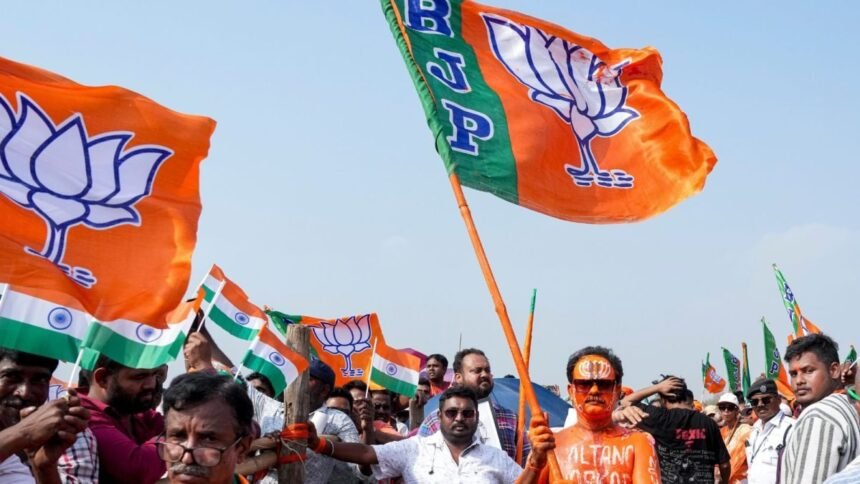
The 2026 manifesto suggests the BJP is no longer trying to replace Mamata Banerjee’s welfare politics; it is trying to replicate and surpass it. (PTI)

For all the headline-grabbing promises—the implementation of a Uniform Civil Code (UCC) within 60 days, and the familiar “detect, delete, deport” pitch on illegal immigration—the Bharatiya Janata Party (BJP)’s latest West Bengal manifesto reveals a far more consequential shift. Beneath the national security rhetoric lies a quieter but sharper recalibration: the BJP is now stepping squarely into the welfare battlefield long dominated by Mamata Banerjee and her Trinamool Congress (TMC).
The 2021 assembly election was, in many ways, the BJP’s high-water mark in Bengal, but also a lesson in limits. The party ran a campaign heavily loaded with themes of identity, national security, and polarisation. While it succeeded in consolidating a significant vote share and jumping from just two seats to 77, it failed to dislodge Banerjee, whose political instinct proved sharper. She anchored her campaign in tangible welfare delivery—cash transfers, subsidised schemes, and direct benefits that touched households across rural and urban Bengal.
Fast forward to the 2026 manifesto, and the BJP appears to have internalised that lesson.
The party has promised to outdo at least four existing TMC schemes, while layering on additional financial support programmes. This is more than policy mimicry.
BJP’S PROMISE VS TMC’S OFFER
This time, it seems the political fight in Bengal is a direct contest over welfare.
At the heart of TMC’s welfare model under Banerjee is the Lakshmir Bhandar scheme. Launched in 2021, it provides monthly financial assistance to women—initially Rs 500, now increased by Rs 1,000-Rs 1,200 depending on category. The BJP, in response, has promised a more aggressive cash transfer model, offering Rs 3,000 per month to middle class, lower-middle class and poor women, positioning it as a tool for financial independence.
The competition extends to unemployed youth as well. TMC’s Yuba Sathi scheme provides Rs 1,500 per month to unemployed youth in the age bracket of 21 to 40. The BJP counters with double the amount—Rs 3,000 monthly allowance, coupled with a broader promise of one crore job creation over five years, attempting to blend welfare with employment assurance.
In healthcare, TMC’s Swasthya Sathi offers insurance coverage up to Rs 5 lakh per family. The BJP proposes integrating beneficiaries with the central scheme Ayushman Bharat while increasing the coverage limit beyond Rs 5 lakh, signalling both expansion and central alignment. Moreover, with Ayushman Bharat, beneficiaries can avail facilities pan-India, not just in West Bengal, as is the case with Sathya Sathi.
Farmers, too, are at the centre of this welfare duel. Under TMC’s Krishak Bandhu, farmers receive annual assistance ranging from Rs 4,000 to Rs 10,000. The BJP promises to enhance this by combining the Centre’s PM-Kisan scheme with additional state support, taking the total assistance to around Rs 9,000 annually. According to BJP, there won’t be any discrimination of categorisation under the new system where every farmer will get the same amount should the BJP come to power.
WHY THIS SHIFT MATTERS
This is a tacit admission of a political truth in Bengal—welfare is not just governance, it is electoral currency.
Banerjee has, over the years, perfected a model where the state’s presence is felt directly in citizens’ lives through schemes like Lakshmir Bhandar and Kanyashree.
These are more than freebies; they are monthly reminders of state support that touches lives. The BJP erred in the 2021 election by underestimating the emotional and economic heft of this model. Even as late as November 2025, the BJP posted a video from its official social media handles, criticising the Bengal chief minister’s dole politics, claiming her freebies are a “debt trap, not a gift”.
However, BJP soon realised that rural Bengal, particularly rural parts of south Bengal, will remain a no-go zone for the party unless they welcome doles that made families loyal to TMC.
By contrast, the 2026 manifesto suggests the BJP is no longer trying to replace Banerjee’s welfare politics; it is trying to replicate and surpass it.
BEATING TMC AT ITS OWN GAME?
This raises a deeper question: can the BJP out-TMC the TMC? There are two risks here. First, credibility. Welfare politics is not just about announcing schemes; it is about trust in delivery. Banerjee’s government enjoys an advantage of being in power. During Madhya Pradesh assembly elections, regardless of Rahul Gandhi’s promise, then chief minister Shivraj Singh Chouhan could deliver on his promises immediately. That is always an added advantage for any ruling party.
Second, differentiation. If both parties are promising similar benefits, the contest shifts from ideology to execution and personality. In such a scenario, Banerjee’s entrenched grassroots and network for decades (including being in power for 15 years) and direct connection with beneficiaries could still give her an edge.
Yet, there is also opportunity for the BJP. By expanding its appeal beyond ideological voters to welfare-dependent households, it broadens its electoral base and vote share. This is particularly significant in a state where economic precarity makes direct financial support a decisive factor.
What we are witnessing is not just a Bengal-specific adjustment, it is part of a larger evolution in Indian politics. Welfare is no longer the monopoly of any one party or ideology. From the Centre to the states, competitive populism has become the norm.
The BJP’s Bengal manifesto is a clear signal that ideology may set the tone, but elections are increasingly won on economics of the everyday.
April 11, 2026, 13:48 IST
Read More