

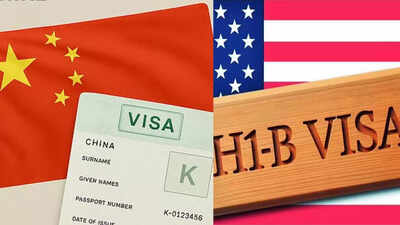
In today’s competitive global talent market, countries are actively seeking skilled professionals, especially in science, technology, engineering, and mathematics (STEM). To attract international talent, China and the United States have developed specialised visa programs. China’s new K Visa, effective from October 1, 2025, focuses on young STEM professionals, offering flexibility, ease of entry, and the ability to engage in research, entrepreneurship, and academic exchanges. In contrast, the US H-1B visa, a long-established program, allows employers to hire foreign workers for specialised occupations but involves strict eligibility requirements, employer sponsorship, annual caps, and a complex application process. Understanding the differences between these visas is essential for international professionals planning their careers abroad and seeking global opportunities.
Understanding US H-1B Visa and China’s K Visa
US H-1B Visa
The H-1B visa is a long-established US work visa for foreign workers in specialty occupations that require at least a bachelor’s degree or equivalent, including fields like IT, engineering, healthcare, and finance, as explained on USCIS official pages. Unlike China’s K visa, the H-1B requires employer sponsorship. A US company must first file a Labor Condition Application (LCA) with the Department of Labor and then submit Form I-129 to USCIS on behalf of the employee, according to US Department of Labor H-1B Program reports.As of September 2025, the H-1B annual cap remains at 85,000 visas per year (65,000 regular plus 20,000 for advanced degree holders), as reported by USCIS. Applications exceeding this limit are selected via a lottery. A recent announcement by the White House introduced a temporary $100,000 fee for new H-1B petitions filed for beneficiaries outside the US, though this does not apply to renewals or existing H-1B holders, as reported by Reuters.H-1B visas are granted initially for up to three years and can be extended to a maximum of six years. Visa holders are tied to their sponsoring employer but may pursue permanent residency under the “dual intent” provision, allowing them to apply for a green card without affecting their nonimmigrant status, according to USCIS FAQs. H-1B holders are restricted to work described in the petition; engaging in other employment requires a new petition.
China’s K Visa
According to the State Council of the People’s Republic of China, effective October 1, 2025, China will introduce a new K visa designed to attract young professionals in science, technology, engineering, and mathematics (STEM), as well as researchers, teachers, and entrepreneurs. The purpose of this visa, according to government announcements reported by China Briefing, is to enhance China’s innovation ecosystem by making it easier for international talent to participate in academic, research, and entrepreneurial activities.The K visa does not require employer sponsorship, allowing individuals to apply independently, which distinguishes it from many other work visa categories, as noted in reports by Newland Chase. Holders of the K visa are permitted to engage in academic exchanges, research, entrepreneurship, cultural programs, and business ventures.
Key differences between US H-1B Visa and China’s K Visa
US H-1B Visa vs. China K Visa: Purpose, target audience, application process and more
Purpose
China’s K Visa was introduced to draw in young professionals in science, technology, engineering, and research. The Chinese government’s goal is to strengthen its innovation ecosystem by making it easier for international talent to participate in academic, research, and entrepreneurial activities inside China.The US H-1B visa, on the other hand, is designed to help American companies address skill shortages. It enables employers to temporarily hire highly educated foreign workers in specialty occupations such as IT, engineering, medicine, and finance. Its primary aim is to fill workforce gaps rather than encourage independent talent exchange.
Target audience
The K Visa specifically focuses on younger professionals with STEM backgrounds who either hold a bachelor’s degree or higher or are engaged in teaching and research. This is meant to align with China’s strategy of attracting youthful, innovative talent that can contribute to long-term scientific advancement.The H-1B visa targets skilled foreign workers in specialty occupations that require at least a US bachelor’s degree or equivalent. Unlike China’s K Visa, the H-1B does not focus on age or independent innovation but instead on filling specific job roles within US companies.
Employer sponsorship
For the K Visa, employer sponsorship is not required. Applicants can submit their visa applications individually, which makes the process more flexible for people who want to engage in research, academic exchange, or entrepreneurial projects without being tied to a specific company.In contrast, the H-1B visa is employer-dependent. A US company must first file a Labor Condition Application (LCA) with the Department of Labor to ensure wage and workplace compliance. Then, the employer files Form I-129 with USCIS on behalf of the applicant. The worker cannot apply independently, making this visa highly structured and employer-driven.
Application process
China’s K Visa is intended to be streamlined and less bureaucratic, allowing individual applications without the heavy employer paperwork that characterizes the US system. Official details are still limited, but the State Council has emphasised efficiency.The H-1B visa requires multiple steps: an employer must obtain an LCA, file a petition with USCIS, and await approval before the applicant can apply for a visa stamp at a US consulate. This process is considered complex, time-consuming, and expensive, often requiring legal assistance.
Annual cap
As of now, China has not announced a numerical cap for K Visas. This suggests potentially broader access, though exact quotas may be clarified in future regulations.For the H-1B, there is a strict annual cap of 85,000 visas: 65,000 regular slots and 20,000 reserved for individuals with advanced degrees from US institutions. When applications exceed this limit, a computerized lottery system decides who can proceed, making the process highly competitive.
Duration and flexibility
Official regulations for the K Visa’s length of stay and renewal terms have not yet been published. Government announcements only note that it will allow “longer stays” and “multiple activities,” implying more freedom compared to traditional Chinese visas.The H-1B is granted initially for up to three years and can be extended for a maximum of six years. It is tied to the sponsoring employer and specific job role. However, it does allow “dual intent,” meaning an H-1B holder can apply for a green card without jeopardising their nonimmigrant status.
Activities allowed
The K Visa is designed to allow participation in academic exchanges, scientific research, entrepreneurship, cultural programs, and business ventures. This makes it versatile for those who want to explore multiple opportunities in China.The H-1B visa is restricted to the job described in the employer’s petition. If the worker wants to change jobs, the new employer must file a new petition. Other business or academic activities outside the approved role are not permitted without separate authorization.
Cost
China has not yet released the official fee schedule for the K Visa. Early indications suggest it may be less expensive than employer-sponsored visas since there are no associated corporate legal or filing fees, but this remains unconfirmed.The H-1B visa is known for its high costs. Employers typically pay USCIS filing fees, fraud prevention fees, and sometimes attorney fees, while workers may also bear costs for visa stamping and legal services. Recently proposed legislation suggested a $100,000 supplemental fee for some petitions, but this is not yet law.
Strategic advantage
China’s K Visa provides flexibility and independence, allowing talented professionals to move between research, business, and academic roles without employer restrictions. It aligns with China’s push to become a global hub for scientific innovation.The H-1B visa offers a structured career pathway, anchored to employment with a US company. While less flexible, it provides stability and, importantly, a potential route to permanent residency through green card sponsorship, making it attractive for those seeking long-term settlement in the United States.Also Read | World’s oldest woman, 116, meets King Charles in historic royal visit honouring a century of life, legacy and longevity

