
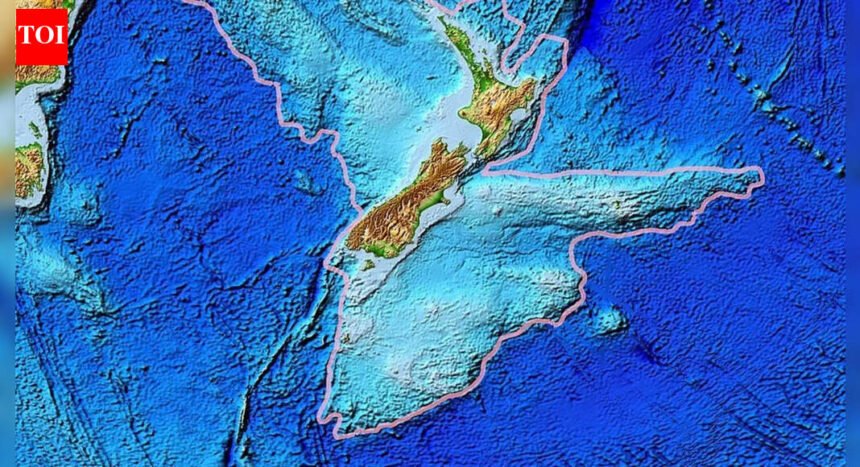
For much of modern geological history, the number of continents seemed fixed and unquestioned. Yet a mostly submerged landmass in the South Pacific has disrupted that familiar picture. Zealandia, sometimes called Earth’s hidden continent, has captured global attention because it challenges long-standing assumptions about what a continent is, how continents form, and why some remain at the surface while others sink. The idea that Earth may have an eighth continent has become increasingly relevant as improved mapping technology brings clearer evidence of Zealandia’s scale, structure and ancient origins. This interest reflects a broader scientific shift toward understanding submerged crust and the dynamic evolution of Earth’s surface over deep time.
What makes Zealandia a continent despite being underwater
The concept of an underwater continent sounds counterintuitive, yet Zealandia fits the modern geological definition surprisingly well. Continental crust is generally thicker, lighter and compositionally distinct from oceanic crust, and Zealandia aligns with all of these characteristics. It spans roughly 4.9 million square kilometres, a size comparable to India, but only a small fraction, close to 5 per cent, rises above sea level. These exposed fragments form New Zealand, New Caledonia and a scattering of small islands. The rest lies hidden beneath the Pacific and Tasman Seas, its ridges and plateaus sitting just below the surface. Despite this submergence, Zealandia exhibits the complexity expected of a continental landmass, with a varied crustal thickness, ancient mountain roots and distinct geological provinces that stretch across its entire width.This partly submerged nature is the primary reason Zealandia remained overlooked for so long. Many earlier classifications relied on visibility rather than crustal characteristics. As understanding of plate tectonics expanded, however, it became clear that continents can be tectonically modified, stretched, fragmented and submerged without losing their essential identity. Zealandia’s spread-out shape and unusually thin crust indicate a turbulent tectonic past that left it too buoyant for complete destruction yet not buoyant enough to remain fully elevated.
What recent mapping finally confirms about Zealandia
The turning point for Zealandia came with a comprehensive geological mapping project completed by GNS Science in 2023. This work, which represents the first time any continent has been mapped entirely to its underwater edges, confirmed the continuous extent and structure of Zealandia. The project combined rock dredging from the seafloor, marine seismic surveys, magnetic measurements and crustal modelling. These methods allowed researchers to trace the continent’s boundaries in detail and to distinguish its continental crust from surrounding oceanic crust. The findings confirmed a sprawling landmass with a clear geological coherence, spanning volcanic arcs, sedimentary basins, metamorphic belts and granitic regions.A major feature highlighted in the mapping was a 4,000-kilometre granite belt, the Median Batholith, which serves as an ancient backbone running through much of Zealandia’s length. The presence of this feature, along with volcanic fields and crustal blocks that match exposed regions in both New Zealand and New Caledonia, offered strong evidence that Zealandia behaves geologically like other recognised continents. This mapping was decisive in strengthening the case for Zealandia as Earth’s eighth continent.
Why Zealandia drowned after breaking away from Gondwana
Understanding how an entire continent ended up beneath the ocean requires looking back tens of millions of years to the breakup of Gondwana. Zealandia was once joined to Antarctica and Australia as part of this supercontinent. During the Cretaceous period, forces pulling Gondwana apart stretched Zealandia’s crust significantly. As the crust thinned, it lost buoyancy, lowering the landmass gradually. Magmatic activity surged during this stretching phase, creating a volcanic region roughly the size of modern New Zealand. These volcanic and tectonic processes weakened the crust further, and sections of Zealandia ultimately sank to their present depth while remaining intact enough to preserve continental characteristics.Rather than collapsing into isolated fragments, Zealandia retained a broad, unified crustal structure, which explains why it still qualifies as a continent despite submergence. This slow sinking also helps clarify why New Zealand’s landscape appears so geologically young and dynamic. The interaction between the Pacific and Australian Plates continues to shape the exposed portions of Zealandia today, creating earthquakes, uplifting mountain ranges and generating volcanic activity.
Why defining Zealandia as a continent matters
The recognition of Zealandia as the eighth continent has broader scientific consequences. It forces researchers to refine how continents are defined and understood, shifting the focus from simple visibility to structural and compositional criteria. This re-evaluation opens opportunities to reconsider other submerged crustal regions and to explore how continental fragments evolve. Zealandia also provides a rare natural laboratory for studying continental thinning, rifting and submergence, processes that influence the development of continental margins across the world.Because Zealandia’s full map now exists, scientists can study how continents respond when subjected to extreme tectonic stretching or volcanic surges. This is particularly valuable for understanding plate interactions, mantle dynamics and the long-term evolution of Earth’s crust. For New Zealand and surrounding regions, the scientific insights also support more accurate geological hazard assessments, resource studies and environmental models.Also Read | Oceans in danger! EU warns ocean carbon removal once seen as a ‘miracle climate cure’ may turn into a global threat

