Last Updated:
Tagore had argued that the later verses of Vande Mataram could alienate non-Hindu communities, whose monotheistic beliefs prohibit worshipping physical entities or deities




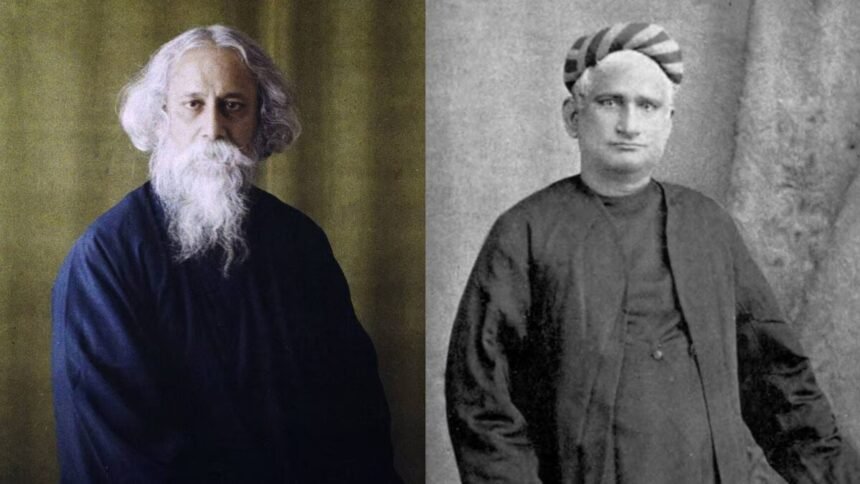
In October 1937, facing growing communal friction, the Congress sought the guidance of Rabindranath Tagore about Bankim’s Vande Mataram. File image
A fierce political clash has erupted over India’s National Song, Vande Mataram, after the Congress Working Committee (CWC) reaffirmed its 1937 policy to sing only the first two stanzas at official party events.
The decision follows allegations by the Bharatiya Janata Party (BJP) that Congress leaders showed disrespect during the song’s rendition on Independence Day. The debate highlights an 89-year-old compromise crafted by Nobel laureate Rabindranath Tagore, Mahatma Gandhi, and Jawaharlal Nehru—a historical decision that remains a central flashpoint in Indian politics.
The 1937 Resolution: Tagore’s Intervention
Composed by Bankim Chandra Chattopadhyay in 1875 and later integrated into his 1882 novel Anandamath, Vande Mataram served as an anthem during the Indian independence movement. However, as anti-colonial protests grew, the song’s latter stanzas sparked intense debate.
Beyond its musical verses, critics and historians often point out the complex political narrative within Bankim’s Anandamath. Set against the backdrop of the 18th-century Sannyasi Rebellion, the novel depicts an uprising where the armed ascetics openly target Muslim rulers and local communities, framing Muslim governance as a source of anarchy and oppression that needed to be overthrown.
Crucially, the novel adopts a remarkably favourable stance towards the British. In the concluding chapters, a mystic guide explicitly advises the rebels to stop fighting, declaring the British to be allies rather than enemies. Bankim presented British rule as a necessary, providential phase that would restore order and foster the revival of native knowledge—a narrative element partly shaped by his own background as a colonial civil servant, which critics argue alienated non-Hindu communities and complicated the song’s legacy as a universal national anthem.
In October 1937, facing growing communal friction, the CWC sought the guidance of Rabindranath Tagore. Tagore wrote to Jawaharlal Nehru, explaining that while the first two stanzas offered a non-denominational tribute to the motherland—praising its rivers, orchards, and fertile fields—the subsequent stanzas contained explicit Hindu religious imagery, equating the nation with deities like Durga and Kamala.
Tagore argued that the later verses could alienate non-Hindu communities, particularly Muslims, whose monotheistic beliefs prohibit worshipping physical entities or deities. Acting on Tagore’s counsel alongside Mahatma Gandhi, Netaji Subhas Chandra Bose, and Sardar Vallabhbhai Patel, the CWC formally resolved on October 28, 1937, that only the first two stanzas would be sung at national gatherings to preserve secular unity.
This two-stanza standard was later adopted by Constituent Assembly President Dr Rajendra Prasad on January 24, 1950, when Vande Mataram was declared the National Song alongside the National Anthem, Jana Gana Mana.
Why the Two-Stanza Policy ignites Debate
Nearly nine decades later, the historical compromise remains deeply divisive, reflecting two contrasting visions of Indian nationalism:
- The BJP Perspective: Ruling party leaders argue that truncating Vande Mataram in 1937 represented an act of “appeasement politics” that validated communal divisions and fueled the two-nation theory, ultimately contributing to Partition. Following the Ministry of Home Affairs’ protocol requiring all six stanzas to be rendered at government functions, the BJP accuses Congress of repeating a “historical error” and failing to honour Bankim Chandra’s complete creation.
- The Congress Perspective: Opposition leaders maintain that adhering to the 1937 resolution respects the consensus established by freedom movement icons like Tagore, Gandhi, and Nehru. They assert that the first two stanzas capture the universal patriotic spirit of the nation without imposing specific religious symbolism on a diverse populace.
The Modern Legal Landscape
The row comes in the wake of recent legislative changes under the Prevention of Insults to National Honour (Amendment) Act, which extended legal protections to Vande Mataram similar to those granted to the National Anthem.
As the battle over national identity continues, the 89-year-old debate over Vande Mataram underscores the ongoing tension between preserving historical compromises for pluralism and promoting a uniform national culture.
About the Author

Pathikrit Sen Gupta is a Senior Associate Editor with News18.com and likes to cut a long story short. He writes sporadically on Politics, Sports, Global Affairs, Space, Entertainment, And Food. He tra…Read More
August 21, 2026, 18:02 IST
Read More