Last Updated:
Voters are uncertain whether they can trust AJUP after AIMIM’s public break-up and widespread media coverage.




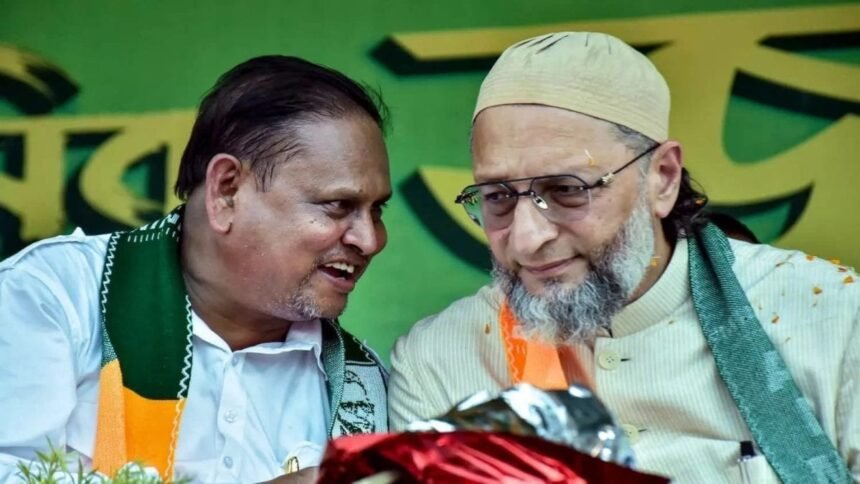
Asaduddin Owaisi formed an alliance with Humayun Kabir for Bengal Assembly polls.
It was Friday. It was 5.30 in the morning when most of West Bengal was waking up. At the crack of dawn, Asaduddin Owaisi’s AIMIM broke up with Humayun Kabir’s Aam Janata Unnayan Party (AJUP), making the news public.
Barely weeks after the two appeared together in Kolkata and announced they would fight for minorities in the state against the TMC, this decision came rather quickly.
The reason? A sting operation released by the ruling TMC, claiming a “covert” understanding with the BJP — that Kabir’s party would emerge as the kingmaker in Bengal in exchange for the Deputy Chief Minister’s post. AIMIM’s decision to break ties with Bengal’s new Muslim party came despite Kabir saying the video is fake and created using advanced artificial intelligence. He has also challenged the TMC to prove the allegations or face a Rs 2,000-crore defamation case.
Notwithstanding the claims made by Kabir, AIMIM said, “Humayun Kabir’s revelations have shown how vulnerable Bengal’s Muslims are.” In their political break-up message, they claimed Bengal’s Muslims are among the “poorest, neglected and oppressed communities”. Owaisi’s party made it clear that they would rather fight independently than share the political burden arising from allegations against Kabir by remaining his ally.
Humayun Kabir’s revelations have shown how vulnerable Bengal’s Muslims are. That AIMIM cannot associate with any statements where integrity of Muslims is brought into question. As of today, AIMIM has withdrawn its alliance with Kabir’s party. Bengal’s Muslims are one of the…— AIMIM (@aimim_national) April 10, 2026
What does this mean for Bengal’s politics, where minorities form 27 per cent of the population according to the 2011 Census, and are a decisive voting bloc that has backed Mamata Banerjee since she came to power in 2011?
Owaisi Has A Bigger Turf To Protect
For Owaisi, Bengal is a small entry point. Beyond Telangana, his party has made inroads in Maharashtra, Bihar and Karnataka as a political outfit that speaks for Muslims. One may disagree with its approach, but it does have takers among the minority community in those states.
In this election, he wanted to expand his footprint to West Bengal, where he had tied up with Humayun Kabir’s party, which capitalised on the disenchantment among Muslims in Murshidabad and Malda districts — two Muslim-heavy districts of Bengal.
However, the TMC’s purported sting operation, which Kabir has contested, makes him and his party a liability for AIMIM, regardless of the truth. It could have a spillover effect in other states where AIMIM is active, raising uncomfortable questions among its support base. No wonder AIMIM immediately broke ties to shield its larger political interests.
Despite Kabir’s Dismissal, Perception Matters
Despite Humayun Kabir’s aggressive dismissal of the sting — calling it an AI-generated fabrication and threatening legal action against the TMC — politics is often about perception.
In the purported video, the former TMC MLA, now a prominent face of Muslim politics in the Murshidabad-Malda-Birbhum belt, is seen speaking to a man not visible on camera. Kabir is heard claiming he has a “covert” understanding with BJP leader Suvendu Adhikari — that if he secures 70–80 seats and the BJP gets around 100–120 seats in the Assembly polls, he would extend support in exchange for the Deputy Chief Minister’s post. Kabir has dismissed the entire video as AI-generated.
However, his past statements may make the claims appear believable to some Muslim voters, even if the video is indeed fabricated. In mid-March, in an interview to PTI, he said, “If our party forms the government, then there will be a Muslim chief minister for the first time. But even if we do not form the government, we will bring such numbers that no government can be formed without us.”
At the time, these may have seemed like typical election-season claims, but such statements could now fuel suspicion and be exploited by his detractors.
A Fractured Muslim Vote?
Muslims have largely voted en bloc for Mamata Banerjee’s TMC since 2011, when their allegiance shifted from the Left Front. However, for the first time, a section of Muslim voters in districts such as Murshidabad, Malda, Uttar Dinajpur and Birbhum appears increasingly detached from the ruling party, despite the BJP’s repeated allegations of Muslim appeasement over the years.
Kabir, a politically astute figure, used a large tract of private land in Beldanga in Murshidabad — a district with a 66 per cent Muslim population — to construct a mosque named after Babri, evoking strong emotions among local Muslims. This soon translated into a steady stream of support for him. Kabir launched his party, allied with AIMIM, and had Owaisi’s backing.
After all, Owaisi may be a prominent pan-India Muslim leader, but his acceptability in Bengal is limited. Cultural differences matter — Owaisi eats mutton, while Bengal’s Muslims prefer fish; he wears a crisp suit, while rural Bengal’s Muslims often wear a lungi. He needed a local bridge, and Humayun Kabir was that bridge. It was a mutually beneficial arrangement.
But now, suddenly, the Muslim voting pattern in these districts — which could have seen a shift towards the alliance — is in disarray just ahead of the election. Voters are uncertain whether they can trust AJUP after AIMIM’s public break-up and widespread media coverage. AIMIM itself is contesting a limited number of seats.
Will voters return to the Congress or the TMC for political security, even if reluctantly? With AJUP, AIMIM, the Left, Congress and the TMC all vying for their attention, and no clear consolidation yet, there is a real possibility that this break-up could fragment Muslim votes — potentially benefiting the BJP.
April 10, 2026, 16:25 IST
Read More