Last Updated:
The popular narrative that Nitish Kumar gave away Bihar to BJP by stepping into the Rajya Sabha and allowing Samrat Choudhary to occupy the chief minister’s chair is superficial




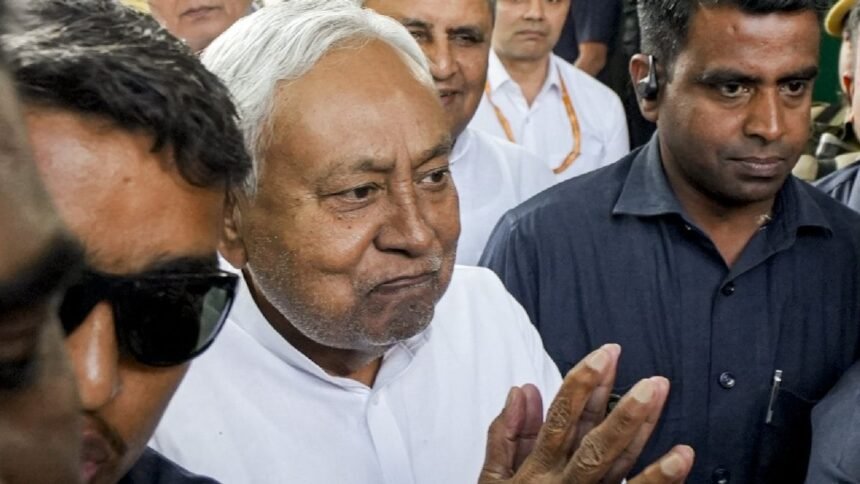
Beyond the state‑level structure, JD(U) Nitish Kumar’s positioning also responds to a wider national‑level mood among upper castes. (Image: PTI/File)
Nitish Kumar’s latest political manoeuvre in Bihar can be read as a masterstroke in consolidating his own authority, even as the BJP achieves a historic milestone by having its own chief minister through Samrat Choudhary.
The transition from speculation about the fading relevance of the Janata Dal (United) in the National Democratic Alliance (NDA) setup to the emergence of a Nitish Kumar‑centric architecture reveals a carefully staged power‑sharing script that deepens his grip over the non‑Yadav OBC‑EBC‑upper‑caste matrix rather than weakening it.
The popular narrative that Nitish gave away Bihar to the BJP by stepping into the Rajya Sabha and allowing Samrat Choudhary to occupy the chief minister’s chair is superficial. In reality, the move follows a classic pattern unique to him.
He has tried to further solidify the grassroots organisation and caste arithmetic while delegating the formal office to a senior ally. By insisting that the BJP accept Choudhary as CM and successfully communicating that choice to New Delhi, he has again demonstrated that this is not a retreat but a rebranding of dominance: he shifts from the visible face of governance to the invisible architect who sets the tone, lineup, and caste calculus of the government.
At the social level, the appointment of Choudhary – a Koeri leader from the ‘Luv‑Kush’ (Kurmi-Koeri) social bloc that Nitish has relied on since the 1990s – reaffirms his core non‑Yadav OBC and EBC base. He built his mass politics by positioning himself as the alternative to Lalu Prasad Yadav’s Muslim-Yadav model and, by ensuring that a Koeri becomes CM, he sends a strong signal that the non‑Yadav OBC and EBC communities still see him as their primary political patron.
It is a strategic recalibration of caste equations to isolate the RJD‑Muslim‑Yadav combine and upgrade the standing of Koeri and allied castes within the NDA structure.
THE CHOICE OF DEPUTIES
The expected appointment of Bhumihar upper-caste leader Vijay Chaudhary and Yadav leader Bijendra Prasad Yadav as deputy CMs is the most significant aspect of this power‑sharing matrix.
Traditionally, the upper castes in Bihar have been the BJP’s natural social base, while the Muslim‑Yadav have been the core of the social coalition of Lalu Prasad Yadav and now his successor and son, Tejashwi Yadav. Nitish’s ability to pull a Bhumihar leader from his own party into the deputy CM slot and secure the representation of a Yadav leader within the JDU‑led NDA framework signals a tactical reconfiguration of caste alignments.
For the BJP, accepting these two deputies alongside its own CM means that the real caste balance of power in Bihar still runs through JD(U). The upper‑caste Bhumihar face legitimises the BJP‑JD(U) coalition in the upper‑caste belt, while the Yadav name creates a fault line in the traditional Yadav‑RJD ecosystem.
If Bijendra Prasad Yadav can comfortably occupy a deputy CM seat under a Nitish Kumar-led coalition, it weakens the monopolistic claim that only the RJD represents Yadav interests.
NITISH KUMAR’S SYMBOLIC ADVANTAGE
Beyond the state‑level structure, Nitish’s positioning also responds to a wider national‑level mood among upper castes.
From the 2018 amendment to the SC/ST Prevention of Atrocities Act to the more recent UGC 2026 equity regulations, upper‑caste groups, especially in north India, have expressed unease over what they see as an increasingly assertive, identity-based framework that potentially marginalises their voices. Nitish’s decision to anchor the Bihar government in a more inclusive, caste‑broad coalition without abandoning upper‑caste representation, plays directly into this sentiment.
By ensuring that a Bhumihar leader becomes deputy CM and by keeping Brahmin leaders like Sanjay Jha in the national working president position, Nitish signals that the JD(U) is not just a non‑Yadav OBC‑centric party but a multi‑caste, pan‑Bihar formation. This helps the party horizontally expand its base across castes rather than being confined to a limited social category.
In the broader picture, Nitish has once again re-established himself as the indispensable balancer in Bihar’s politics. His decision to become a Rajya Sabha member while allowing Choudhary to be CM gives him the freedom to operate at both national and state levels without being bogged down by day-to-day administrative heat.
April 15, 2026, 06:30 IST
Read More