Last Updated:
A hung assembly in Bengal would mean no party crosses 148 seats and no single party can form the government on its own




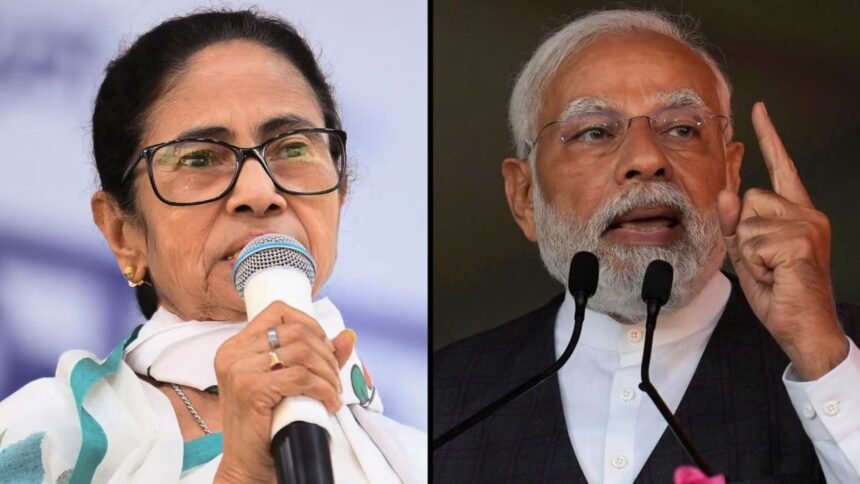
West Bengal Chief Minister and TMC chief Mamata Banerjee (Left); PM Narendra Modi. (PTI)
The 2026 West Bengal election is not throwing up a wave but a statistical deadlock. Across most exit polls, the story isn’t who is winning, but how narrowly the contest is balanced around the majority mark of 148. Seat ranges overlap, leads are fragile, and in several projections, a shift of even 5-10 seats could decide whether the state gets a stable government or slips into a hung assembly.
The core trend across most exit polls shows a neck-and-neck fight between the ruling Trinamool Congress (TMC) and the Bharatiya Janata Party (BJP), which has been working on expanding its footprint in the state.
According to Matrize (ABP), the BJP is expected to 146-161 seats, with the TMC at 125-140. At 146, the BJP would fall short, directly sitting in the hung assembly territory. PMARQ numbers, though slightly more in favour of BJP, also show the close contest. The poll gives BJP 150-175 seats and 118-138 to the TMC. Even here, the lower end (150) is just above majority (148), pointing to a fragile mandate. The tight nature of the contest is also visible in the fact that Axis My India, one of the most sought-after pollsters, decided to not release its numbers for the state, pointing to a massive chunk of voters who refused to disclose their choice. Some like Peoples Pulse gave both parties a massive overlap, showing that either could theoretically win.
The Hung Assembly Risk
Given the numbers, hung assembly remains a strong possibility in West Bengal. Most projections cluster around roughly 140-160 seats for BJP and about 120-140 for the TMC. This places both of them close to the majority mark, but not consistently above it, giving rise to the classic definition of a hung assembly scenario.
ALSO READ | Bengal Exit Polls 2026: CM Mamata’s Reign To End? Pollsters Predict Tight Fight Between TMC, BJP
However, it is important to note that exit poll numbers are only an indication and have a history of going wrong.
A hung assembly in Bengal would mean no party crosses 148 seats and no single party can form the government on its own.
What Happens If There’s A Hung Assembly?
In case of a hung assembly, the Governor steps in, inviting the largest party to try forming government first.
In case the BJP falls short of majority, it could seek support from smaller parties and Independents. The Trinamool, meanwhile, could look at the Congress and Left for support. Congress president Mallikarjun Kharge, when asked about supporting TMC in case the need arises, said the party would “wait for a clearer picture” to emerge.
Any government formed must prove majority in the assembly through a floor test. If no coalition works out, there’s a possibility of President’s Rule (temporary) and fresh elections (rare but possible).
What Makes 2026 Bengal Battle Different?
Unlike earlier elections, the 2026 poll is now a bipolar contest between TMC and BJP. The anti-incumbency votes are fragmented across parties and the over 92 per cent turnout indicates strong mobilisation.
ALSO READ | 2021 Exit Polls Vs Actual Results: How Accurate Were The Projections?
A hung assembly matters for BJP, even if it emerges largest, because it will need allies. This would limit its control in a state where the party has been trying to wrest power from Mamata Banerjee and make its mark.
For the TMC, it could be a test of opposition unity as the party could retain power despite trailing BJP if its national allies like Congress and Left lend a hand. This would also give the Congress and Left the opportunity to become kingmakers and gain relevance despite a low—or nil—seat share.
Read More