Last Updated:
The immediate trigger for this recalibration was an incident in Ghazipur earlier this month




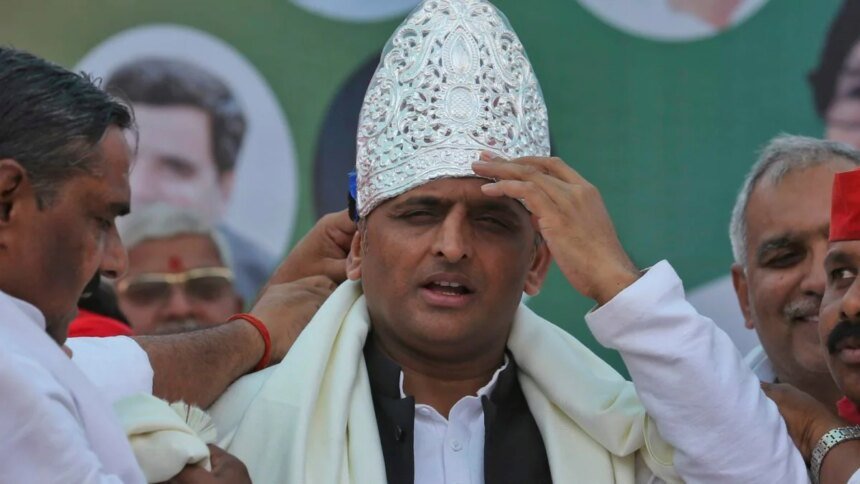
Samajwadi Party president Akhilesh Yadav. (AP File)
Will Samajwadi Party’s new strategy work or will it backfire?
As Akhilesh Yadav pushes the Samajwadi Party towards a “guerrilla war” style of politics ahead of 2027 Assembly Polls, the move is being seen as both a return to street mobilisation and a high-risk political gamble.
As a part of this strategy, SP leaders will now reach victims of crime and administrative failure without informing the police or local authorities in advance. The party says this is aimed at ensuring that its delegations are not stopped or restricted, while also allowing it to highlight what it calls governance failures in real time.
The trigger
The immediate trigger for this recalibration was an incident in Ghazipur earlier this month. On April 15, a young girl from an OBC community died under suspicious circumstances. When a Samajwadi Party delegation attempted to visit the family on April 22, the situation escalated into a clash with villagers, leaving several party leaders, including former minister Ram Asrey Vishwakarma, injured.
The party alleged that instead of acting against the accused, the police filed cases against its workers, reinforcing its belief that prior intimation to authorities works against its interests.
Following this, Yadav publicly declared that his party would no longer inform the administration before visiting victims. He argued that such information often leads to obstruction, and that direct, unannounced outreach is necessary to ensure justice for the affected families.
Political shift
The strategy also signals a broader political shift. In recent years, the Samajwadi Party has often been criticised for relying heavily on social media messaging and press conferences rather than sustained ground mobilisation. By adopting what it calls a “guerrilla war” model, the party appears to be attempting a return to its earlier style of politics—one that emphasised physical presence, rapid mobilisation, and direct engagement with local issues.
This approach draws parallels with the “Halla Bol” phase under Mulayam Singh Yadav, when the party built its identity through aggressive protests and street-level activism. The current shift suggests an effort to revive that legacy, particularly at a time when the party is seeking to consolidate its core support base.
Focus on PDA
A key component of the new strategy is its focus on PDA communities — Backward classes, Dalits, and minorities. Party leaders say that incidents involving these groups will receive particular attention, especially in cases where there are allegations of administrative inaction or bias. Delegations will not only visit victims but also offer legal and organisational support.
Political observers see this as a calculated move to regain grassroots relevance. By responding quickly to local incidents and physically reaching affected families, the party aims to position itself as an active and responsive opposition. It also allows the Samajwadi Party to shift its focus from broad national narratives to state-level governance issues that directly impact voters.
The risks and reactions
However, the strategy is not without risks. Unannounced visits to sensitive locations could lead to law-and-order challenges, as seen in the Ghazipur incident. There is also the possibility of confrontation with local communities or authorities, which could backfire politically if not managed carefully.
The ruling Bharatiya Janata Party has already criticised the move. Party leaders argue that such tactics are outdated and unnecessary in an era driven by transparency and communication. They have also questioned whether this approach could create avoidable tensions on the ground.
Despite the criticism, the Samajwadi Party appears committed to testing this strategy across the state. For Akhilesh Yadav, it represents an attempt to redefine his leadership style—moving from a controlled, message-driven approach to one that is more immediate, visible, and interventionist.
If it succeeds in reconnecting the party with grassroots issues and communities, it could strengthen the Samajwadi Party’s position as a credible opposition force.
April 27, 2026, 15:37 IST
Read More