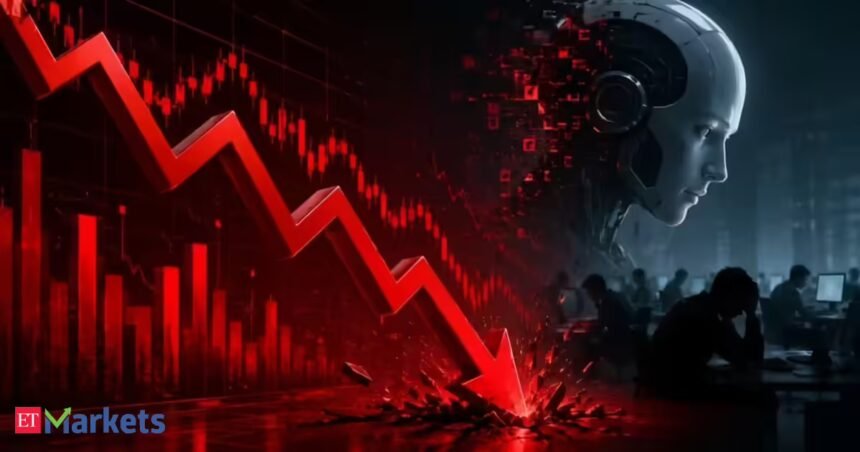
The Nifty IT index plunged nearly 6% on Wednesday, led by an 8% crash in TCS shares which recorded their sharpest single-day drop since the infamous COVID-19 crash of 2020. Persistent Systems, LTI Mindtree and Coforge shares sank nearly 7%, while Tech Mahindra and HCL Tech shares plunged 5-6%. Infosys shares tumbled 4%, while Wipro shares closed 3% lower.
This comes after the Nifty IT index jumped more than 4% on Tuesday to record its highest single day gain since May 2026. The index soared nearly 8% in just three sessions, before Wednesday’s sharp crash.
What led to the crash in IT stocks?
Analysts mostly attributed the sharp plunge in IT stocks to profit booking after the bull run. Apoorva Khandelwal from Anand Rathi Institutional Equity explained that IT stocks had previously jumped after Nvidia CEO Jensen Huang said that AI agents will be a big multiplier for software usage, which calmed fears that AI would dent software demand. This, along with Snowflake’s upbeat results, hopes of stronger AI-led spending, a weaker rupee, and expectations of US rate cuts boosted the stocks. However, the analyst added that the up move ran too far too fast, so investors are simply cashed in their gains.

Have IT stocks bottomed out? Khandelwal believes not. He advised investors to expect more such swings at least until the hype-laden three IPOs of SpaceX, OpenAI and Anthropic in the US, because prices now move sharply every time a new AI tool or model launches. “But the long-term story stays intact as clients move from building AI to actually using it across their businesses, Indian IT does that hands-on work and several new revenue pools are opening up,” he added, advising investors to use these dips to slowly accumulate select scaled large-caps like Infosys and LTM, and Persistent and Mphasis in mid-caps.
Uttam Kumar Srimal, Senior Research Analyst at Axis Direct, also explained that IT stocks could remain volatile as markets assess the impact of global economic conditions, interest rates, AI disruption fears creating doubts about long-term growth and pricing power for traditional IT services companies, corporate technology spending trends. From an investors stand point, the key variables to monitor over the next few quarters will be the recovery in U.S. discretionary spending, the extent to which AI starts contributing meaningfully to revenues, and improvements in utilization and hiring trends across the industy, he said.
Simple profit booking or fundamental weakness in IT stocks?
Harshal Dasani, Business Head at INVasset PMS, meanwhile said that the weakness in IT index is not just an AI-disruption story. AI may be the immediate trigger, but the larger problem is that valuations still do not reflect the slowdown in growth. He said that Wednesday’s crash was market’s way of saying “this was more of a dead cat bounce than a genuine trend reversal”. When a sector is growing at barely low single digits but continues to trade at mid to high teen earnings multiples, the risk-reward becomes difficult to defend, he added.
The rupee’s depreciation has helped reported earnings at the margin, but currency cannot compensate for weak client spending, slower deal conversion and the structural pressure AI is placing on the traditional outsourcing model, the analyst further said, adding that the bigger issue is that FIIs now have better alternatives. Korea, Taiwan, Japan and the US offer more direct exposure to AI-led earnings growth, while Indian IT is still trying to prove how AI will replace lost revenue rather than compress it, he said.
“Large IT companies remain high-quality businesses with strong balance sheets and cash flows, but quality alone cannot support premium valuations when earnings visibility is fading. Until the sector shows clear AI-led revenue acceleration, every bounce is likely to meet supply. The setup remains cautious, and the burden of proof is now on earnings, not commentary,” according to Dasani.
Technical view on IT stocks
Hitesh Rathi from Angel One meanwhile explained the move from a technical perspective. He said that the recent rebound in IT stocks was largely driven by the Nifty IT index approaching a major long-term support zone near the 50% Fibonacci retracement of its rally from the 2020 lows, which also coincides with a key historical swing low.
However, from a trend perspective, caution remains warranted. Rathi advised investors to look at the previous rebound as a relief rally within a broader corrective phase.
(Disclaimer: Recommendations, suggestions, views and opinions given by the experts are their own. These do not represent the views of The Economic Times)