I’m interested in two things that look contrary, but aren’t. One, that the Bharatiya Janata Party (BJP) has created a political miracle by making India almost a one-party state despite being well short of a Lok Sabha majority.
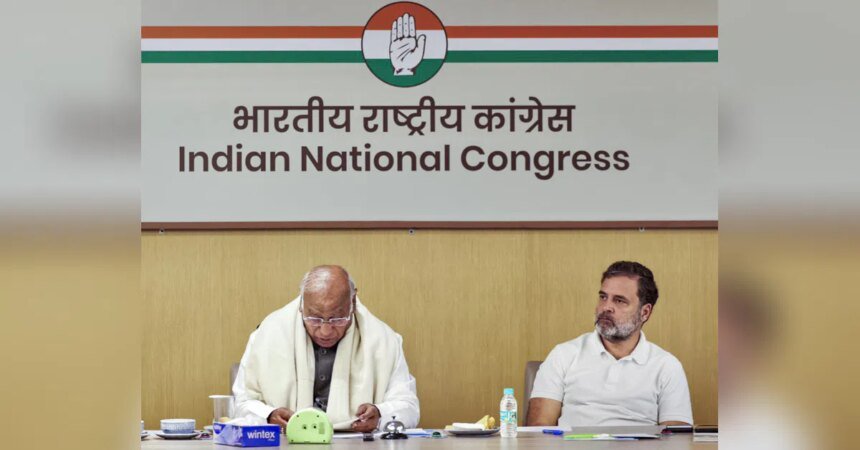
And two, that since much of this is being done by splitting, co-opting, or destroying regional parties, the Congress is the only significant Opposition that remains intact. Thereby, Indian politics has also become a two-party contest.
It should be a perfectly simple and linear equation. If only the Congress looked like a convincing challenger. It can’t, with a strike rate of 10 per cent or thereabouts against the BJP.
Such a two-party system will suit the BJP just fine because they’ve only struggled when up against a strong regional party. Most are now decimated and Akhilesh Yadav’s Samajwadi Party will face its trial by Yogi fire.
Three questions arise. One, why does the Modi-Shah BJP find the Congress such a convenient rival? Second, what does the Congress lack that it can’t be a credible challenger? And third, how can the Congress pull itself up?
The answer to the first is simple: The BJP is propelling itself on four engines: Hard Hindutva, harder nationalism, efficient and fair welfare, and massive physical infrastructure visible to all. The Congress doesn’t have a credible counter, which also answers the second question. If all of what the BJP is doing is wrong, as the Congress says, what will it do if it came to power?
On the economy, strategic issues and defence, how will it be different from the BJP? How’ll it deal with Pakistan, China, the United States, and West Asia? How will it spend on defence? What’s its vision for an alternative to the BJP? That the BJP is “corrupt, crony-capitalist, and compromising the national interest” are all opinions, which is fair enough in competitive politics. But, what will you do that’s different? If the Congress sees itself as the choice it wants voters to prefer over the BJP, how’s the product it’s offering different?
The Congress has to answer these questions first. And then counter the four engines we said are powering the BJP railroad. That we didn’t use juggernaut is deliberate. It would be factually wrong given the pace at which the BJP is moving and we’d rather avoid a metaphor from religious tradition.
The first, on Hindutva, the Congress shouldn’t even try competing with the BJP. That territory is taken and the Congress can’t dent it, however many temples its leaders visit. Even the Shiv Sena gave up. Uddhav Thackeray, in fact, said to me once, sort of philosophically, that Balasaheb (his father) erred in shifting from Maharashtravad (Maharashtra regional appeal) to Hinduvad, as it only enabled Narendra Modi to walk into Sena territory and take over. On welfare, the Congress can promise the world. It’s done so successfully in Karnataka and Telangana. On infrastructure, it will have a problem. All of these years, it has seemed to oppose too many marquee projects, Nicobar being the latest.
With religion out of reach and welfare/development being too anodyne to pack much emotion, the Congress is left with nationalism.
How the Congress has abandoned nationalism is the most intriguing aspect of its post-2014 politics. Some parts of it might pretend to be like the European Greens, but the real Congress was never a party of bleeding heart pacifists. It’s the party that, under Indira Gandhi, defeated and dismembered Pakistan in 1971, and, with Lal Bahadur Shastri as Prime Minister, won the 1965 war, in the sense that it fully thwarted and threw back Pakistan, which had launched the war confident of grabbing Kashmir.
It also fought hard, even brutally, against Northeastern insurgencies, sent the IAF to strafe and break the siege of Aizawl on March 5, 1966, as the rebels looked poised to overrun the treasury, the Assam Rifles battalion headquarters, and the Deputy Commissioner’s residence. And, while it may not want to be reminded of it now, it sent the Army into the Golden Temple complex in Operation Bluestar, following it up with Black Thunder 1 and 2.
The first two were under Indira and the last two under her son, Rajiv. Subsequently, it fought back two of our bloodiest phases of terrorism and insurgency, in Kashmir Valley and Punjab (1991-95). This was under P V Narasimha Rao. Even the war with Naga insurgents was fought with the harshest methods under Jawaharlal Nehru, who also sent the forces to liberate Goa. The Congress may not like its non-Gandhi/Nehru Prime Ministers, but the fact is, it never produced a leader that was weak on national security. It’s amazing, therefore, to see how the original party of hard nationalism has lost its way.
Whether on the surgical strikes post-Uri, bombing of Balakot after Pulwama, the East Ladakh/Galwan crisis and now Operation Sindoor, the Congress has greatly damaged its cause by only raising questions and seeking evidence. In some cases, the hangers-on close to Rahul Gandhi have done it — Sam Pitroda on Balakot, Digvijaya Singh on the surgical strikes. Lately, it’s Rahul himself.
His statement that the “Chinese are thrashing our soldiers” or have “occupied 2,000 km of our territory” even earned him a Supreme Court rebuke even as the judges let him off in a defamation case. On Op Sindoor, his intervention in Parliament was more about how many planes India lost and why. Separately, he posted on X, with a 17-second Jaishankar clip, to ask why India told Pakistan it would confine itself to attacking terror bases and won’t attack its military installations. One of his party MPs from Punjab even waved what he claimed was the wreckage of an IAF plane.
How smart is all of this? I can give you an idea of how his grandmother would have handled these. Each time, she would have started out by heaping high praise on Indian armed forces, hailed their success, and then attacked the Modi government for its multiple failures. The arrival of 300 kg of RDX in Pulwama, the lack of protection at Pahalgam, and may be too soft an approach initially in Op Sindoor.
She would then have said that our brilliant and indomitable armed forces performed a miracle despite “this incompetent and bumbling government, so thank you our soldiers and officers, pilots and airmen”. She would’ve clinically separated the armed forces and the government. The first she would praise, and attack the second. She would never ask if any planes were lost or talk loose and fast of territory “lost” to China merely on the evidence of social media posts from your durbaris.
This Congress doesn’t have the footwork to walk back from an error. Contrast this with Mr Modi. In his reply on the no confidence motion in the Lok Sabha on August 10, 2023, Mr Modi made what I then noted as three indiscreet statements: On Kachchatheevu, IAF strafing of Aizawl in 1966, and Operation Bluestar, or what he called “attack on the Akal Takht.” Now he did figure the downside in these statements. The Aizawl and Bluestar points, he never repeated again. Kachchatheevu came up on the eve of 2024 elections but has been forgotten. These were missteps he walked back. Each of these pertained to national security.
Indian nationalism is unique. It emerges from a shared sense of history: Ancient, medieval and modern, freedom movement and the Constitution. The BJP has Hinduised it. That’s where the Congress can find an argument, or product differentiation. But if it’s going to persist with its current approach, insisting that India — and its armed forces — only keep losing to China and Pakistan, nobody is going to be impressed. This, I’m afraid, can easily take today’s two-party equation to an unquestioned one-party system.
By special arrangement with ThePrint