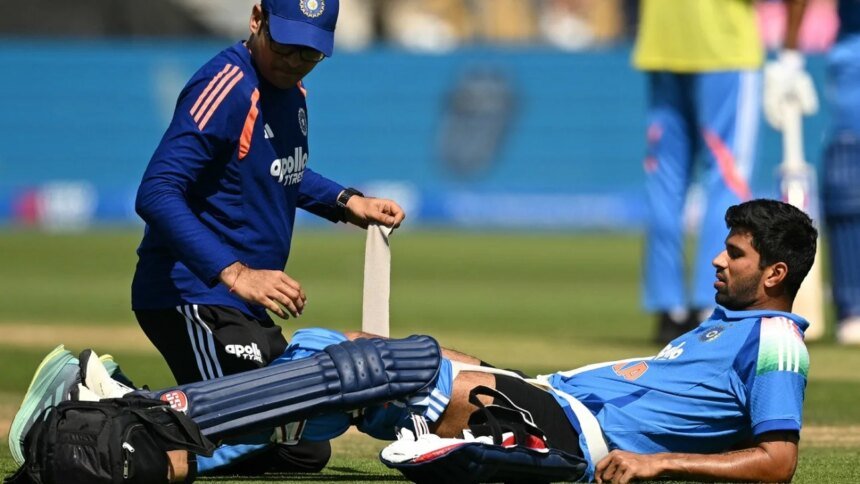
“If you look at the first squad we had announced [for the England ODI series], from that minimum five players did not play this match,” he said after defeat in the decider. “If one player is injured you look at playing another combination, two players are injured you look at playing another combination, but if after every match some player is missing then somewhere we are missing a trick.
“If you keep the World Cup as the goal where we have to play 11 matches in a row and here we have players not being able to finish a two-to-three-match series. So there is some limitation where our players are not being able to play continuously, they play one or two matches, they suffer a niggle and then we are forced to play a different combination which we originally did not plan to play.
“So keeping all this mind it becomes a little difficult that you come to the ground on the morning and you come to know a player has a niggle, then it’s almost like do you want to take a chance? Some player is 80% fit, you are playing with five bowlers and if this player comes out after bowling five overs, then who will bowl? This is difficult. So as a group we need improved our fitness and all those things.”
Talking about the Lord’s defeat itself, which turned out to be a run fest, Gill said that the India bowlers gave away too many loose deliveries in the first 10 overs as well as in the final 10 where the “momentum shifted” in favour of England.
“Our bowling is a little bit inexperienced,” he said. “We were put under the pump in this match and we didn’t respond well. We didn’t start well in the powerplay. We gave away too many loose balls and then were always chasing the game trying to take wickets, create something which didn’t happen for us. By then the game was already ahead of us.
“[In the] last three overs we gave away 62 [63] runs and that’s where the momentum completely shifted. We were sort of looking at [a target of] 340-350 at one point. They got close to 390 and chasing 390, no matter what surface you are batting on, [is] never easy.”
While India had played three bowling allrounders in Axar, Washington and Shivam Dube for the first two ODIs, the latter two were absent at Lord’s with Washington ruled out of the series due to injury and the latter benched and replaced by a specialist fast bowler in Prince Yadav.
According to Gill, the slowness in the pitch, which became more pronounced during the second half of India’s innings, played a role in them failing to scale the massive target despite being ahead compared to England until the 45-over mark.
However, Gill believed India played a “pretty decent” series despite the defeat. The one other key learning for him was that India were “in the game for about 80% of the time” but it was in the “crunch moment, actual moments that dictate the game” where his team were “missing the trick.” Gill said India needed to get “smarter” in assessing the conditions and cited India’s seamers giving away too many runs in the powerplay when England score 58 runs.
Nagraj Gollapudi is news editor at Cricinfo