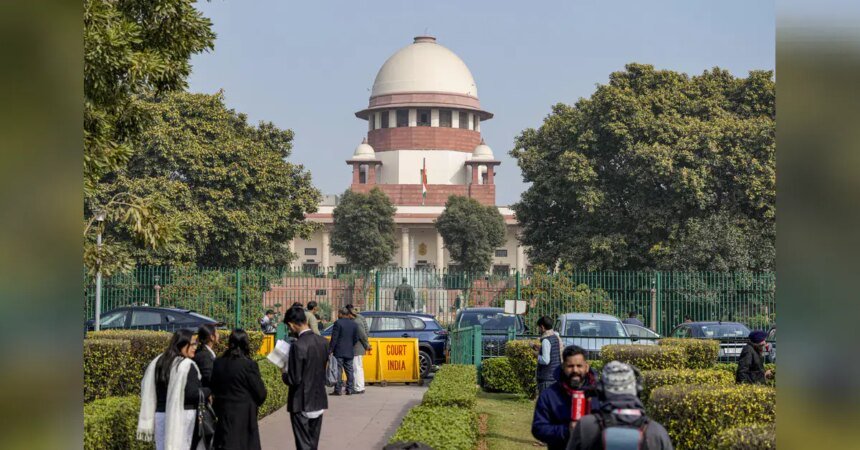
The Supreme Court on Wednesday held that judicial officers are a distinct class and cannot be equated with State government employees while examining whether the retirement age of District Judges should be raised from 60 to 62 years.
A Bench led by Chief Justice of India Justice Surya Kant, along with Justice Joymalya Bagchi and Justice V Mohan, rejected one of the principal objections raised by several State governments, which argued that extending the retirement age of judicial officers beyond that of government employees could invite claims of discrimination.
The issue arose during the hearing after amicus curiae and Senior Advocate Siddharth Bhatnagar informed the Court that some States had opposed the proposal on the ground that judicial officers are appointed by State governments and therefore should not enjoy a higher retirement age than other employees.
Rejecting the contention, the Bench observed: “Judicial officers are not government servants. Though they are appointed under the constitutional scheme by the State Government, they constitute a distinct and separate class.”
The Court held that prescribing a different age of superannuation for judicial officers is based on a reasonable classification. It noted that varying retirement ages already exist for professionals such as doctors and professors, adding that experience is a relevant factor while determining the appropriate retirement age in specialised services.
The Bench also dismissed the States’ argument that extending service would impose an additional financial burden. It observed that retirement itself entails payment of pension and other terminal benefits, while vacancies must subsequently be filled by new recruits drawing salaries.
Retaining experienced judicial officers, it said, could, in fact, reduce the financial liability.
“It seems to us that both the reasons assigned by the State Governments for declining to enhance the age of retirement are untenable,” the Court said.
The States were directed to reconsider the proposal independently, without linking the decision to the retirement age applicable to government employees.
During the hearing, the Court was informed that Telangana has already increased the retirement age of judicial officers to 61 years.
Madhya Pradesh indicated it was willing to consider a similar proposal based on the recommendation of the High Court’s Full Court, while Tamil Nadu stated it had no objection to raising the age to 61 years.
Himachal Pradesh, Jharkhand and Nagaland opposed the proposal, citing financial implications, while Assam and the National Capital Territory of Delhi sought additional time to decide.
The Court recalled its 1991 ruling in All India Judges’ Association vs Union of India, which directed all States and Union Territories to raise the retirement age of judicial officers to 60 years with effect from December 31, 1992, recognising the unique nature of judicial service.
It also noted that a subsequent review petition by States challenging that direction on grounds of financial burden and parity with other services had been rejected.
Referring to those precedents, the Bench said State governments should revisit the issue with a pragmatic approach instead of treating the recommendations of High Courts as determinative of their decision.
On July 22, the Supreme Court had directed High Courts to take a time-bound decision on the proposal to enhance the retirement age of judicial officers.
It also ordered that where a State government and the jurisdictional High Court agree on the enhancement, eligible officers may continue in service until the higher retirement age, with any eventual increase taking effect retrospectively for officers retiring on or after April 1, 2026.