Last Updated:
In the last Lok Sabha election, BJP and SAD contested separately. BJP did not win any of Punjab’s 13 seats but secured 18.56% of the vote. The SAD won one seat with 13.42%.




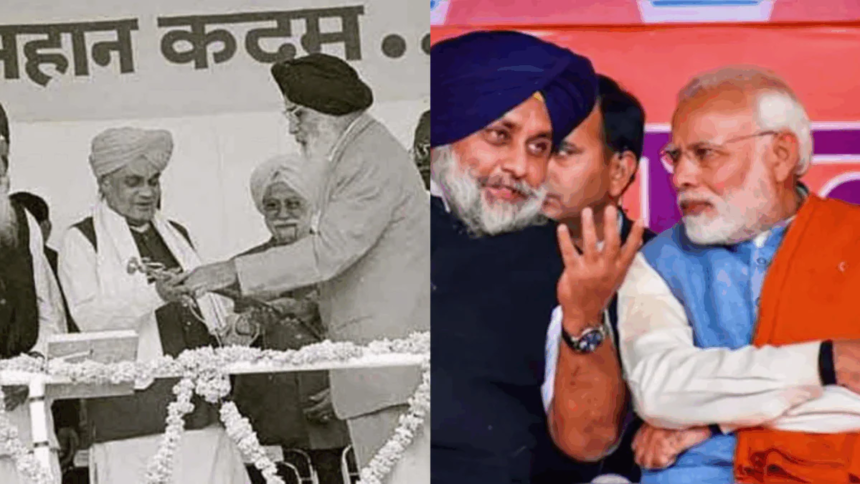
Parkash Singh Badal and senior BJP leaders including Atal Bihari Vajpayee and LK Advani helped transform the old, often tactical cooperation into a structured political partnership.
The BJP is looking to build on its recent success in West Bengal as it turns its attention to Punjab, with talks underway on a possible alliance with the Shiromani Akali Dal (SAD) ahead of the Assembly polls scheduled early next year.
The possibility of a BJP-SAD reunion gained momentum after SAD MP Harsimrat Kaur Badal made remarks about “agreements” that could bring development and progress to Punjab from Delhi.
One round of discussions between the two parties has already taken place, according to a NDTV report, with a second round expected soon. The talks are likely to focus on seat-sharing and the constituencies each party would contest.
‘People Want Both Parties Together’
SAD leader Bikram Singh Majithia said the two parties had a long history of working together. He said the alliance built by Atal Bihari Vajpayee and Parkash Singh Badal continued during Prime Minister Narendra Modi’s tenure, before the parties separated over the farm laws.
Majithia said people now wanted the BJP and SAD to come together because of Punjab’s position as a border state, along with concerns over social harmony, law and order, development and employment.
He said the final decision would be taken by the leadership of both parties and that the picture would become clearer in the coming days.
BJP Sees Vote Share Advantage
The BJP believes an alliance could benefit both parties and improve their chances in Punjab’s four-way electoral contest.
In the last Lok Sabha election, the BJP and SAD contested separately. The BJP did not win any of Punjab’s 13 seats but secured 18.56 per cent of the vote. The SAD won one seat with 13.42 per cent.
Together, the parties had around 32 per cent of the vote.
BJP leaders believe adding some more votes could allow the alliance to mount a strong challenge to the ruling Aam Aadmi Party (AAP), which they say is facing anti-incumbency.
The numbers were different in the previous Assembly election. The SAD won three of 117 seats with 18.38 per cent of the vote, while the BJP won two seats with 6.60 per cent.
The BJP’s Lok Sabha vote share was therefore nearly three times its Assembly vote share. If an alliance is finalised, the BJP is expected to seek more seats than it contested previously.
BJP Had Strong Showing In 38 Seats
In the Lok Sabha election, the BJP led in 23 Assembly segments, while the SAD led in nine.
The BJP finished second in around 17 Assembly segments and the SAD was runner-up in 14. The BJP lost five seats by fewer than 5,000 votes and another 10 by fewer than 10,000 votes.
The BJP believes this shows it has a strong independent position across 38 Assembly seats.
The two parties had maintained an alliance from 1996 to 2020. They won a landslide in 1997, when the SAD secured 75 seats and the BJP 18.
In 2007, the SAD won 49 seats and the BJP 19. In 2012, they made history by winning a second consecutive term, with the SAD taking 56 seats and the BJP 12.
BJP Targets AAP Government
The BJP plans to attack the AAP government over corruption, governance and unfulfilled promises. It also plans to highlight financial assistance and schemes provided to Punjab by the Centre.
The party may present a vision document focused on employment, while also proposing measures to rebuild Panthic and social trust.
The BJP has alleged that AAP, which came to power promising to fight corruption, has failed on that front. It cited the arrest of 144 government officials in corruption cases last year and 43 Punjab police personnel caught in bribery traps.
It also pointed to the dismissal of Cabinet Minister Vijay Singla over corruption allegations and Vigilance Bureau raids on MLA Raman Arora.
The BJP has further alleged that AAP’s senior leadership in Delhi controls Punjab’s government and extracts undue benefits from contractors.
Health, Education In BJP’s Attack
The BJP has also criticised the government over health, education and social justice.
It cited a primary-level dropout rate of 2.5 per cent, compared with the national average of 0.3 per cent.
According to the BJP, only 52.5 per cent of Punjab’s 3,699 health centres meet Indian Public Health Standards. Just 4.3 per cent of district hospitals and 4.9 per cent of Community Health Centres meet national quality standards, while only 15.7 per cent of Primary Health Centres meet them.
The party has also claimed that teacher vacancies in government schools stand at 60 per cent. It said a promise to establish 16 medical colleges had been made, but none has been set up.
BJP To Highlight Centre’s Support
The BJP plans to highlight central government assistance to Punjab.
Under PM-KISAN, Rs 7,596.84 crore was provided to 18 lakh farmer beneficiaries. Under MGNREGA, Rs 8,144.11 crore was allocated for rural development and 8.14 lakh person-days of work.
The Pradhan Mantri Gram Sadak Yojana received Rs 1,722.68 crore for 65,370.51 km of rural roads and 415 bridges. Another Rs 359.56 crore was allocated for individual and community toilets under Swachh Bharat Mission (Gramin).
The Centre also provided tap water connections to 32 lakh households under the Jal Jeevan Mission and supported the development of 816 Amrit Sarovars.
Railway and airport projects have also received central support.
The BJP is considering promises including financial assistance for women and new medical colleges, while seeking to shift Punjab’s economy away from “freebies” towards employment and wealth creation.
The strategy is to challenge AAP’s record while offering an alternative focused on Punjab’s economy, health, education and Panthic concerns.
Key Questions Answered
 Ask News18
A potential BJP-SAD alliance could significantly alter Punjab’s political landscape by transforming the electoral contest from a two-way race involving the Aam Aadmi Party (AAP) and Congress into a multi-cornered one. Both parties have struggled independently in recent elections, with the BJP not winning any seats in the last Lok Sabha election in Punjab despite securing 18.56% of the vote, and SAD winning only one seat with 13.
Ask News18About the Author

Shuddhanta Patra is an Indian journalist with about nine years of experience in covering national politics, geopolitics, defence, diplomacy and international affairs. Her reporting focuses on South As…Read More
Punjab, India, India
August 22, 2026, 08:33 IST
Read More