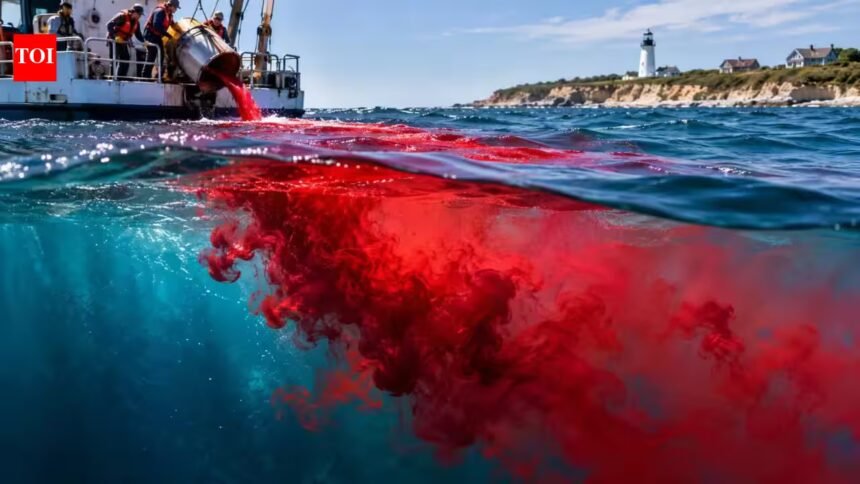
In a striking ocean experiment, scientists released 75 kilograms of rhodamine dye into the Atlantic Ocean south of Martha’s Vineyard, Massachusetts, to watch how water moves and mixes beneath the surface. The experiment, conducted on August 16–17, 2018, showed that the dye spread readily within the ocean’s upper mixed layer but crossed into the denser water below far more slowly, according to a study published in Continental Shelf Research on ScienceDirect. The findings offer a detailed glimpse into a part of the ocean that is constantly being stirred by winds, waves and currents, and show just how strongly the ocean’s structure can limit movement between its layers.
Why release dye into the ocean?
The experiment was not intended simply to watch a colourful plume drift through the sea. The researchers were using rhodamine, a neutrally buoyant chemical tracer, as a marker for a parcel of seawater.The release took place about 28 kilometres south of Martha’s Vineyard. Scientists pumped roughly 130 gallons of a rhodamine-ethanol mixture into the water from the research vessel R/V Connecticut, with the mixture designed to have approximately the same density as the surrounding near-surface seawater.By tracking the dye’s concentration through the water column and combining those measurements with observations of currents, temperature and other water properties, researchers could follow how the water itself was being transported.
The ocean has a well-stirred upper layer
Near the surface, the ocean contains a region known as the mixed layer. Turbulence generated by processes such as wind and surface forcing continually stirs this layer, helping make its properties relatively uniform with depth. NOAA describes the surface mixed layer as an important zone for exchanges of heat, freshwater, momentum and dissolved gases between the atmosphere and ocean. That vigorous mixing was clearly reflected in the dye experiment.The researchers estimated vertical diffusivity, a measure of how efficiently material spreads vertically, within the mixed layer at approximately 7 × 10⁻⁴ square metres per second.But at the bottom of that layer, where the water becomes more strongly stratified in the region known as the pycnocline, the estimated diffusivity fell to approximately 5 × 10⁻⁶ square metres per second. That means vertical mixing within the mixed layer was about 140 times greater than mixing across its base.
Most of the dye stayed near the surface
Over the roughly 33-hour survey, scientists detected 99% of the dye within the mixed layer. That does not mean the dye never moved downward. Some dye was detected below the mixed layer, but its distribution was patchy and did not closely match the concentrations above it.The researchers suggested that some of the dye found below may have left the mixed layer earlier and at a different location before being carried horizontally by currents. In other words, the ocean’s currents could transport water that had already crossed the boundary, making the dye appear beneath the mixed layer far from where that downward movement originally occurred.
A barrier beneath the surface
The sharp difference in mixing rates highlights the importance of ocean stratification. Inside the mixed layer, turbulence can distribute a tracer relatively quickly. But beneath it, differences in density make it considerably harder for water and dissolved substances to cross into the stratified ocean below.The researchers concluded that downward penetration from the mixed layer was a slow process occurring over timescales of at least several days, rather than something that happens uniformly within hours. The downward movement also appeared to occur in intermittent, patchy events rather than as a smooth, continuous process.
Why the experiment matters
Understanding how quickly substances move through the ocean is important far beyond one dye plume. Oceanographers use mixing estimates to improve models of how heat, nutrients, pollutants and other dissolved substances are transported. The researchers also found that the dye’s horizontal movement could largely be explained by currents measured using high-frequency radar, with a relatively small additional contribution from turbulent diffusion.What looked like a simple red plume was therefore a window into a much bigger question: how does the ocean move material around? The experiment showed that the answer depends not only on where the water is flowing, but also on which layer it is in, because beneath the restless surface, the ocean can behave like a surprisingly effective barrier.