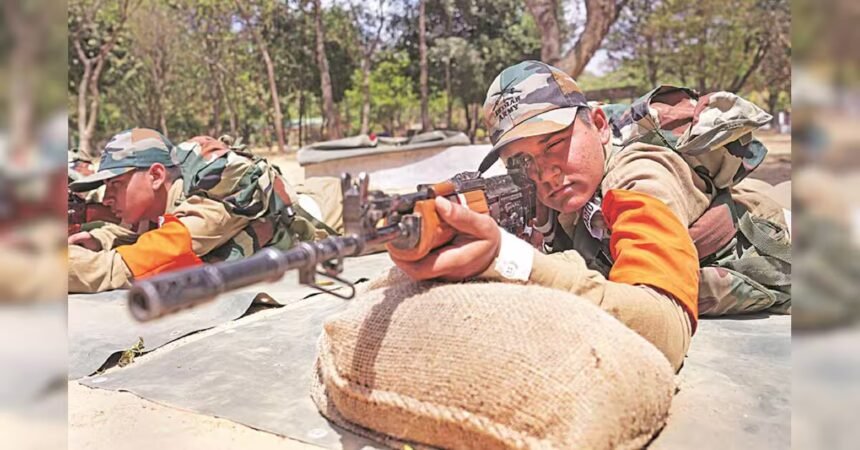
You can find a more diplomatic or politically convenient description for it, but the Modi government’s latest move on the Agniveer scheme, brought in with such aplomb, is a rollback. More so, a poll-eve capitulation.
Seventy-five per cent of the first lot of Agniveers would have finished their tour of duty, or walked the Agnipath (path of fire), as the scheme was named, and returned to their hometowns and villages by December.
It’s just that many would have gone back to Uttar Pradesh, Uttarakhand and Punjab, even Manipur, all going to the polls this coming February. All are traditionally major catchment areas for armed forces recruitment. For the Bharatiya Janata Party (BJP), the first two are much too vital to risk.
The prospect of these demobilised soldiers returning and joining opposition rallies, even enrolling in something like the Cockroach Janta Party, was scary for the BJP which, until the other day, was riding an all-conquering confidence. Now, it was seen as a risk not worth taking.
On top of these, in November or thereabouts next year, Himachal Pradesh and Gujarat will have their state elections. Gujarat, the BJP can still be calm about. But Himachal, a stronghold it lost to the Congress last time, is a traditional recruiting area with a large ex-servicemen’s constituency.
The party has now become far too risk-averse to put to the electoral test what was once its favourite reform. Reform it was, though. And we’ll talk about how, and then why it collapsed at its first test.
There are three things governments are remembered for. Then there’s a fourth category: The good ideas a government implements and then withdraws under pressure or in panic. The good and the bad ideas are the first two. The third is the good ideas they propose but lack the nerve or skills to implement. We can list many of the United Progressive Alliance’s (UPA’s), for example: Aadhaar and India Stack based on it, direct benefit transfer (DBT) of welfare, even targeted delivery of subsidised cooking gas only to the poor and deserving.
So were its many grand and audacious infrastructure projects of national importance. All got caught either in its indecision loop, internal party-versus-government contradictions, or ideological opposition. Most were subsequently consummated by the Modi government. Think the rail link to Srinagar, Mumbai Metro, Trans Harbour Link, the new Expressways, completion of the dedicated freight corridors (DFCs) and even the annihilation of armed Maoism. All of these were UPA projects abandoned midway. The Modi government did a brilliant job with these. It just tripped up on some of its own ideas.
In journalism, we follow the three-example rule, meaning that these make a straight line. Or your argument. For Modi government’s rollbacks, count the farm laws, brought in with such self-assurance in 2020 and rolled back in their entirety in 2021 in the face of opposition from farmers. The second is now the Agniveer scheme. For the third, my preference would be the caste Census. The Modi government was opposed to it forever, then suddenly included it in the delayed 2021 Census being carried out now. This was under Rahul Gandhi’s pressure.
If you don’t think that’s strong enough to make the third example —although I think it does, given the implications — I can give you another. The Prime Minister repeatedly derided the freebie culture, or what he contemptuously dismissed as “revdi” culture. Speaking at the inauguration of the Bundelkhand Expressway at Jalaun in UP in July 2022, he said, “This revdi culture is very dangerous for the development of the country. Those with revdi culture will never build new expressways, new airports or defence corridors for you.”
And then, around the time of the Chhattisgarh elections in the winter of 2023, he announced that the Covid-era free food grain scheme would continue. In the same set of elections, the BJP brought in the Ladli Behna Yojana for cash transfers to women. Then, probably stung by the loss of majority in 2024, the party unleashed an almighty revdi “revolution”, with payouts reaching up to ~10,000 as a one-time transfer in Bihar and a promise of ~2 lakh if the woman started an enterprise.
This was so expensive that even a rich state like Maharashtra is struggling to pay out, looking for excuses to reduce the number of beneficiaries. Women are already protesting, saying they’ve been denied their “Ladki Bahin” payouts. If you prefer, you can list this as the third example.
However you look at it, this government has lost much of its appetite for risk, even with reforms where it had shown great conviction and commitment. These four examples are enough to show that the Modi government will also be remembered for the really good ideas it brought in, Agnipath included, and rolled back. This column, for the record, had supported each of these ideas.
Between the farm laws and Agnipath, you could say the Modi government failed the test of both elements of the “ Jai Jawan, Jai Kisan” sentiment. It erred in taking its most significant and loyal constituencies for granted: Hindi heartland farmers and soldiers.
The most disappointing thing is how it failed to reach out to them and build acceptance for such radical changes. People are by and large suspicious of major policy shifts with such significant implications for their lives, particularly when introduced through a shock-and-awe approach. That, however, has been this government’s style. Think sudden demonetisation or the Covid lockdown. Decisions affecting farmers and soldiers were taken in much the same way. Unlike the first two, which came with an end date, these policy changes were meant to survive in perpetuity. That explains the pushback from the base, and the Modi government’s rollback.
Governance remains a painstaking, laborious, even boring business because it requires background work, scenario-mapping, war-gaming, or what the armed forces would call staff work. That is what the civil services and bureaucracies are there for. The absence of this precise element has bedevilled these plans — surprising, given how heavily the Modi government depends on civil servants. Were they asked to do their homework, or handed the decision first? There may be a concern that decisions could get caught in an analysis-paralysis loop. But you can’t always be like a commando who jumps out of a plane without checking the parachute. That isn’t fearless. It’s reckless.
When Agnipath was implemented, it was well known that the first lot would leave on the eve of these state elections. An extensive rehabilitation programme, beginning midway through their four years, could have cushioned the blow. Now, the baby is gone, and with it the bathwater.
The same lack of homework preceded the implementation of One Rank, One Pension (OROP). It was an election promise, all parties agreed with it, and no Indian would begrudge soldiers this benefit. But if the additional costs had been calculated and a necessary top-up provided to the defence budget, the story might have been different. The sudden increase in pensions because of OROP came from a defence budget that didn’t even keep pace with inflation over the years. This shrank the capital or acquisition budget.
As concerns grew, Agnipath was rolled out in a hurry. Poor staff work created two kinds of soldiers, two sets of wages and even two sets of benefits for families in the event of a battle fatality. Most significant armies now have soldiers serving short tenures. But they don’t treat conscripted soldiers as a category separate from those on full-career service. Here, they were even addressed separately. Each unit then had an Agniveer sub-unit within it. This was unsustainable.
The twin ideas of reducing the pension burden going ahead and making the armed forces much younger were both virtuous. Both have been lost to poor planning, hasty implementation and now withdrawal. This first batch will finish its sixth year on the eve of the 2029 general election. Rescuing this good idea will be a political miracle. It’s looking like a case of na khuda hi mila, na visaal-e-sanam (neither did I find God, nor my beloved).
By special arrangement with ThePrint