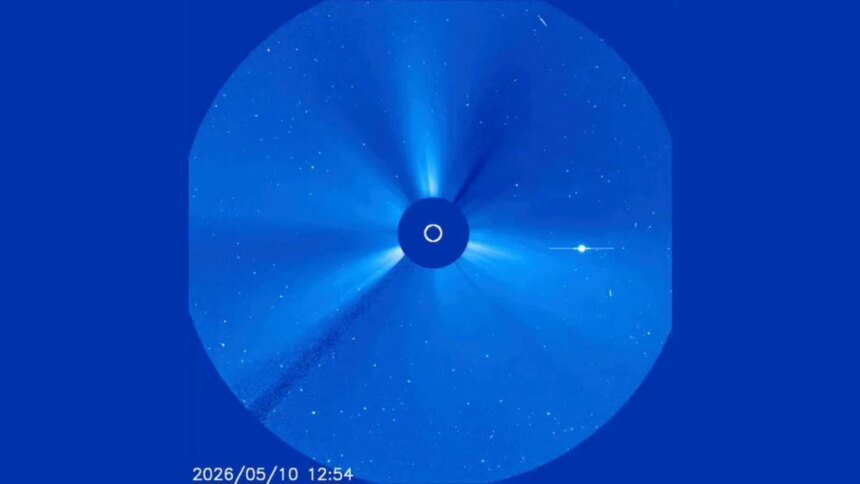
On May 10, 2026, the Sun exploded with an M5.7-class solar flare from the sunspot AR4436. This event resulted in the loss of high-frequency radio communications in the Atlantic and the release of a coronal mass ejection, which consists of a rapidly moving mass of charged solar particles. As the majority of this plasma cloud moves towards Earth from the east, there will be a minor impact in the vicinity of May 13.
Flares, CMEs, and Radio Blackouts
According to NASA, the solar flares are classified according to the levels A, B, C, M, and X—where X is the highest—and each classification is one order of magnitude higher than the preceding category. The M-category solar flares are midway on this classification; however, they release an immense amount of energy. The flare led to the disruption of high-frequency communications via radio waves for ships, flights, and amateur radio operators within minutes of the flare. This occurs since the X-rays produced ionise the upper atmospheric layers, leading to signal disruption.
Storms, Auroras, and a Busy Sun
As modeled, if that CME were to reach Earth ultimately, it could cause a G1 (minor) geomagnetic storm—the weakest of the five scales but still enough to shove auroras farther south than they typically reach. Northern lights may paint auroras in this midweek sky for watchers in northern England, Scotland, and up toward the northern United States—including Seattle and Minneapolis. This episode takes place while the Sun is approaching solar maximum, the height of its 11-year activity cycle. That means eruptions like this one are likely to become more frequent and intense throughout the rest of 2026.