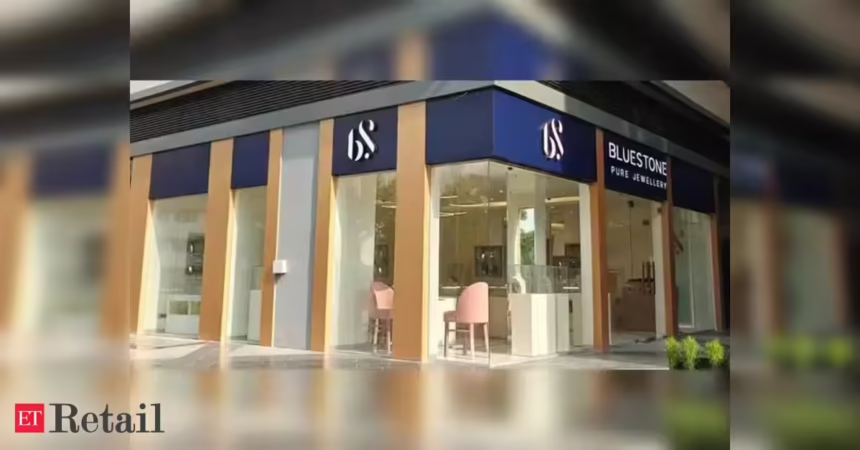
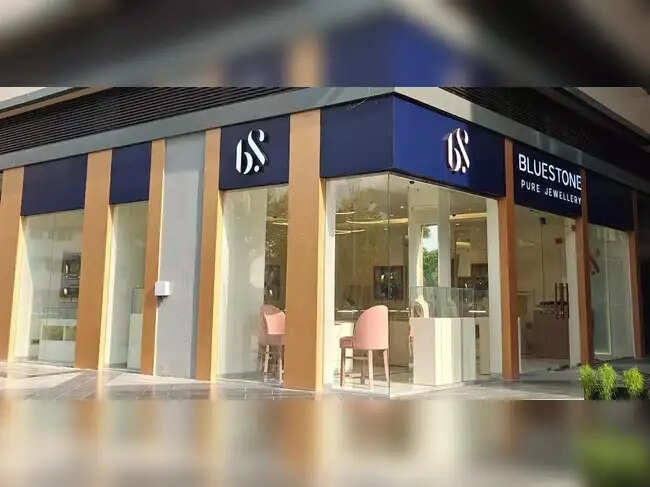
BlueStone is accelerating its retail expansion after delivering 49 per cent revenue growth and 39 per cent same-store sales growth in Q1FY26, with the jewellery retailer targeting more than 700 stores and Rs 12,000 crore revenue by FY30, even as it doubles down on men’s jewellery through dedicated stores in premium malls, Gaurav Singh Kushwaha, founder & CEO, BlueStone and Sudeep Nagar, co-founder & COO, BlueStone told ETRetail.
The company currently operates around 350 stores across 139 cities, including 12 stores added recently, and plans to add nearly 70 stores in FY27.
From a base of around 400 stores next year, the retailer expects to add approximately 80 stores in FY28 and another 90 stores thereafter, translating into around 20 per cent annual distribution growth.
“We intend to grow distribution by approximately 20 per cent. From around 340 stores, we want to reach 700-plus stores over the next four years. Together with strong same-store sales growth, we believe this has the potential to take revenues to almost Rs 12,000 crore,” they asserted.
The company currently has an almost evenly split footprint between larger cities and emerging markets, with approximately 50 per cent of stores in metros and tier I cities and the remaining 50 per cent in tier II and tier III towns. The expansion strategy will continue across both markets.
The retailer’s growth is being supported by strong customer retention, with repeat customers contributing in the high-50 per cent range of sales.
According to Sudeep Nagar, Co-founder & COO, BlueStone, design differentiation and accessible entry price points are helping the company acquire consumers early and subsequently increase their wallet share.
BlueStone’s entry price points start at around Rs 10,000, while its core customer acquisition range is approximately Rs 20,000-50,000. As consumers mature within the brand, purchases can move into the Rs 4-6 lakh range. The company’s average ticket size currently stands at around Rs 65,000-70,000.
“Consumers come back because of the design differentiation we provide. When we acquire customers early, they come back and buy across different categories and price points. That is resulting in strong overall growth as well as same-store sales growth,” Nagar said.
Contemporary, lightweight jewellery remains central to BlueStone’s proposition, with products typically priced from Rs 25,000-30,000 to Rs 4-5 lakh. The company believes changing consumer lifestyles, migration towards metros and growing preference for modern, wearable jewellery are creating additional headroom for organised players.
Digital discovery is also feeding the physical-store network. Around 70-80 per cent of customers walking into BlueStone stores have browsed the company’s website multiple times before visiting a store. The omnichannel model allows consumers to check designs, locate the nearest store and verify inventory before making the purchase.
A key emerging growth opportunity for BlueStone is men’s jewellery, a segment the company believes has remained relatively underserved by organised jewellery chains. The broader men’s jewellery market already accounts for more than 20 per cent of the overall jewellery market, according to the company.
BlueStone currently operates five dedicated men’s and kids’ stores, primarily in premium malls, and plans to add another five stores in the coming months. If the format gains traction, the company intends to expand dedicated men’s and kids’ stores across almost all premium malls in India.
“The men’s category was largely ignored in the industry. It was predominantly a women’s category, while men’s offerings were limited. We are bringing contemporary designs across categories such as cufflinks, chains and bracelets,” Nagar said.
The dedicated format will offer a differentiated experience, while BlueStone’s regular stores will continue to carry men’s and kids’ jewellery. The company will use the next few months to assess consumer uptake before scaling the standalone format more aggressively.
Meanwhile, BlueStone is maintaining its broader omnichannel strategy rather than creating a separate lab-grown diamond proposition under the core brand. Its lab-grown diamond business operates through a separate subsidiary and brand, which currently has nine stores, an independent team and separate operations.
Despite its rapid growth, BlueStone estimates that it currently commands less than 1 per cent of India’s roughly $100 billion jewellery market, leaving significant room for expansion.
By FY30, the company expects its store network to cross 700, revenue to approach Rs 12,000 crore, and operating margins to rise to around 15 per cent from the current 7.5 per cent, driven by operating leverage as the network scales.
“We expect strong same-store sales growth from all our cohorts, led by new customer recruitment and higher repeat purchases. Coupled with distribution growth from around 340 to 700-plus stores, these levers can drive us towards Rs 12,000 crore revenue by FY30,” Kushwaha concluded.